What Housing Policies Should Angelenos Be Advocating For, Post-Measure S?
Measure S won't fix the affordable housing crisis. When the vote is over, win or lose, what can we do that will actually move the needle?
56 posts.
Measure S won't fix the affordable housing crisis. When the vote is over, win or lose, what can we do that will actually move the needle?
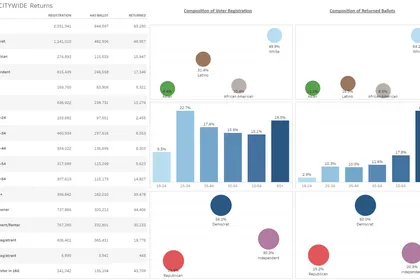
About 40% of registered voters in LA receive vote-by-mail ballots, but the people actually returning them are heavily skewed.
Bear with me; there are a lot of them.
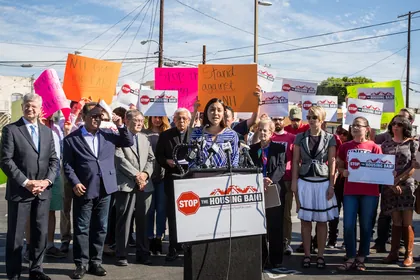
In just the past three weeks, 1,300 homes for low-income residents and the formerly homeless were proposed in Los Angeles. Measure S would block them all.
There's a local election coming up for the City and County of Los Angeles on March 7th, 2017. Here's how you should vote on the 5 ballot measures.
At least 19,000 desperately-needed homes, including thousands of affordable units, could not be built if Measure S passes in the March 7th Los Angeles election.
Measure S is an ego trip masquerading as a social justice crusade. It's the Donald Trump of ballot initiatives, and these are 7 of the most important reasons that Los Angeles can't allow it to pass.
The city has put together an early draft of its proposal for the DTLA 2040 Community Plan update. It doesn't go far enough, and I think we can do better.
Read here for additional details on my DTLA 2040 Community Plan update counter-proposal and argument for more housing downtown.
Between 2010 and 2015, Los Angeles built ten new multifamily homes for every one it tore down. But we can do better than that.
The City Planning department has some ideas for how to improve parking policy and reduce the prevalence of parking podiums in downtown LA. Here are my thoughts.
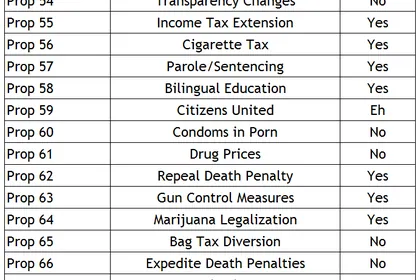
A cheat-sheet voting guide for 17 California ballot initiatives, and several more in Los Angeles County, the City of LA, and Santa Monica.
Analysis and recommendations for all 17 California ballot initiatives, along with some local ones in LA County, the City of Los Angeles, and Santa Monica.
Stabilized rents are not synonymous with affordable rents.
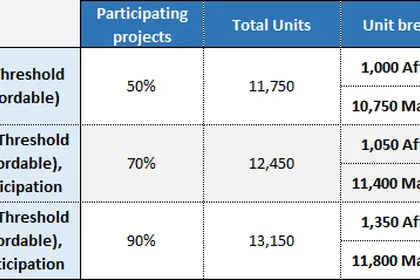
Right now rent stabilization applies to multifamily housing built before 1979. Instead, we should consider a "rolling" threshold that includes all buildings over 30 years old.
We've made it illegal to build almost anything but single-family homes and car-oriented strip malls, but why stop there? Begone, suburbs; bring back the orchards.
Forecasts rarely pan out, yet they're a foundation of the planning process. Instead, we should plan around something we can measure in real time: vacancy rates.
Along with its many other benefits, a non-profit acquisition-based affordable housing program could also increase tenant mobility.
A non-profit housing acquisition program could start small, focusing first on residents displaced by Ellis Act evictions, and grow from there after proving its efficacy.
Apartment tenants at risk of displacement have good reason to oppose new development. Instead of demonizing them, we should be helping them.
We share the same goals, but our focuses differ. Can we reconcile our differences and come together?
To all the bureaucrats, advocates, wonks, writers, and politicos working on urban planning issues in Los Angeles, I implore you: Drink more beers together. Wine or cocktails is also acceptable.
By planning decades into the future, built-out cities can create Central Park-style open spaces at minimum cost and with limited displacement.
Opposing new development because it requires demolition of some rent-controlled units is shortsighted, and overlooks the many real affordability solutions available to us.
Using affordable housing funds to acquire existing buildings is less expensive and more sustainable than using them to subsidize new units, and would be accompanied by numerous other benefits to the housing market and low-income residents.
A little bit of behavioral economics might help us get more affordable housing out of the state's density bonus law.
Governor Jerry Brown has a new plan to streamline the approval process for multifamily developments that include affordable housing. Here's what the bill actually says.
Proposition U froze our commercial corridors in time and contributed to our affordability crisis. Repealing it may be the best thing we can do to heal the wounds of the past.
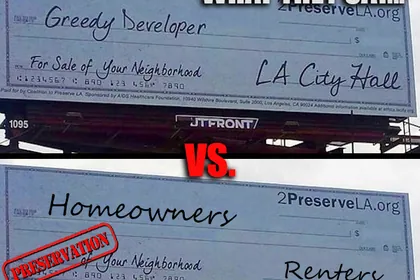
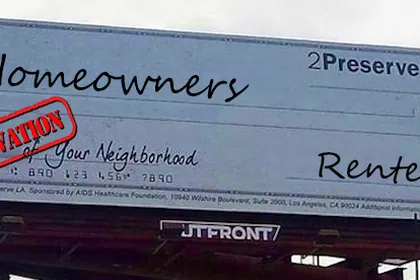
Are greedy developers responsible for Los Angeles' affordable housing crisis? Or greedy, misguided homeowners?
If housing development is the cause of skyrocketing rents, why are no-growth communities like Venice and Brentwood increasing in value just as quickly as hot markets like downtown and Hollywood?
The Neighborhood Integrity Initiative is an ego trip masquerading as a social justice crusade. It's the Donald Trump of ballot initiatives, and these are 7 of the most important reasons that Los Angeles can't allow it to pass.
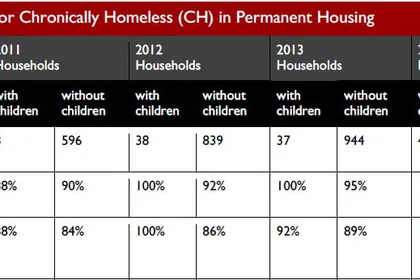
Eliminating homelessness is an expensive proposition, but we can pay for the great majority of it by simply redirecting money that's already being spent inefficiently on treating homeless individuals on the street.
The official fiscal analysis of California's High Speed Rail program has looked just a few decades into the future to assess its impact, but HSR is a 100-year investment. What do costs and revenues look like in that distant future?