Earlier this year I argued that the up-front cost of local transportation projects, like light rail and bus rapid transit, **aren’t really comparable**to the cost of California’s high speed rail system. While all of these investments are fighting for the same dollars to some degree, their long-term balance sheets look very different: Local transit typically requires a persistent operating subsidy, whereas even the low-ridership estimates for high speed rail forecast a consistent operating profit. As a result, longer time horizons favor high speed rail, as profits gradually eat away at the high initial capital costs required to build out the network.
Unfortunately, the existing literature on California’s high speed rail project doesn’t take the long view. The official source for HSR’s cost, revenue, and ridership projections—the California High Speed Rail Authority’s **2014 Business Plan—**limits its analysis to a 35-year operational period, from approximately 2025 to 2060. Much of the rail infrastructure, however, including some of the most expensive aspects of the project such as tunnels, viaducts, and bridges, have 100-year lifespans. Other up-front costs, such as for right-of-way acquisition, will only require a single, one-time payment.
Given this reality, what we need is an analysis that accounts for a more complete utilization of assets—an analysis that can fully amortize the high up-front capital costs over their useful lifetimes and most accurately determine the extent to which California HSR revenues can cover not just operational costs, but also those of capital. The analysis below will look at costs and revenue over a full 100-year period, at which point even the longest-lasting rail infrastructure will require full replacement. The spreadsheet analysis on which this is based can be found here. (Note that this analysis is ultimately just a simple extrapolation, unmindful of whatever technical constraints official analysts are required to work within.)
It’s not my intent that the project live or die by its economics, any more than a bikeway or subway line (or a highway) should be discarded just because it doesn’t earn money. High speed rail has countless side benefits, including improved connections between California’s major cities, reduced emissions in the heavily-polluted Central Valley and reduced air and road congestion throughout the state, job creation, more sustainable growth near stations, preservation of valuable agricultural land, and reduced car dependence. All of these benefits have been reported at length by writers like **James Fallows**and Robert Cruickshank, and they’re all important to the final “go/no-go” determination. The purpose here is to expand our perspective beyond the social, environmental, and mobility impacts of this project, to include the potential for long-term, direct fiscal benefits as well.
So, let’s get started.
CAPITAL COSTS
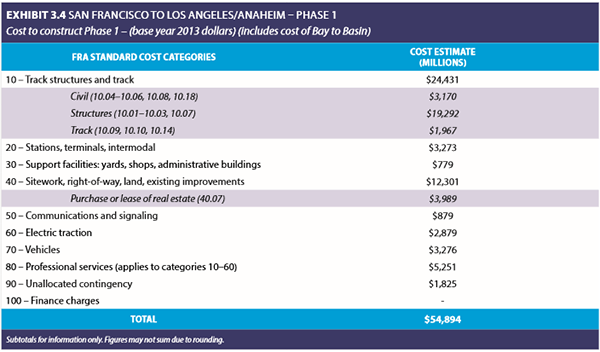
The California high speed rail project’s current capital cost estimate is $54.9 billion (all values reported here will be in 2013 dollars), contingent upon a variety of factors that haven’t yet been finalized, including whether the system will travel underground through the Angeles National Forest, or take a cheaper (but more circuitous) route between Palmdale and Los Angeles.
It’s fair to question whether the state and its contractors will be able to hold to this estimate. In an analysis of 258 mega-projects around the world, researcher Bent Flyvbjerg found that 9 out of 10 came in over budget, with an average cost overrun of 28 percent. But, as the chairman of the CA HSR Authority has himself noted, their team has put the project through an extremely rigorous risk assessment/management program, and it’s unlikely that any project in the country has undergone more outside scrutiny. In lieu of credible alternative estimates, we’ll have to take the word of the Authority and the independent panel of experts that oversee their work.
REVENUES
The estimated annual revenues from the 2014 Business Plan, for select years through 2060, are shown below:
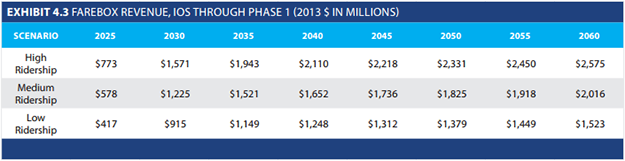
These numbers represent only farebox revenue, i.e., revenue from ticket sales; ancillary revenue sources such as advertising, concessions, and real estate interests are not included. After 2035, ridership, and therefore revenue, is expected to have reached 100% of its current potential – growth that follows is presumably the result of other factors, such as increased demand for travel and population growth. For this analysis we will use the Medium Ridership scenario, which corresponds to roughly the 50th percentile of potential ridership outcomes. The forecast assumes 5.1 percent growth over each five-year period through 2060 (about one percent per year).* Extrapolating this to the year 2125, farebox revenue is anticipated to total $3.849 billion ($3,849 million) in 2125.
Under this ridership scenario, cumulative revenue for years 2025 through 2125 is $240.7 billion. Ancillary revenue sources in other high speed rail markets have added 2 to 30 percent over and above farebox revenues, and it is conservatively estimated here that CAHSR will produce ancillary incomes of 5 percent above farebox. This brings cumulative revenues to $252.8 billion by the year 2125.
OPERATIONS AND MAINTENANCE COSTS
Operating costs represent the cost of running the high speed rail system, including labor, electricity, and general maintenance required to maintain a state of good repair for vehicles, tracks and track structures, stations, etc. It does not include the cost of major rehabilitation or replacement of capital resources, due either to significant unaccounted-for breakdowns or resources reaching the ends of their useful lives. These costs are accounted for in the “Lifecycle Costs” section of this analysis, found further below.
The estimated annual operations and maintenance costs from the 2014 Business Plan, for select years through 2060, are shown below:
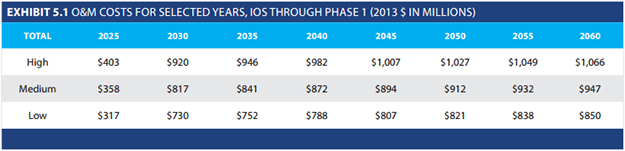
As with revenues, we’ll assume the Medium Cost scenario for this analysis. The forecast assumes 2.0 percent operations and maintenance cost growth over each five-year period (0.4 percent per year) through 2060.* Extrapolating this to the year 2125, O&M costs are anticipated to total $1.225 billion ($1,225 million) in 2125.
Under this scenario, cumulative operations and maintenance costs for years 2025 through 2125 are $100.2 billion by the year 2125.
LIFECYCLE COSTS
Lifecycle costs are those costs not covered under operations and maintenance, that include major rehabilitation and replacement of system infrastructure such as tracks, stations, tunnels, etc. Using the Business Plan’s “50-Year Lifecycle Capital Cost Model Documentation,” which describes the expected lifetime of all capital assets, anticipated rehabilitation schedules and costs, and replacement costs, I was able to extend this analysis to the year 2125. Where capital asset rehab and replacement costs are listed as a percentage of initial capital costs, values were taken from Exhibit 3.4 in the Business Plan.
Total lifecycle costs over this time period come to approximately $56.3 billion. This is almost certainly a conservative estimate, as the lifecycle costs through 2060 total $8.6 billion, a 22 percent premium over Business Plan estimates. (The Business Plan estimates a cumulative lifecycle cost of $7.0 billion by 2060.)
Because the 50-Year Lifecycle documentation provides limited line-item detail, and some longer-lived infrastructure lacked detailed rehabilitation and replacement cost estimates, various simplifying assumptions were made that tended to overestimate likely costs.**
SUMMARY
Below is a summary of these results, including additional sensitivity analysis to account for potentially slower increases in revenue growth, faster increases in costs, or both. Under the baseline circumstances described above, the state of California could realize a long-term profit of approximately $41 billion:
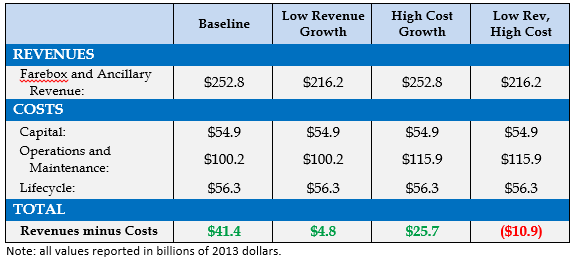
The low revenue scenario assumes slower revenue growth after 2060, with increases of just 2 percent, rather than 5.1 percent, every five years. The high cost scenario assumes faster O&M cost growth, with increases of 5 percent, rather than 2 percent, every five years. The Low Revenue, High Cost scenario combines these two scenarios. As you can see, only under the latter scenario does the state lose money, and even then it amounts to a loss of just $109 million per year – still enough to pay off the vast majority of capital costs. Compare this to what we would spend expanding our airports and roadway network in response to the state’s population growth and increased demand for intra-state travel, and even a slight loss on high speed rail looks pretty appealing.
This is, of course, far from the last word on the California high speed rail project’s economics. Numerous other scenarios are possible, including higher up-front capital costs, systemically lower ridership, or higher operations costs. This also doesn’t take into account the likelihood of private partnerships and financing costs, which will almost certainly divert some profits away from the state. That said, there’s no reason to believe things couldn’t actually turn out better for the state—these are just median projections, after all. We’ve certainly been surprised by above-average ridership on local transit throughout the country, from **Seattle**to **Tucson**to LA itself. Looking this far into the future, it’s impossible to know exactly how things will shake out.
In the end, the point is that we’re not building a high speed rail network for 35 years of use. It’s a much longer-term investment in California’s future that could be in operation for a century or more. The project’s benefits are to be enjoyed by residents and visitors to California throughout that period—not just fiscal benefits, but environmental, mobility, health, and social—so we should take care to examine its costs over the same timeline.
*Note that, because all values are reported in 2013 dollars, inflation will result in higher cost and revenue growth in nominal terms.
**Some simplifying assumptions for the lifecycle cost estimate:
- The project is completed in phases from 2022 to 2028, but this analysis averages these phases out, assuming the capital lifecycle clock starts ticking in 2025.
- Capital equipment in “Category 30 – Support Facilities, Yards, Shops, Administration Buildings” did not provide rehabilitation costs as a share of total up-front capital costs for that category (example: total capital costs for the category were $779 million; rehabbing the overhead catenary might cost 2% of that total), rehabilitation schedules varied between 20 and 30 years, and lifespans tended to meet or exceed 50 years. To simplify, it was assumed that all components in this category would be rehabilitated after 20 years at 100% of initial capital costs, rehabbed again 20 years later at 50% of initial capital costs, and replaced 10 years later at 100% of initial capital costs.
- Similar assumptions were made for categories 50 and 60.
- It was assumed that the number of train sets would increase by 50 percent in 2085 and double by 2115.
- Pedestrian, bicycle, car, and bus access (including roads) rehab and replacement data was not provided in the 50-Year Lifecycle documentation, so it was very conservatively estimated that this would cost $500 million. With rehabilitation every 10 years and replacement every 50 years, this alone added $3 billion to the 100-year lifecycle costs for the project.

21 comments
Archived from the original site. Commenting is closed.
Such a simple minded analysis! Life cycle costs need to be discounted at the prevailing interest rate for such projects. Ordinarily this means that anything beyond about 25 years is negligible. Phillips is effectively using a discount rate of 0%.
John, your point is essentially self-refuting. Discounting makes any analysis beyond a certain number of years negligible, but this is a system that will continue to benefit the state for many generations. I've never agreed with the idea of discounting by public institutions anyway when it comes to investments in infrastructure and so forth. Pensions, sure, but the state doesn't have some hurdle rate they're trying to make for their investors, because they don't have investors, they just have people who want good services. The state is also much more concerned with long-term results than businesses and investors -- no individual investor is looking 100 years into the future because they'll be dead by now, but the state will still be around and shouldn't be pretending that what they do now has no impact on that distant future. <br /><br />It's understandable that you'd argue about interest rates since I've brought profit into the discussion, but the real point is to compare this to other infrastructure investments we might make, like local transit, airports, and highways. Discount rates don't change the fact that while high speed rail has a fair chance of turning a long term profit, almost no other infrastructure is very likely to do so.<br /><br />Anyway, for the record I did discount this back when I did the original analysis (which has slightly lower lifecycle costs), using just the federal treasury rate for the discount rate, and came out to about -$10 billion over a 100-year period. Again, pretty solid outcome for an investment of this scale and value.
Let's face it, there are alternative claims for the up-front capital your HSR requires. There are public projects with shorter lives that can pay back their investment, making funds available for the next opportunity. The only fair way to compare alternative projects with varying lifespans is to use cost-benefit analysis with discounting of future costs and benefits.<br /><br />Also predicting the future is unsure- who knows, perhaps folks will want faster transportation and that bugaboo of rail fans, maglev, will become all the rage, making high speed rail obsolete.
The future is most definitely unsure, but the alternative is... what? Do nothing while we wait for some miracle technology to save us? Maglev is too expensive even for Japan, where I believe they're expecting to lose money -- it's definitely beyond our current need or financial capacity (relative to prospective ridership) here.<br /><br />And you're right that there are alternative claims for the up-front capital HSR requires, though it's not clear that they're any more credible. Given that only the route studied in the Business Plan has gone through multiple stages of modeling, it's almost certainly the most realistic estimate at this point in time. The real question will be whether we rely more on tunneling or elevated/at-grade tracks through certain regions, but again, that's still somewhat up for debate. It doesn't change the fact that the status quo is most definitely not going to serve us for much longer (it barely does now), and that there haven't really been any realistic alternatives proposed.<br /><br />And if you have a list of other projects with shorter lives and better returns, let me know! If your answer is protected bike lanes and transit-only lanes, I'm fully behind you. But if it doesn't solve the problem of medium-distance mobility, something that roads and airports are decreasingly suited to, then it's not really valuable as a comparison to high speed rail. The (ever-worsening) status quo is not acceptable, so until I hear of another clean, productive, efficient alternative that also has potential to earn a net profit in the long run, I'm sticking with high speed rail.
There are other urgent claims on the public purse besides transportation, many of which have greater net present value/investment ratios. However as far as transportation is concerned, highways and airways are so far out of optimum that NPV analysis always shows enormous benefit to cost ratio. This makes it very difficult to justify new systems vs current improvements.
I think the authority's limited timeframe is defensible. Once you're projecting more than about 50 years, you really have no idea what technology's going to look like and if there'll be a better competitor than today.
I think it's fair that they limit their official report to that JMS, but I also think there's value in looking at the long-run, should it continue to operate beyond that time point. Given Japan's history with HSR, which already has passed the 50 year mark, the precedent is already there that it can continue to serve people for many decades.
In order to earn a profit of $41 B (revenue minus cost*) in 50 years, all it would take is an initial investment of $16 B at the OMB 30 year non-inflation adjusted discount rate of 1.9%/y. This is the rate for an essentially risk free investment.<br />$16 B is considerably less than the estimated capital cost of $68 B for the CAHSR project.<br />* Cost surely includes depreciation which accounts for initial investment.
That's a meaningless comparison John. Yes, it's true that investing money up front can yield a greater return, but the key difference is that with the type of investment you're talking about you get absolutely nothing in the mean time. You're basically treading water. <br /><br />The point here is that HSR provides a valuable service in a number of ways, WHILE having the potential to earn a profit. No one's disputing the fact that if your sole focus was financial returns, there are much better places to put your money (though governments are typically limited in how they can invest their money anyway). But if you're a government that needs to invest in improved transportation anyway, few options have even the potential to pay themselves off like HSR does.
Please factor into your equations the opportunity cost of capital. In other words, would investing in the stock market bring taxpayers a better long-term return on their investment than investing in HSR?
See above response. It's not a reasonable comparison because investing money in the stock market doesn't provide any benefit to taxpayers in the meantime, whereas HSR provides a cleaner, more productive medium/long distance transportation option, connects the state's second-tier cities to the So Cal and Bay Area mega-regions, takes pressure off the need to expand other, less efficient/sustainable infrastructure, etc. Also, I'm almost certain that state governments can't invest money in the stock market outside of things like pension funds. Generally speaking, it's not the government's job to make a profit, it's their job to protect and serve their constituents. My point here is that they can do that job and still manage to earn some money in the process.
Shane. Cost and revenue estimates are often rightly considered "bait and switch" tactics. When the 2008 Prop 1A cost estimate of $42 billion escalated to $92 billion 3 years later, supporters lost faith in the project management team who did little more than make excuses and more promises based upon a mountain a paperwork that only a devotee can trust. <br /><br />You've structured this article comparing local/regional transit to HSR with a cost/revenue assumption favoring the later. I'd argue that upgrades to local/regional transit is where we should invest if our goal is reducing energy consumption and CO2 emissions, promoting infill development, etc. Long-distance travel is a luxury, not a daily travel expense that occurs between home and workplace/institution/retailer/etc. With that in mind, travel between LA and San Francisco will remain an expense only the wealthy can afford, no matter the cost; likewise daily travel between Palmdale/LA, between Gilroy/Bay Area, etc. <br /><br />I've always promoted 125mph (Mid Speed Rail) to reduce cost and because it is applicable to more railway corridors nationally, using the 'dual-mode' Talgo XXI as my model. These slower train systems could probably accommodate 4 trains hourly. I doubt that 12 trains hourly as proposed is even possible. All paper calculations disintigrate once the realities of constructing a far-fetched system comes down to the wire. The Madera-to-Fresno 1st Phase is little more than starting a project its advocates calculate must continue regardless of cost/benefit analysis.
It's every government infrastructure project's job to give us a better return on our tax dollars than we could earn with our own money in the stock market, otherwise there's no sense in making that infrastructure investment.
Not sure where you got that idea Derek, I'd like to see reference to any public official in history saying that. Not even sure that's true when you take into account non-financial benefits like health, productivity, environmental preservation, etc, but if you want to go down that road you're not going to get better results than HSR that also makes a decent financial return.
Thanks for the comment Art. Here are my thoughts:<br /><br />On cost estimates, I don't think I'm going to change your mind. You've clearly lost trust in the team running HSR, and nothing except them actually doing it and doing it well is going to change your mind, so we'll just have to see how things turn out. I don't think you have any more real evidence that it's going to be a failure than I have that it's going to be a success, so I don't see the point in debating it. If we want to have a productive debate about cost, let's talk about tangible things like route selection.<br /><br />Although this comparison certainly applies to local/regional transit, the comparison i'm actually focused on his airports and highways -- the direct competition for HSR. I'd rather spend the money on HSR, not just because of the various benefits catalogued all over the internet, but the additional potential for financial returns. And I strongly disagree that trips of this distance are only for the rich -- seriously $200-300 round trip is only for wealthy people? And even less money for people traveling shorter distances along the line? I don't think you're gonna get anyone to buy that who's not already bought into an anti-HSR agenda. This isn't an investment for rich people, though it is a very different service because it is operationally self-sustaining, and potentially able to recoup capital costs as well.<br /><br />All of that said, I'm a huge supporter of local transit (I haven't owned a car in 6 years, so it's kind of a given). I just don't believe this should be a discussion where we can only have one or the other, and frankly neither form of transit is going to have a massive impact on reducing local emissions, so my concerns lie in what other benefits they can produce, including a steady stream of revenues that can fund other transportation investments.<br /><br />To your last point, 125mph between SF and LA would be fairly useless, since at an average speed of probably 100 mph or so it'd be nowhere near competitive with air travel. I'm all for these incremental upgrades where they're warranted, but there's real demand for traveling between the Bay area and LA (and in between), and it exceeds what a mid-speed rail line could support. I'm certainly no expert on the technical aspects of running a rail line, but if you want to see a cost/benefit analysis the HSR Authority has already done one. As I recall, the benefits were about 2 or 2.5 times the costs, when all is said and done.<br /><br />Your arguments ultimately come down to "I don't believe what they say," and I don't know what to say to you about that. Like I said, they've undergone more scrutiny than anyone and have been reviewed by an independent panel that treated their 2012 Business Plan quite harshly. If that didn't do anything for you, I certainly won't be able to sway you.
Sure, there are other urgent projects with great benefit/cost ratios -- free school lunches, lead removal, renewable energy.<br /><br />But if we're going to talk about ALL projects, then it's time to look at the TRILLION dollars wasted YEARLY on the US military, which has NO benefits and has actually been HURTING us internationally. This is enough to fund pretty much everyone else's projects.
If you look at the long-term record of the stock market, it's a big loser to invest in it. Only during the 20th century has the stock market been reliably profitable. Remember this.
"I'd like to see reference to any public official in history saying that [public infrastructure projects should make financial sense]."<br /><br />That's implied whenever a public official calls the HSR project a "boondoggle." Of course the same official will ignore the cost-effectiveness of his/her own pet projects, so this is why we need people like you to take a closer look at the numbers.<br /><br />I support HSR for many reasons, and I agree that it's probably more cost-effective than the alternatives, but without a true accounting of opportunity costs and the negative externalities of the alternatives (which you also didn't calculate), there's no way to know for sure.
Shane. IMO, costs are an important issue when they become prohibitive. I'm more concerned about various impacts - noise impact upon residential and wildlife, visual impact, property takings. Where HSR's separate ROW leaves existing railway unimproved, this is a failure to reduce impact. Cost overruns lead to opposition of future passenger-rail projects, likewise a failure to reduce overall travel impacts. I'm not ideologically opposed to rail transit, nevermind its cost. Too many base their opposition solely on cost. I'm only trying to represent that concern alongside more important issues. <br /><br />I calculate a 5-hour LA-to-SF trip time (at 100mph average) as sufficiently competitive with air travel. To say this slower travel time "is fairly useless" is pretentious. It's likely that most trips will not originate in LA and finish in SF. I still doubt the possibility of operating trains every 5 minutes. It takes closer to 15 minutes to board and store luggage. The capacity calculation as it relates to revenue is thus questionable. <br /><br />I expect the first segment, Madera-to-Fresno and even to Bakersfield will fail to generate sufficient ridership and operating revenue. As the eventual HSR system will reach Sacramento, that leg seems the better 1st Phase than Pacheco. I'm concerned about how the San Juaquins ultimately interconnect. I suspect Pacheco is more suitable for standard railway. And I prefer Altamont for the HSR corridor as it includes higher population centers and much worse traffic, again the question of impact. Gilroy and Los Banos will no doubt develop more sprawl than station areas. You can dismiss these concerns, but it puts you in the camp of project managers who've already alienated too many supporters. <br /><br />
Well said, Art.<br />
"But if we're going to talk about ALL projects, then it's time to look at the TRILLION dollars wasted YEARLY on the US military, which has NO benefits and has actually been HURTING us internationally. This is enough to fund pretty much everyone else's projects."<br /><br />BAM!!!!! <br /><br />$5 Trillions WASTED on illegal GHOST wars in Iraq and Afghanistan (& huge profits by War-Corporations). Not too many brave souls though are willing to tackle this great train robbery, but lots willing to shoot down real infrastructure investments. Take a look at what China is doing throughout Asia with their HSR expansion to connect into ASEAN (soon to grow connection of over 3 billion people in the greater Asia/ASEAN region). The big picture no one discuss: "Failed US domestic and international economic and foreign policies of 40+ years", which has finally caught up to the US, opening gaps for BRICS to move ahead, China now being the largest economy, moving at a pace with their partners in the region (and beyond). $67b is but a drop in the bucket relative to the $18 trillions of the rapidly growing national debt (driven off borrowed money for wars).<br /><br />If the feds can lend the bankers money, the feds can lend CA money!<br /><br />You take the eye off the ball, you lose!