Last week UCLA published a working paper arguing that urban transportation projects were more cost-effective at reducing greenhouse gas emissions than high-speed rail (HSR). **I posted a critique**of that paper, focusing first on the benefits side of the ledger, showing that the authors had overstated the user savings of light rail, bus, and bicycle infrastructure projects while HSR’s savings may have been undersold. This week, I’m going to look at costs.
I want to start this out by noting that the study’s authors, Juan Matute and Mikhail Chester, Ph.D, seem to be focused on making a case for using the state’s cap-and-trade revenues for what they view as worthy investments. That’s fine, and there should be a debate about how those funds are spent, but the premises of that debate should be accurate. I don’t think this working paper meets that requirement in its current form.
LA’s Orange Line bus rapid transit and bicycle path, and Gold Line light rail services are all great projects, and we absolutely should invest in more bicycle paths, light rail, bus rapid transit, and pedestrian facilities. The error in the UCLA report is in the belief that these projects are in competition with HSR, which shouldn’t be the case.
Now, onto the numbers.
CAPITAL AND OPERATING COSTS
The **California High Speed Rail Authority’s 2014 Draft Business Plan**says the project should cost $54.9 billion in 2013 dollars to build up to Phase 1, which gets us from San Francisco to Los Angeles. If this estimate sounds low, it’s because reports on the rail line often use year-of-expenditure numbers, but we’re going to use 2013 dollars for capital, revenue, and costs to keep things simple and consistent. (The UCLA authors use this same 2014 draft business plan for their report, by the way.) The following table shows the projects estimated capital cost; the relevant number can be found in the last row of the “Cumulative Capital Cost (Billions 2013$) column:
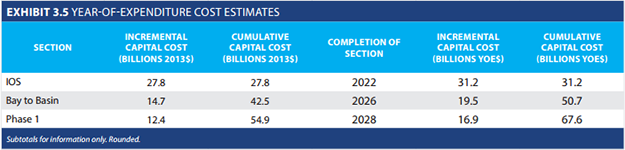
Projected capital costs.
According to the UCLA study, $54 billion is the total high-speed rail project cost. That’s wrong. The authors make the erroneous assumption that HSR will operate at a zero-profit level, apparently using an obscure table from page 55 of the 2014 business plan that shows a net operating cash flow of $165 million. For whatever reason, they seem to have interpreted this number as the total profit of the project for its entire lifecycle. I suspect it actually represents a single year’s profit in an early year of the initial operating segment’s active service, but it doesn’t actually matter because we have much more detailed figures in this very same business plan.
First let’s look at operating/maintenance costs and lifecycle costs. Here are the tables that summarize those costs:
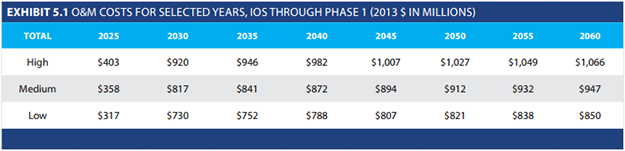
Projected operating and maintenance costs.
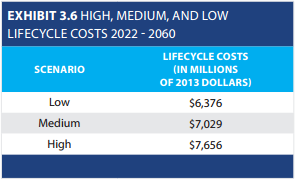
Projected lifecycle costs.
There are low, medium, and high ridership scenarios, which effect these costs: more riders means higher operations, maintenance, and lifecycle costs (as well as higher revenues, which we’ll get to). They only provided the annual O&M costs at five-year intervals, so I summed them up by averaging the costs at adjacent 5-year periods, then multiplying that average cost by 5 for every column except for 2060, which is the final year of the project’s lifecycle. Here’s an example:
O&M costs under the high ridership scenario are projected to be $403 million in 2025 and $920 million in 2030. Averaging those numbers gives us an annual cost of $661.5 million, for a total of $3.3075 billion over five years from 2025 to 2029. This isn’t perfect but it’s a close approximation, and revenues are summed in the same way so any error should be canceled out on the revenue side.
Lifecycle costs mostly consist of rolling stock replacement, so costs don’t vary too much whether the trains are used frequently or not. They just get old after a while.
Here’s a table I made of total operations, maintenance, and lifecycle costs through 2060:
| Scenario | O&M | Lifecycle | Total costs |
| High ridership | $34,394 | $7,656 | $42,050 |
| Medium ridership | $30,550 | $7,029 | $37,579 |
| Low ridership | $27,448 | $6,376 | $33,824 |
REVENUES
Now, if the UCLA authors’ assumption is correct, revenues should come out to about the same as costs. That’s not the case, as you’ll see below.
First, here’s another table from the business plan. This one is projected farebox revenues under the three ridership scenarios:
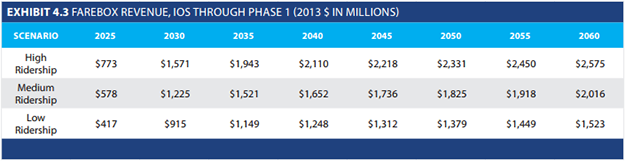
Projected revenues.
This is just farebox revenue, i.e., the revenues from ticket sales. It doesn’t include any ancillary income, such as advertising or food and beverage sales. According to the business plan, ancillary income can add anywhere between 2 and 30 percent to revenues above ticket sales. I’m going to assume that ancillary income adds 10 percent to revenues—with opportunities for transit-oriented development and the potential for high-profit services targeted at business travelers, I think this is fairly conservative.
Revenues with and without this additional income can be found below:
| Scenario | Farebox revenue | Ancillary income | Total revenue |
| High ridership | $74,060 | $7,406 | $81,466 |
| Medium ridership | $57,886 | $5,789 | $63,675 |
| Low ridership | $43,633 | $4,363 | $47,996 |
SUMMING UP
We’ve got a lot of numbers at this point, so lets put them all together. Here’s capital, operating, maintenance, and lifecycle costs, plus revenue, all in the same table:
| Ridership | Capital | O&M / Lifecycle | Revenue | Net cost |
| High ridership | ($54,900) | ($42,050) | $81,466 | ($15,484) |
| Medium ridership | ($54,900) | ($37,579) | $63,675 | ($28,804) |
| Low ridership | ($54,900) | ($33,824) | $47,996 | ($40,727) |
o rather than a $54.9 billion total project cost, as the authors assert, the actual cost according to the CA HSR Business Plan projects that costs will range from $15 to $41 billion through 2060. That’s still a huge amount of money, but consider the fact that this is a 520-mile mega-project, and that it’s very likely that a portion of this project will be funded with federal assistance (not in the next few years, but this is a long-term project and politics shift rapidly) and/or private partnerships. Accounting for federal and private funding sources, it’s entirely possible that the project could net a profit for the state of California in the long term, as well as boosting the regional economy and reducing greenhouse gas emissions statewide.
A study prepared by Parsons Brinckerhoff (and commissioned by the California High Speed Rail Authority) estimates that 4,200 new lane-miles of highway, 115 new airport gates, and 4 runways would need to be constructed to match the capacity of HSR, all at a cost of over $130 billion. This is bogus, frankly, since I don’t think anyone believes we’re ever going to construct an extra six lanes of freeway between LA and SF. It’s quite clear that the vast majority of that highway capacity would never be built in the absence of HSR, though some of the airport expansion remains a distinct possibility.
Despite this transparent attempt to justify the cost of high-speed rail, I think reasonable people can agree that some expansion of airports and highways will be necessary over the next 45 years to accommodate additional trips of 200-500 miles—unless we build high-speed rail. Is it so hard to imagine that the cost of highway and airport expansions wouldn’t reach into the tens of billions over that time period? I, for one, would rather spend that on an emissions-free, displacement-lite transportation mode.
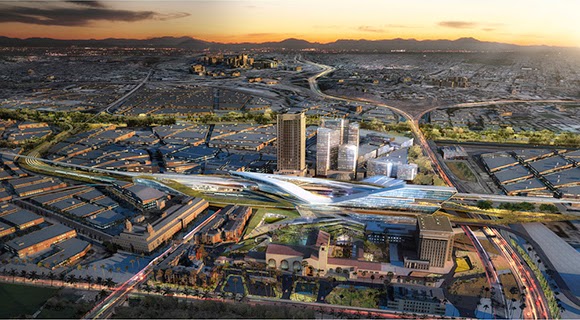
A vision of LA’s Union Station in 2050, from Bustler .
Last, we should consider the timeline under consideration here: 2025-2060. Implicit in this study period is the assumption that once the ball drops and 2060 begins, the whole process starts anew. New rails, new trains, new legal bills, new tunneling, new acquisition costs, new everything. Did New York cave in all its subway tunnels after 35 years of operation and start from scratch? It’s silly to take such a short-range view on such a monumental project.
There will certainly be significant replacement costs as infrastructure ages into disrepair, but consider the fact that right-of-way acquisition is expected to cost $12 billion, more than a fifth of HSR’s total capital cost. That’s something you only pay for once. Stations also won’t have to be re-constructed, just renovated over time, which is probably accounted for in operations and maintenance anyway. Even track construction, which accounts for nearly half of the total project cost, will be cheaper the second time around. If tracks don’t need to be fully replaced after 35 years of use, the costs will be even lower.
Assuming even the medium ridership scenario, if we extend the timeline of high-speed rail service into the year 2100 we easily achieve profits on operationsand capital. And that’s exactly the perspective we should be taking on this project—it’s a long-term investment in California’s future, not a short-term economic recovery effort. This is transportation for the long haul (ho ho!), and over the long haul it can be a money-maker that actually helps the state fund other important infrastructure projects, including urban transportation like light rail, bus service, and bicycle and pedestrian improvements.
I don’t think profitability should be the primary goal of HSR, but when you take into account the opportunities for federal and private funding, reduced highway and airport expansion costs, and a longer operations horizon, California high-speed rail has potential to make a lot of money for the state. That’s something that urban transportation projects can’t say, but that shouldn’t be an argument against those forms of investment. Instead, it should be viewed as an argument for high-speed rail—the sooner it begins operation, the sooner it can start creating a funding stream for our state’s various other infrastructure needs.


3 comments
Archived from the original site. Commenting is closed.
Shane, there's so much wrong here that I'm left wondering whether you read the working paper. We'll have another version up next week that incorporates some of the feedback we've received to date. HSR will perform better than it had in the new version.<br /><br />I'll point out that the Authority's financing plan trades future profits from operations for private capital investment. We're analyzing the cost-effectiveness of greenhouse gas reductions from public investments in these projects, not the private cash flows. The Authority currently plans to use $175M in 2012 dollars from operations towards capital, and $8,196B in private capital (essentially selling the right to operate and profit from the CAHSR service). This private capital is needed to bridge the capital financing gap. If the public Authority self-financed against the future revenue stream, then they would assume both the risks and the revenues, but the proceeds would accrue to the public and be included within the scope of the analysis.<br /><br />We consider a 100-year time horizon, including costs of of construction and operations. We're not considering a second build in 2060. In fact, because the authority puts capital replacement expenses on the private operator, analyzing the public investment doesn't need to consider capital replacement costs after the IOS.<br /><br />You write that "The error in the UCLA report is in the belief that these projects are in competition with HSR, which shouldn't be the case." These and other projects and investment opportunities are all in competition for expenditures from the state's Greenhouse Gas Reduction Fund, which is the only funding our analysis addresses.
Ugh, I just wrote a whole thing and the comment got deleted. I'll just sum up again quickly.<br /><br />First, thanks again for responding Juan.<br /><br />I want to be clear that not all of this is a direct criticism of your working paper, some of it is more a critique of how we evaluate infrastructure projects in general, especially the shorter timelines for major, long-term projects. <br /><br />And that's a good point on the private capital issue, which trades future profits for less up front spending. That would of course reduce the public expenditure according to your assessment as well.<br /><br />Your last point is valid and I don't mean to ignore the political realities of how funds are allocated, and so again this wasn't a critique that is specific to your paper. Instead, it's a critique of how we look at funding somewhat myopically, where optimal funding mechanisms are essentially ignored because "it just doesn't work that way." That's true, and I understand that perhaps especially in an academic paper you need to clearly define your scope, but I'm not writing an academic paper here so I can be a little more unbounded!
Shane,<br /><br />The new version of the paper is now up at http://www.lewis.ucla.edu/publication/cost-effectiveness-reductions-greenhouse-gas-emissions-california-high-speed-rail-urban-transportation-projects/<br /><br />All your critiques on the analysis still apply, though you may like the result better. The most significant oversight in the first paper was the average price for a high speed rail ticket, which I shouldn't have assumed at $81 (only applied to the LA-SF trip) and the only check I did was based on YOE results rather than 2012 discounted results. In the updated analysis I used an average fare in 2012 dollars of $52.75.<br /><br />This is why working papers are made publicly available - to put them through the ropes (though no one discovered the error with the average fare assumption, I had to dig into the 2014 business plan to notice that).<br /><br />We didn't update for the 2014 business plan because there are substantial changes in the Authority's business model, away from displacing air travel and towards shorter regional trips.<br /><br />http://www.lewis.ucla.edu/publication/cost-effectiveness-reductions-greenhouse-gas-emissions-california-high-speed-rail-urban-transportation-projects/