*If you’re interested in fighting back against Measure S and the backward-looking, anti-housing campaign to “Preserve LA,” you can join me and hundreds of your fellows as a member of Abundant Housing LA.*It’s free, and we’ll keep you up to date with key actions and updates as the election nears!
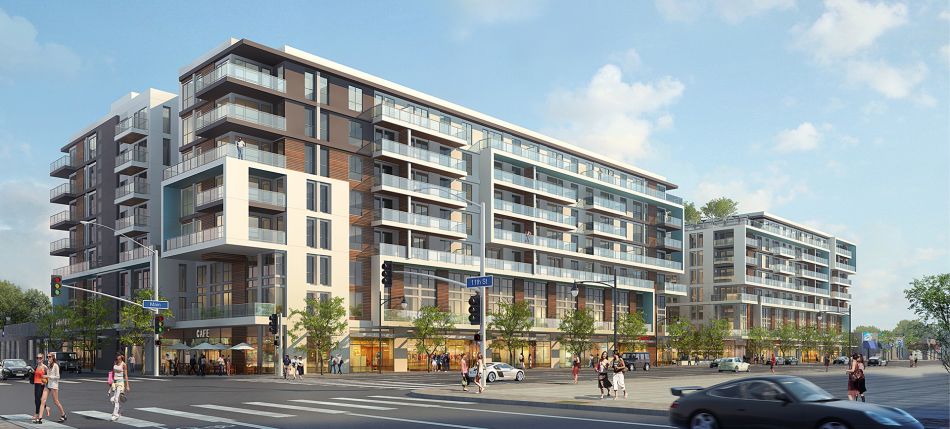
A 379-unit housing development proposed for 1100 S Main Street in downtown LA, half a mile from Metro’s Pico station. It would include 42 units for low-income households and 26,000 sq ft of office and neighborhood-serving space, and would replace several one-story commercial buildings—no households would be displaced. This project requires a general plan amendment, zone change, and height district; if Measure S passed it couldn’t be built because this area is currently zoned for “light manufacturing” only.
The campaign behind Measure S, the anti-housing initiative on Los Angeles’ March 7th ballot, keeps arguing that their construction moratorium and general plan amendment only affects 5% of developments—which is a lie. But if not 5%, exactly how many housing units would it stop? It’s hard to know, since the city doesn’t really track these kinds of things.
To get to the bottom of this, I’ve been going back through development proposals from the past year or so—most projects, though not all, were first proposed in 2016—and tracking all of those that are requesting a general plan amendment, zone change, and/or height district change. (Many thanks to the guys at Urbanize LA for keeping track of these proposals, because I’ve been 100% reliant on their archive to dig through all these projects.) The results have been illuminating.
Click here to view the list of projects, which is a work in progress.
The running total so far: Over 19,000 new homes currently working their way through the permitting process would be blocked by Measure S, including roughly 1,000 to 2,000 units reserved specifically for low income households. That’s 19,000 kids who can’t move out from their parent’s home; 19,000 families forced into overcrowded conditions; 19,000 households forced to live in Palmdale or San Bernardino who have to commute into LA each day; 19,000 households displaced by a wealthier person who was willing to pay more for their unit, because nothing new was built to accommodate them without forcing someone else out.
I didn’t track the specific numbers, but I’d ballpark the required demolition to make way for these homes at around 100 units—roughly 200 new homes for every one torn down, and 10 or 20 new affordable, rent-controlled homes for every rent-stabilized house that is lost. (Rent-controlled units require a covenant and actually guarantee affordability; rent-stabilized units are not synonymous with affordability and mainly benefit long-term tenants.) This is consistent with previous research showing that “spot-zoned” projects banned by Measure S actually result in far less displacement than the “by-right” developments that the initiative ignores.
Looking ahead to future projects, the share of units that will be affordable to low and moderate income households will only increase. Measure JJJ mandates that any upcoming developments requiring changes to the general plan, zoning, or height district must reserve between 11 and 20 percent of their units for low income households. If Measure S passes, Measure JJJ’s benefits are nullified.
The above list also doesn’t include existing or future 100% affordable projects, or permanent supportive housing to be built with Measure HHH funds, since those are harder to track—these projects are also banned by Measure S if they require a general plan amendment, which many do.
So next time someone tells you Measure S will only affect a small number of projects being built by the greediest developers, point them to this page. The reality is that Measure S is not just a minor tweak—it’s armageddon for a housing market that is already desperately under-supplied.
Everyone agrees that our planning process needs reform, but we also know that it needs a scalpel, not a butcher’s knife. There are ways for us to fix this system without utterly destroying our ability to accommodate growth in the years to come, and without forcing even more low income families onto the streets. Measure S is not that fix.


4 comments
Archived from the original site. Commenting is closed.
<p>Thanks for posting. Do you know if the Cumulus project (at La Cienega and Jefferson Blvds) would be affected by Measure S?</p>
<p>Hard to say. It is already approved, from what I understand, but Measure S blocks the issuance of building permits during the 2-year moratorium period. I think the project is already being sued too, so most likely the delay from the lawsuit won't be much less than that of the moratorium, should Measure S pass. After the moratorium is over, I believe the owners would be free to build the project. </p>
<p>I'm not a big fan of the Cumulus project since I think it should have included on-site affordable housing, but any future projects will be required to provide between 11 and 25 percent affordable housing thanks to Measure JJJ, so the problem is basically resolved for any projects going forward. Measure S may delay this one from being built for a couple years, but I don't think it'll stop it, and it'll prevent a whole bunch of affordable housing that could be built in the future.</p>
<p>Shane Philips, you couldnt be further from the truth. Measure S does not block the issuance of building permits that are affordable living. The said measure would impose a 2 year moratorium on buildings seeking general plan amendments or zone or height, or loss of zoned open space, agricultural or industrial areas, WITH EXCEPTIONS INCLUDING FOR AFFORDABLE HOUSING PROJECTS AND PROJECTS FOR WHICH VESTED RIGHTS HAVE ACCRUED;</p>
<p>Nowhere in this measure does it say that building permits will not be granted to any development project. Your post is clearly meant to confuse and sway the undecided by way of deception. WE WONT STAND FOR MISINFORMATION.</p>
<p>"WE WONT STAND FOR MISINFORMATION."</p>
<p>LOL. </p>
<p>The irony! The entire Measure S campaign has been predicated on mis-information from the very beginning. It won't stop evictions, it will affect many more projects than you imply, it does not exempt even 100% affordable projects if they require a general plan amendment (and doesn't exempt <em>any</em> projects that have less than 100% affordable housing, which describes every project in the above list), it doesn't say anything about mansionization whatsoever, does nothing to reform campaign finance, on and on and on. </p>
<p>You guys keep saying that affordable housing projects are exempted, but it's only for those that are 100% affordable—i.e., built with public tax revenues—and even then only if they require only zone changes or height district changes. General plan amendments are completely banned. At first I thought the Yes on S people were lying when they said affordable projects were exempt, but you've said it so often now that I honestly think people like you actually don't know the truth. If you know enough to understand vested rights, you should understand that general plan amendments are banned even if projects are 100% affordable, and stop glossing over that fact. There are thousands of units in 100% affordable projects that depend on general plan amendments, and if Measure S passes they won't be able to be built.</p>