Note: This is my summary of the key features of the proposed DTLA 2040 Community Plan update (based on the limited information available from City Planning at this time), the major flaws or problems as I envision them, and a number of recommendations for improving it. After reading it, if you want to learn more about the details of my counter-proposal and my arguments for why we should demand more from the Planning department, please continue to the page linked here, which goes deep into the weeds on all of the topics discussed below.
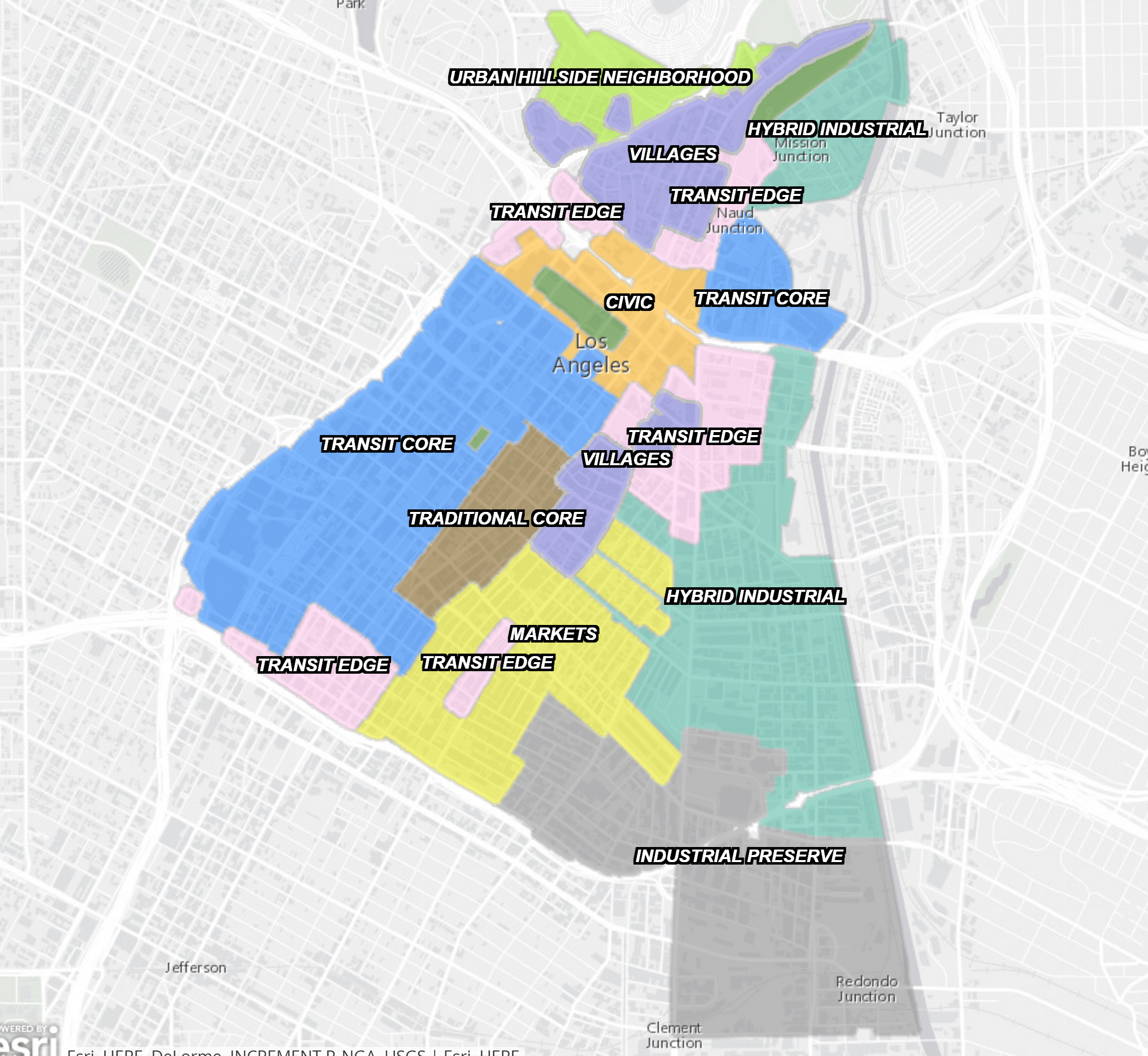
A map of the proposed zones in the DTLA 2040 plan. Source: DTLA2040.org .
The Department of City Planning is aiming to have the Downtown LA Community Plan updates (Central City and Central City North) approved and ready for implementation by early 2018. This update is an unparalleled opportunity to reshape downtown, and to create an incredible amount of value and capture it for use on local priorities in the coming years.
I think downtown is different from the rest of Los Angeles, and that if you show us something truly visionary, we’re ready to get behind it. Maybe I’ve got my head too high up in the clouds, but I really believe that. Our ambition and openness to change is being underestimated by this plan; we can and should do better.
The city will need to complete an environmental impact report as a part of their update process, which means they’ll be finalizing many of the fundamental components of the plan over the next few months. Now is when we have the most leverage to demand changes from the people in the city who are putting this plan together.
Key features of the proposed updates
Details on the website are thin, but more information was presented to those able to attend the open studio in October or meetings at some of the local BIDs. The basics of the proposed update are as follows:
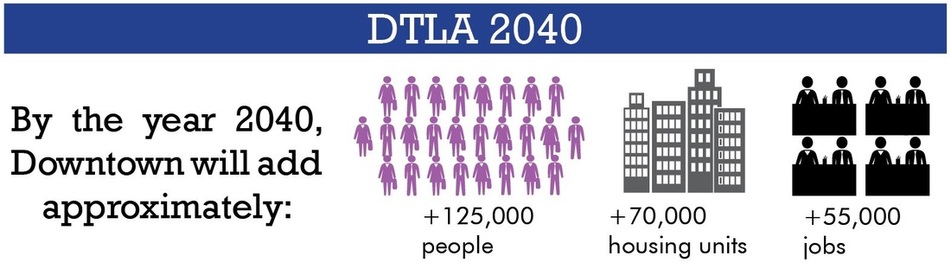
**1.**The plan seeks to accommodate 70,000 new households, 125,000 new residents, and 55,000 new jobs through 2040.
**2.**It will upzone much of downtown and (presumably) tie the utilization of increased development capacity to community benefits like affordable housing, open space, streetscape investments, etc.—similar to Cornfield Arroyo Seco Specific Plan (CASP) and proposed Expo Corridor Transit Neighborhood Plan.
3. Southeast downtown will be completely off-limits to housing, preserving existing low-employment-density manufacturing and warehousing uses.
Problems with the City’s proposal
Without getting too great into the details on this summary post, here are the main weaknesses of the currently DTLA 2040 plan, as I see them.
70,000 new households isn’t enough. If more people want to move here, we should allow them to—and the more people that do move here, the more we can secure in community benefits (through value capture), general funds, Measure M and R, etc.
City Planning is explicitly trying to avoid “too much” of LA’s growth from occurring downtown. As a result, we end up with a city that is constantly zoned for only slightly more housing than we currently use, creating an artificial scarcity of developable land that drives up the price of land, and therefore housing. We also get less housing and jobs near the best transit in the county.
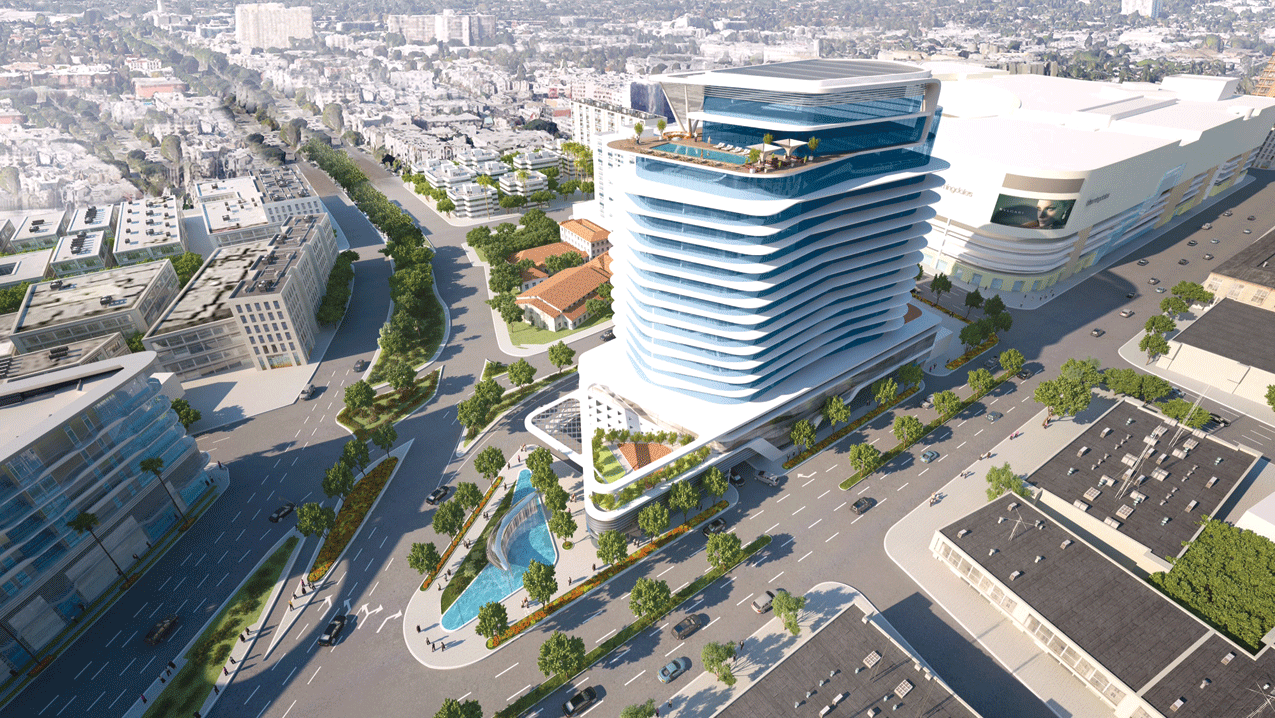
The constant delays and NIMBY roadblocks thrown up in front of good projects outside of downtown are an excellent example of why we should take full advantage of as much housing as developers are willing to build in downtown LA.
They believe that if we zone for too much housing, nothing will get built. Their argument boils down to the idea that if we zone for more than developers currently want to build (e.g., 10:1 floor-area ratio in an area where no one wants to build more than 6:1 FAR right now), property owners will hold their land off the market longer, waiting for demand and prices to rise. But is there any evidence that this actually happens on a meaningful scale?
Preserving industrial land (no housing) is delaying the inevitable. In the long run, it only ensures that steadily fewer jobs will be contained within this ~1,000 acre area, despite a new light rail line on the way (the Eco-Rapid to the Gateway Cities) and increasing demand for housing moving toward the southeast.
There’s not much room for innovative programs or approaches to the housing crisis or downtown’s unique needs. If anywhere is willing and able to try something creative and transformative, it’s DTLA, and we shouldn’t waste the opportunity.
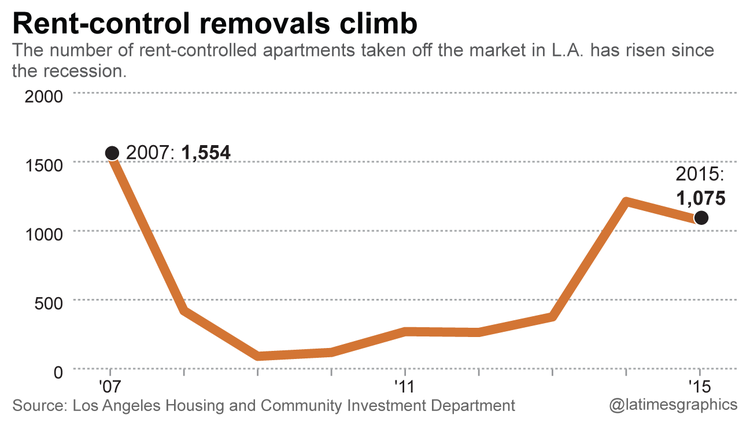
In addition to moderating rent increases and providing new supply, both of which reduce the incentives for landlords to utilize Ellis Act evictions, downtown can also try out innovative support programs that better mitigate the impacts of redevelopment.
Recommended changes
Because it’s still relatively early in the plan update process, there’s still plenty of time to make your voice heard and to advocate for a more aggressive plan. The Planning department needs to hear from downtowners who want to see more housing, more flexibility, and more vision.
Below are my key recommendations; the first three are especially high priorities.
Increase capacity for new housing overall. Downtown LA should be allowed to build as much housing as people are willing to move into, not the amount determined by some arbitrary forecast. Larger up-zones will create additional value that can be captured to fund local community needs like affordable housing, homeless services, parks, and transportation infrastructure; more housing means less rent pressure on existing units in downtown and beyond; and more land available for redevelopment reduces the value to a developer for any particular parcel, which in turn can help reduce the overall cost of new housing.
Create a flexible, predictable value capture mechanism. Upzones create incredible value for existing property owners, and so it should be a priority to recapture much of that value for community benefit rather than leave it as a windfall for the owner. (The captured amount should not exceed the value created by the upzone, however.) The value capture mechanisms used in CASP and the Expo Corridor TNP are complex and relatively inflexible, so we should strive to find something that is more straightforward and predictable, encouraging developers to invest in our community—especially smaller and mid-size developers that have been regulated out of the market by complex rules and project-by-project negotiations.
One example of a simple value capture mechanism: Pay a fee for each square foot of development above existing (pre-Community Plan update) FAR. If current zoning allows for 1.5 FAR and the new plan increases that to 10.0 FAR, a fee is paid on each square foot of development above 1.5. For zones that are changed to allow residential uses where they were previously prohibited, a higher fee might be charged because the increase in value is greater for a change of use than a simple FAR increase.
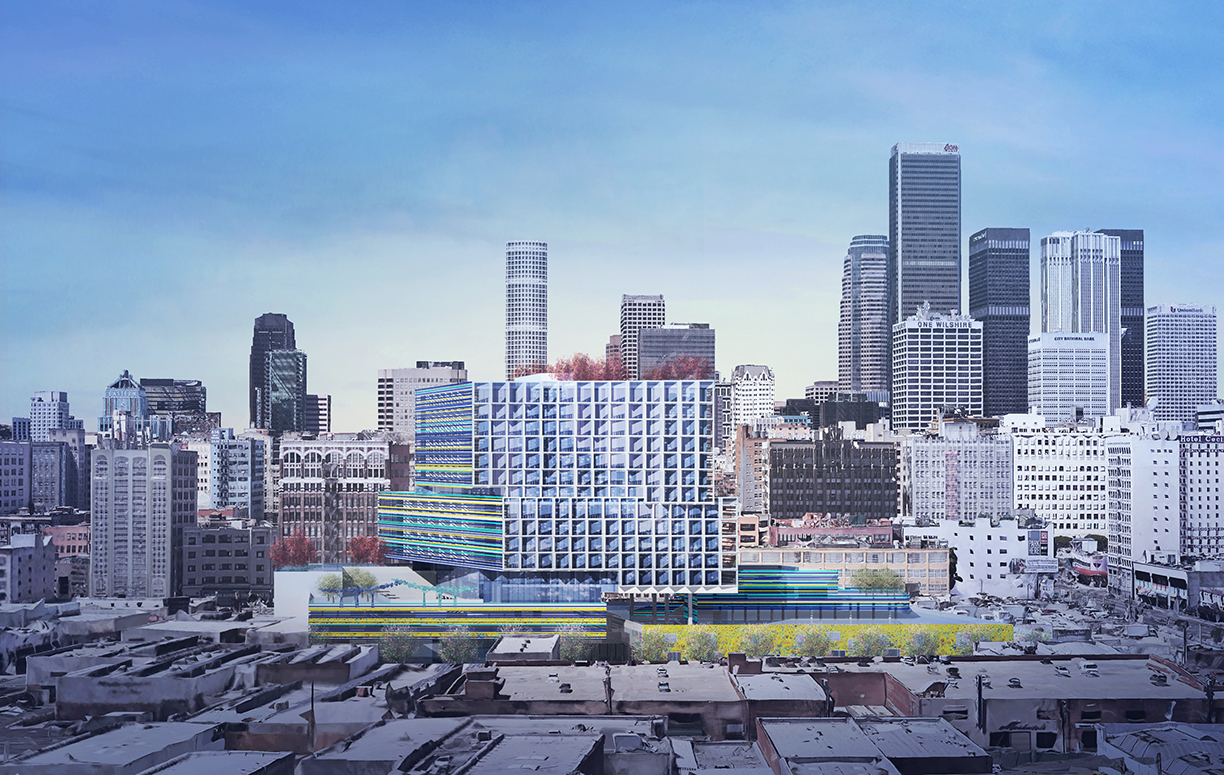
The proposed Southern California Flower Market redevelopment is a great example of development being used to not only create new housing, but to create the value needed to preserve historic, job-producing uses.
Allow housing throughout downtown. Manufacturing employment has been declining for decades, and with the growth of automation that’s unlikely to change. Unfortunately, right now City Planning intends to entirely prohibit housing in the southeastern parts of downtown, in the proposed “Industrial Preserve.” Many “heavy” industrial uses are incompatible with a safe, walkable, transit-oriented downtown. Sacrificing potentially tens of thousands of units of housing and many thousands of higher-density jobs in order to preserve the relatively few manufacturing and warehouse jobs in southeast DTLA—temporarily, at that—is incredibly wasteful and short-sighted, especially in light of the rail stations planned for the east side of downtown.
If preserving jobs is a priority, we should tie the construction of new housing to the provision of office and/or light industrial work spaces (e.g., allowing construction of up to 6.0 FAR if a third of the building’s space is used for non-residential/retail/hotel uses). Residential zoning is extremely valuable; by expanding mixed-use zoning throughout downtown we can create value that also helps pay for business relocation and employee retraining, rather than simply watching these jobs disappear one by one over the coming decades, with no assistance offered to those affected.
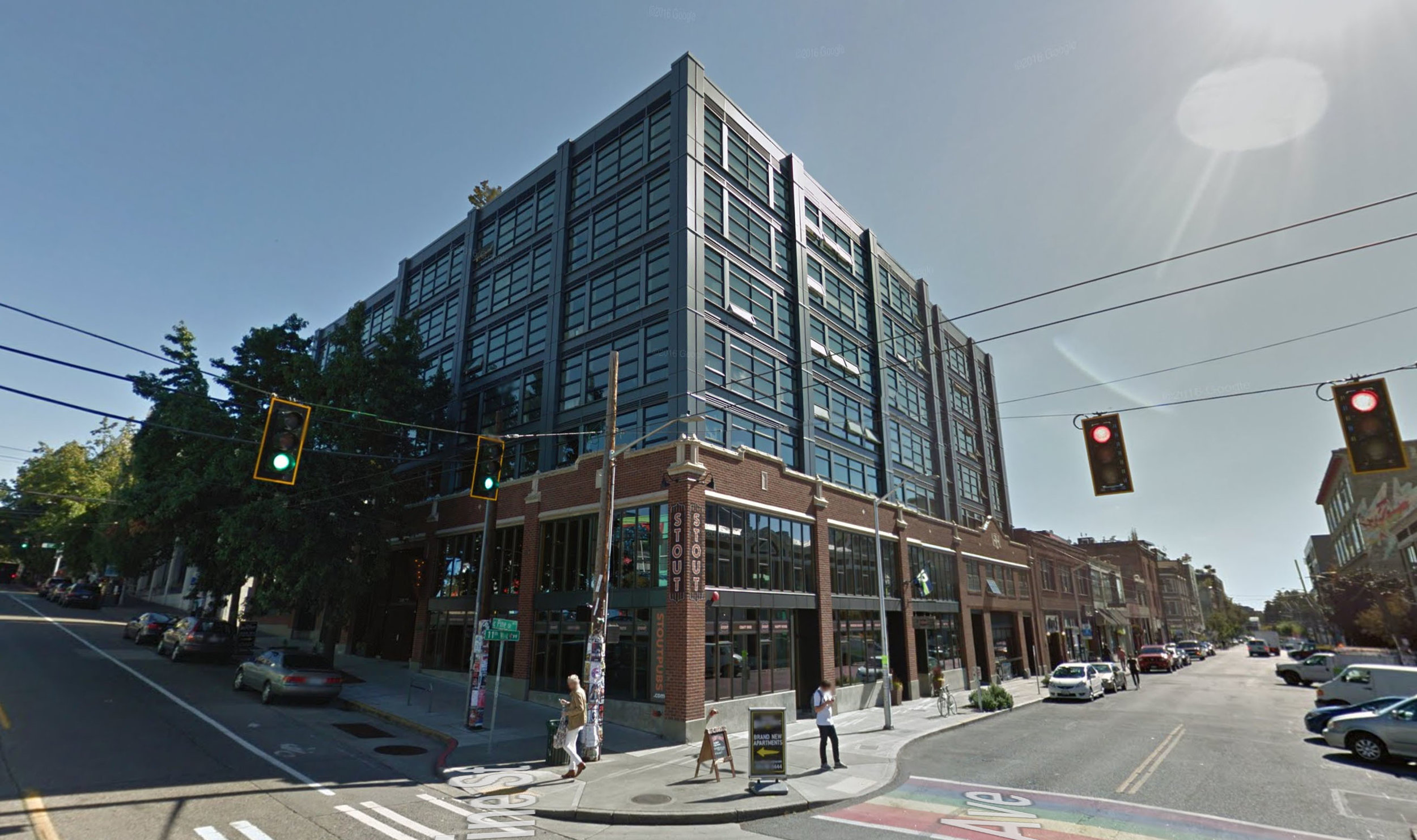
New developments can be designed to retain the heritage features of old structures, such as the facade seen here in a Seattle redevelopment project, while still allowing for growth and densification.
Set aside some value capture proceeds for innovative programs. Zoning for an aggressive amount of new housing is fairly unusual in large American cities, but we’re otherwise not doing much that other places with even more unaffordable housing (SF, NY) haven’t already tried. Downtown can and should help explore new approaches that could actually make a dent in the crisis. These can include things like: non-profit acquisition of existing housing, to set aside a share for low-income residents and hold long-term; temporary relocation and rent assistance, and right of return for displaced residents, regardless of income; funding for business retention; and more.
Study a “high-growth” alternative in the EIR. One push-back from City Planning to the idea of a more aggressive growth plan is that more housing means analyzing more impacts in the environmental impact report, and it may be harder to justify those impacts without a solid basis for the growth projections (like SCAG housing allocations, which are currently being used). If Planning can evaluate both scenarios, “SCAG-projected growth” and “high-growth,” we at least have a sense for what those impacts might be and can make an educated decision when the draft EIR goes out for review. We can’t know what we don’t study.
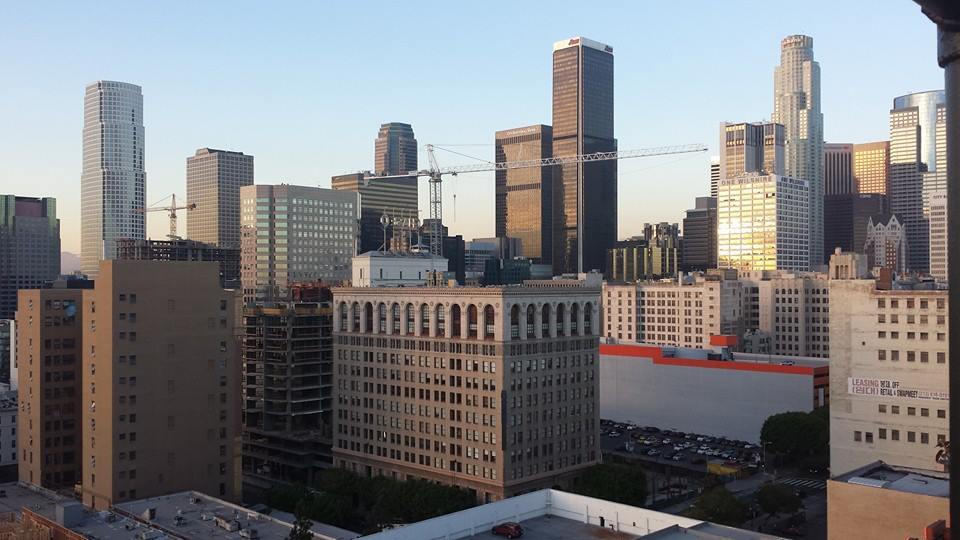
Humans are horrible at predicting the future, and our growth plans should account for a range of possibilities that leave flexibility for if (and when) our predictions don’t turn out as we imagine.
Examine options and implementation for major infrastructure changes and roadway reallocations. With a large and robust value capture program comes the responsibility to spend those public revenues effectively. Examples of potential projects include: open space on the scale of Grand Park, most likely located south of 7th Street anywhere from the Fashion District to the LA River (and which would require acquisition of several city blocks); narrowing and closure of some roads to most car traffic, or adoption of woonerfs, in places where roads don’t cut straight through downtown (ex., 10th Street between San Pedro and Central, 11th Street between Broadway and San Pedro); a fully-protected east-west bikeway with safe intersections and, potentially, park space to accompany it along its length; dedicated lanes for transit and local shuttle service, especially connecting people to Metro rail lines (and taking plans for the FASTLinkDTLA transportation management organization into account)… other ideas welcome.
Take car-free and car-lite transportation seriously. This relates to the previous bullet point, but if every new household built in DTLA includes a parking space and at least one driver—even if only 70,000 new households come to downtown—then the whole neighborhood is going to come to a standstill. We need real plans for how we can grow without dramatically increasing the number of cars used by residents each day. This will require real investments and re-allocations of space on downtown streets, and a convincing argument for why developers can and should build new housing with limited parking. Lower land prices resulting from an abundance of redevelopable land, combined with reduced parking costs, should also help reduce rents to a level where developers feel comfortable providing less parking. (A parking space in a new building typically adds $200 to $400 per month to a tenant’s rent; high land prices add a similar amount.)
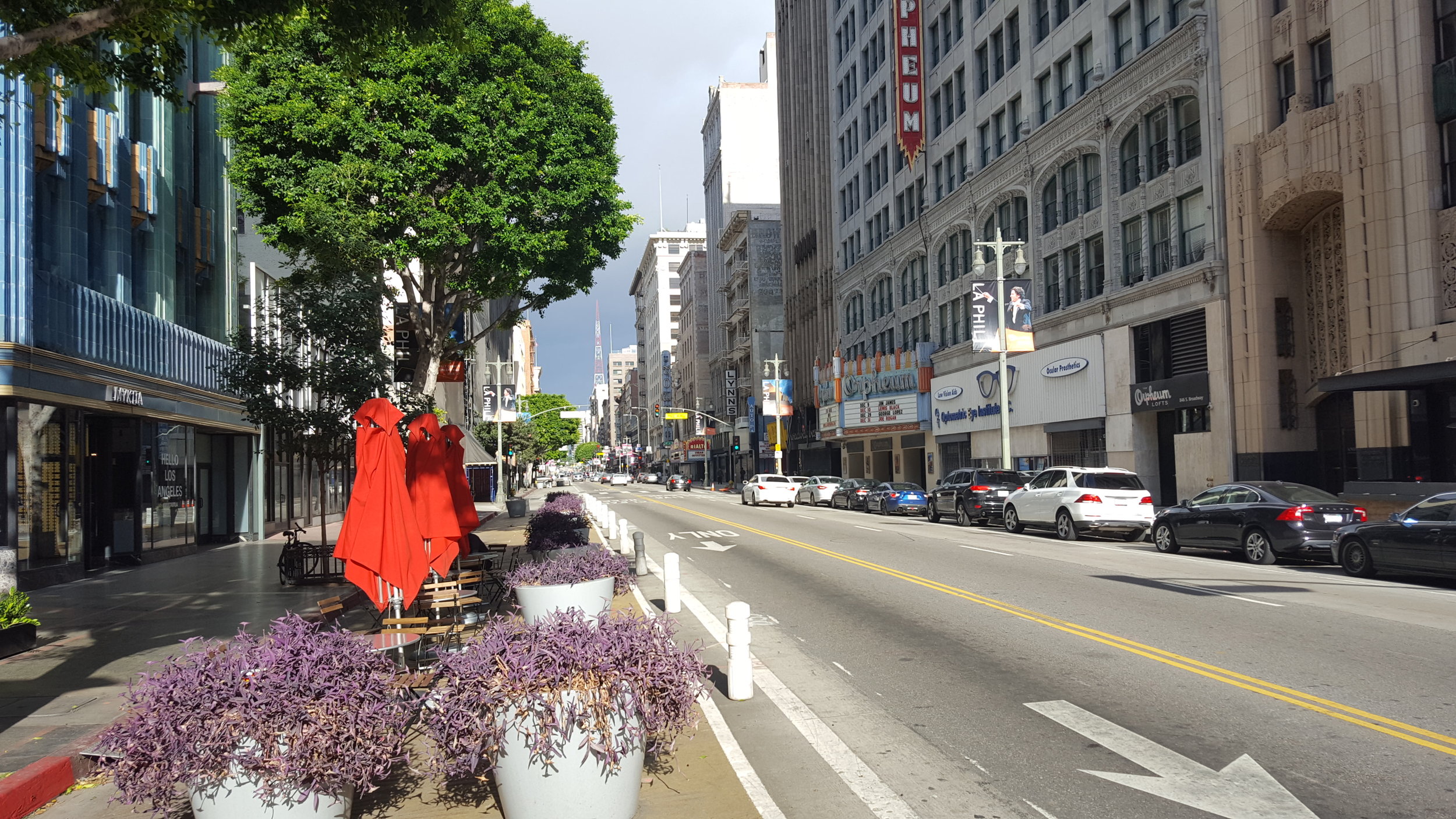
Limiting parking can also make it easier to fill in smaller parcels, and help create the kind of consistent streetwall that makes many of our historic streets so beautiful.
Designate areas that might benefit from Master Plans and Master EIRs alongside or following DTLA 2040 approval. Master Plans and Master EIRs create a framework for by by-right development that does not require a years-long process of project-specific approvals. This creates additional value for the owner of the land, which can in turn increase the amount of value capture possible from each parcel. Rather than leaving the developer to take the risk of approval and absorb the costs of that expensive process, the city can clear the way and capture much of that value for local benefit instead. It would also help us respond to changes in demand much more quickly than we can today.
Next Steps
There’s a lot going on with this update, and a whole lot at stake, so we need downtown stakeholders to be super engaged with the city’s DTLA 2040 team over the next few months. All I’ve written above and in the complementary detailed post is intended as a starting point—albeit a big one—for further discussion about what the community plans should actually look like.
As with everything I write, critiques and additional input are very welcome. But please, if your comment is critical in nature, pointing out why x, y, or z might not work as I envision, please include your own suggestions for how it could be done better. Naysaying just for naysaying’s sake doesn’t further the conversation, and a productive, public conversation is what we really need here. Also, if your comment relates to additional details or clarification, there’s a good chance you’ll find an answer in my complementary post.
Thank you for reading, and for your involvement on this in the coming months! If you want to get more involved, please shoot me an email through the contact form linked to at the top right of this page! Let’s talk!
To read additional details about my counter-proposal to the city’s early draft of the DTLA 2040 Community Plan update, please click here.

11 comments
Archived from the original site. Commenting is closed.
<p>Downtown should not have minimum off-street parking requirements, but it currently does for new construction. Doesn't advocating for "value capture" just drive up the cost of development, and work against your stated goal of making things less complex for developers? I don't think that upzoning downtown is something that has to be a quid pro quo. Just the fact of more housing being built will add value to the neighborhood and the City (e.g. by increasing the density of taxpayers, making transit run more efficiently, etc.). Cities should actually be willing to pay for some infrastructure through taxes, instead of hitting up developers for it. We say we want affordable housing, then we pile on the fees and bureaucracy any time someone tries to build housing. Doesn't make a lot of sense. Our failed approach shows in CA's astronomically high housing costs.</p>
<p>It would probably be better to just require that a developer provide replacement affordable housing units when existing affordable or older/cheaper market rate units are demolished as part of a project.</p>
<p>The state needs to reform CEQA, and have straight up exemptions for even large-scale dense infill development.</p>
<p>Thanks for the comment Chewie. Totally agree about removing parking requirements entirely. </p>
<p>Regarding value capture, I think about this in two frames. One is with respect to fairness: Upzoning creates a huge amount of value for property owners, and I think it's unfair that we would just give it away as a windfall to them rather than try to turn it back into a greater benefit for the community. A community is ultimately what makes a neighborhood valuable, not the specific property owners (though they can certainly contribute, or detract), and so it seems sensible that much of the artificial value provided by an upzone would be returned to that community. I fully agree that the city should be willing to pay for infrastructure and I also strongly disagree with people who believe that development itself is an "impact" that needs to be mitigated. That said, why give away billions of dollars to the people who least need it? </p>
<p>The other frame is politics: I just don't see a plan like this succeeding without a give-back. For example, I can imagine that if I were a resident of Boyle Heights that I would look at a fully market-rate downtown with extreme concern. You'd have tens of thousands of higher-income residents moving next door to your neighborhood, bringing the demand for additional low- and mid-paying jobs with them, and all those people also need somewhere to live. If you have no affordable or moderate income housing downtown, guess where those new workers are going to want to live? That's just one example, but I think it's a good representation. Although I didn't vote for it, the voters just made very clear with the approval of Measure JJJ that they don't like the idea of giving away free zoning rights.</p>
<p>If it were 30 years ago and we weren't already decades into a housing shortage that had driven up land and construction costs, I might agree that just opening the market and maximizing supply would be an adequate solution. Today, housing prices being what they are, I think we need to address concerns with displacement and gentrification at the same time as we address supply. It makes the job harder, but if we fail to do so we're going to see the tide turn against development everywhere and we won't build anything at all.</p>
<p>I think the replacement affordable housing idea is interesting, but it's difficult in practice. For one, are you just talking about covenanted affordable housing, or market-rate units that rent for a relatively affordable rate? And if low income residents live in any of the market-rate units, do your responsibilities change? Because that can be very confusing (the updated density bonus law, AB2222, has some of these problems), I prefer a system that doesn't require you to know the specific tenant mix of the existing property and instead allows you to pay a uniform fee that is devoted to mitigation. Trying to have each developer provide the services/infrastructure directly, regardless of the size of their projects, is not only inefficient but tends to favor the big guys who can get economies of scale.</p>
<p>And yes, absolutely CEQA needs to be reformed. Obviously that's outside the scope of the DTLA 2040 plan, but I would love to see areas like downtown exempted from most of the study categories in CEQA. Maybe we'd still be required to study cultural and historic resources, geology, and a few other topics, but the stuff we already know like traffic and noise should be waived.</p>
<p>"This relates to the previous bullet point, but if every new household built in DTLA includes a parking space and at least one driver—even if only 70,000 new households come to downtown—then the whole neighborhood is going to come to a standstill."</p>
<p>We should definitely promote car free/car lite by abolishing parking requirements, but 70,000 more cars isn't going to completely destroy downtown. It wouldnt be good, but DTLA has a robust grid of streets and 70k isn't a huge number.</p>
<p>You might be right, but it would still be worse than the alternative of planning for a future where cars aren't people's default mode of transportation. Or at least not cars that they own and store in their building.</p>
<p>Two questions:</p>
<p>We've heard a lot about the change in traffic impact measurement under CEQA from LOS (Level of Service) to VMT (Vehicle Miles Traveled) as part of S.B. 743. Will those changes be in effect for this EIR, allowing the traffic effects to be measure with VMT?</p>
<p>How do those of us who are not Downtown residents but who care deeply about the future growth of Downtown advocate for some of the changes you are suggesting?</p>
<p>As I understand it, it's now up to cities to adopt those VMT rules. Unfortunately LA still hasn't done it. (Pasadena and others have, so it's our own fault, not something we can blame on others.) I doubt we could get the rules changed quickly enough that it would benefit this study, but I would love to see it happen. It seems like it'd make the study of potential impacts MUCH easier if we could focus on VMT instead of LOS.</p>
<p>I don't yet know the best way for non-downtowners to engage, but you can email me (shanedphillips@gmail.com) if you want to stay involved. If you happen to be in Council District 14 you can definitely reach out to Councilmember Huizar, whether you're in the downtown part of his district or not. Sharing with friends and colleagues have have an interest in downtown is also helpful, and I think expressing support to the Planning Dept and your Councilmember, whoever they may be, is still helpful in showing that there are many residents in LA who want to see us address the housing crisis and are open to change and growth in our city.</p>
<p>Great article, though I do have some differing opinions on the best path forward for downtown. </p>
<p>I completely agree with your sentiment that an "Industrial Preserve" makes little sense considering the housing crisis and the trend away from heavy manufacturing. Services (increasingly being provided by web-based applications) are the new "products" and the manufacturing of said products comes without many of the hazardous impacts that made Industrial Zoning a necessity in the first place. The entire downtown loop (and many parts just outside the loop) should be zoned for mixed-use to promote walkability and to allow for whatever land uses the future demands. The only restrictions I see value in is the preservation of certain facades as pointed out by the examples in the article.</p>
<p>As downtown continues to shift away from being a center of traditional industrial production, I would like to see incentives for land owners to provide easements for walking paths to break up some of the SUPER-BLOCKS in the SE portion of downtown. </p>
<p>I also agree that parking minimums fly in the face of the transit-first ideology touted heavily by many city leaders. To be realistic though, we need to expand transit to every corner of the downtown loop before developers would be willing to take the risk of developing new units with little to no parking.</p>
<p>In terms of affordable housing, I seem to be in the minority here but I've never been a fan of it, at least not in its current form. Charging a very small handful of persons $800 to live in a unit that could rent for $2000 does nothing to meaningfully alleviate the housing pressure on the vast majority of Angelenos. That unrealized $1200/month/unit means less taxable revenue for city services like education, parks, and transit; services that benefit all Angelenos of all incomes. The existence of affordable units in luxury buildings makes no sense. Why should anyone directly or indirectly (developer or taxpayer) subsidize a rooftop pool, an amenity deck, gym, screening room, etc. for many of the new affordable units that come online. You could probably build at least twice as many units in another building without all of the bells and whistles. If anything, I think affordable housing in the urban core should be directed toward persons who provide essential services that contribute to our city functioning properly. </p>
<p>I would love to see allowable density to be more dynamic to respond to market forces. Imagine that instead of allowable density for new construction being a static number of dwelling units per acre, it was instead a multiplier (1.05, 1.1, or 1.15) of the existing average dwelling units per acre on the current block. This sort of policy would promote the gradual densification of neighborhoods rather than the spot zoning that we see today. As you pointed out, we suck at predicting the future. So, let's build in a mechanism that allows our city to continue to grow should we need it in a manner that isn't disruptive to our communities.</p>
<p>Hey Chuck,</p>
<p>Very much agree with you on your points about super blocks and providing good transit to reduce the need for parking.</p>
<p>Regarding affordable housing, I'm sympathetic to your view but think that it's challenging no matter how it's done. On the one hand you can build or purchase more affordable housing if you take fees and use them on less high-end buildings, but on the other hand there is some value in having buildings that aren't fully segregated between high-income and low-income residents. I really don't think there's a great solution. </p>
<p>And I don't think it's correct to say that higher-income residents are directly subsidizing those in the same building. Realistically the value is created in the upzone, not by charging more for market-rate units, because you CAN'T charge more for market-rates than the market will bear. If you had no requirement for affordable housing it wouldn't result in more affordable units, it would just mean all of them would be market-rate and, because that would earn a higher income for the owner of the redeveloped property, would result in higher land costs. It's the existing property owner who bears the cost of the affordable units, effectively, and that's okay because they're getting a huge value increase to compensate for it.</p>
<p>One interesting thing your comment made me think of though is what we could accomplish if instead of allocating a share of housing for low income or moderate income households, we just said that ALL of the units need to be $400 less per month (for example) than comparable market-rate units. The cost to the developer would be about the same as setting aside 20% of units for low-income households, but the result would be very different. In practice there would be a lot of problems to work out with this framework but I think it's an interesting thought. Nice new downtown studios renting for $1400 on average rather than $1800, and 1 BRs renting for $1650 rather than $2050, would make for a very different landscape.</p>
<p>I can't say that I agree with the incremental approach in downtown, because our needs are too great. If we've got a 1-story building and a developer wants to build a 10-story building in its place, I say let them build it. We need the housing. Arbitrarily limiting them based on what's nearby just means it'll take that much longer for us to address the housing shortage, and I can't support that. In other communities—those that don't already have mid- and high-rise buildings, maybe—I'd be open to the idea, depending how it was implemented.</p>
<p>It seems to me that the proposed FAR requirements of 13:1 for already high (or growing) density areas like Transit Core (South Park, Bunker Hill, etc.) is a little bit low. Is there any particular reason why these areas don't have higher maximums like 20:1? For example, the city is advertising the "Angels Landing" site near Pershing Square as a prime location for very-tall development with unlimited height, and yet its FAR is limited to 13:1. Do you think the city would consider revising this? Are there things developers can do to get highers FARs for prime sites like Angels Landing?</p>
<p>There is indeed! It's actually written into the city charter that nothing can be built to greater than 13:1 FAR. We'd have to change the charter to change that rule. I'm not sure how much more challenging that is than passing an ordinance (e.g.), but I'm guessing it hasn't been proposed since very few buildings actually build to 13:1, even in downtown. Maybe that won't always be the case, but it hasn't been very problematic up to this point.</p>