The Department of City Planning released a treasure trove of housing-related data earlier this month in the form of the 2015 Growth & Infrastructure Report.
And with relatively little editorializing, I’d like to bring people’s attention to one bit in particular. Below is a table from the report comparing unit counts for new units, and demolished ones, between 2010 and 2015. I assume that most single family dwelling units (SFDUs) are torn down only to be replaced by larger single-family homes, so I recommend focusing your attention on the multifamily (MFDU) unit data (new, demolished, and net):
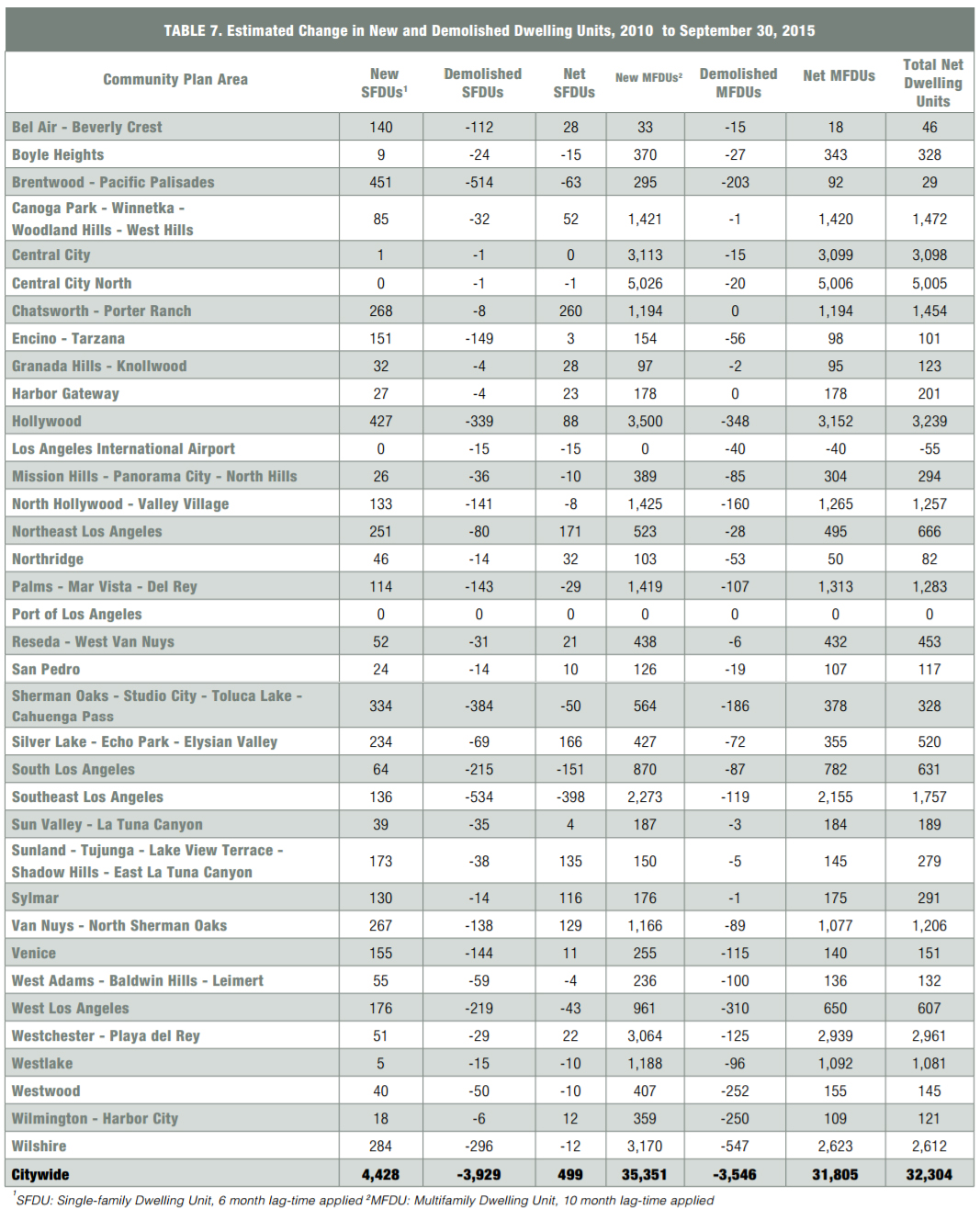
Overall, we demolished a little over 3,500 multifamily units over the 5-year study period. During that time, we built just over 35 thousand new ones: almost exactly a 10-to-1 replacement ratio.
The ratios vary pretty dramatically between Community Plan Areas: in Wilshire, about 5 new MFDUs were built for every 1 torn down; in Hollywood, it was a little under 10 to 1; in Central City (downtown), the ratio was an astounding 200 to 1. Lots of parking lots bit the dust, but the housing that was there was pretty much all preserved.
If we’re looking to hand out awards, Canoga Park and its environs take the prize with a 1,420:1 ratio of construction to demolition, though. But Chatsworth and Harbor Gateway deserve credit too: both of them break the universe with 1,194 and 178 new homes, respectively, and zero multifamily units lost. (Never divide by zero, people.)
For me, this is pretty good news overall. The new housing that we’re building, insufficient though it may be, is coming at the expense of relatively little existing stock. But we can do better.
For one, we can build more housing where none currently exists, like on parking lots and commercial strips. If we **repeal Proposition U**we’ll end up with a lot higher construction-to-demolition ratio, and much less displacement—and less development pressure on single-family and low-density neighborhoods.
If we eliminate the “Parking (P, PB)” designation in our zoning code (yes, we literally have places in our city where nothing but parking is allowed to be built), that would help too. While we’re at it, we should eliminate parking minimums entirely, since they just force developers to build more parking at the expense of housing. We currently have more square footage devoted to car storage than to human shelter, so even more space for cars really should not be a priority.
We should also upzone more of our transit-oriented neighborhoods, so that the most transit-accessible communities are able to build more housing for every unit replaced. We can have one household displaced for every 10 households, or one for every 50, and that’s almost entirely determined by zoning. If it’s one for every 50, it becomes a hell of a lot easier to force deveopers (or property owners, or the city, or whoever), to re-house any displaced families and provide more affordable housing in their new project.
And we should definitely improve our density bonus, making sure that every time a new building goes up, it’s maximizing both its market-rate and affordable housing component. With historically low vacancy rates in the LA County region, we can’t afford to scrimp on either.
Ten-to-one is good—great, even. But we can do better. And we know what it takes to get there. So, you know… let’s.


4 comments
Archived from the original site. Commenting is closed.
<p>lol not that easy</p>
<p>First - because the zoning classification for most commercial parcels in Los Angeles are zoned C2 and their Height District varies from 1 to 1VL, (setting a maximum height of 45)’ the sanctioned FAR of 1.5:1 is not conducive for mixed use. Though R4 density is permitted in the calculation for density ( total units) - due to the anti-development coalition “Not Yet New York” spearheaded by UCLA professor Laura Lake (now part of “Fix the City”) Proposition U (1986), the total mass of any building built on any C2 zoned dropped from an original 3:1 to a restrictive 1.5:1 FAR in order to stop urbanization of Los Angeles. However in in the last decade the City of Los Angeles recognized and addressed the 1.5 FAR issue by creating RAS3 and RAS4 zones to accommodate residential mixed-use structures. </p>
<p>Secondly, most C zoned commercial corridor parcels in Los Angeles abut either R1 of RD zoned property, which in turn severely limits total height - as described in LAMC Section 12.21.1 ,A-1 0 (Transitional Height Ordinance). Transitional Height provisions limit the construction of any Classification C-2 structure to 25 feet within a 49 foot distance from any R1-1 zoned property (and limits 33 feet for any portions of a building within 50-99 feet of the adjacent Rl-1 property). Also, due to the average depth of a commercial lot in Los Angeles being 124’ feet, a restriction of 25’ feet height up to a 49’ feet distance from a R1-1 zoned property creates an onerous situation for a developer to create market rate units - and much less affordable housing on-site. Therefore there is an inherent conflict between policies encouraging the production of affordable housing and the provisions of the Code that were created to help buffer single-family housing from adjacent commercial buildings (ZA-2011-3126-ZV-1A ). </p>
<p>Lastly, from an engineering and rational perspective - Parking Requirements L.A.M.C. Sections 12.22A25 and 12.21A4 have in the past severely impacted the construction of new mixed use structures due to excessive parking to unit ratios that create a cost detriment for developers and the construction of new housing. Funds per parking space in Los Angeles that cost 50,000 dollars per spot severely hamper the ability of developers to utilize , and cost is further compounded if a developer were to consider underground parking which also comes with its own caveats such as a feasibility barrier to the requirement of a minimum 124’ ft in depth lots to assure structural integrity to an underground facility.</p>
<p>but to fix it you would have to target a couple of things...for example the total height of a project, for projects that are located in a TPA area but are adjacent to an R1 zone, the height of the proposed project cannot go above 45’ HD-1VL for any reason - and are limited to 45’ ft - this limitation is further exacerbated by the Transitional Height requirement that limits C-zoned structures at 25’ ft if within 50 feet from an R1 zoned property. However projects abutting either R1 or RD zoning may qualify for an off menu Transitional Height incentive as seen in CPC-2008-3464-DB if the project demonstrates “architectural articulation” and “quality design” in accordance to LAMC Section 12.22.A.25. and as termed by the findings section 1.B.(1.) of the CPC-2008-3464-DB Determination Letter. The argument for the allowance of off-menu transitional height incentive is further bolstered by LAMC Section 12.22 A 25 (g)(3), the Density Bonus Ordinance, as well as the California State Government Code Section 65915, the State Density Program. Secondly, with Transitional Height waved as a project demonstrates “architectural articulation”, all developments adjacent to RD (and over) receive an additional 11 feet in height if the existing zone is 1VL height limit of 45- (can be raised to a total of 55’ feet) if they also maximize the amount of affordable units under the city definition. For projects not in the City 1,500 TPA but are in front of a Major Highway, qualify for State TPA, and are in the C-1.5+ zoning area - then an MND discretionary process for RAS3/4 is possible, to allow 3:1 FAR, and because the project would still be under the State definition of a TPA (the project would still qualify for lowered parking requirements) and the agency managing the project can call on the RFP (through the redevelopment agencies discretion) the utilization Mayor Executive Directive 13 for 20% affordable units (as a condition to still bring in affordable housing).</p>
<p>The ratio of replacement is less important than the total volume. 31k new MFU for 3k destroyed has a nice ratio, but what about 100k new vs 50k destroyed? It might be destroying more, but it is also creating more. We need 100k units per year. I'll take 500k created for 400k destroyed(even if that is unsustainable)</p>