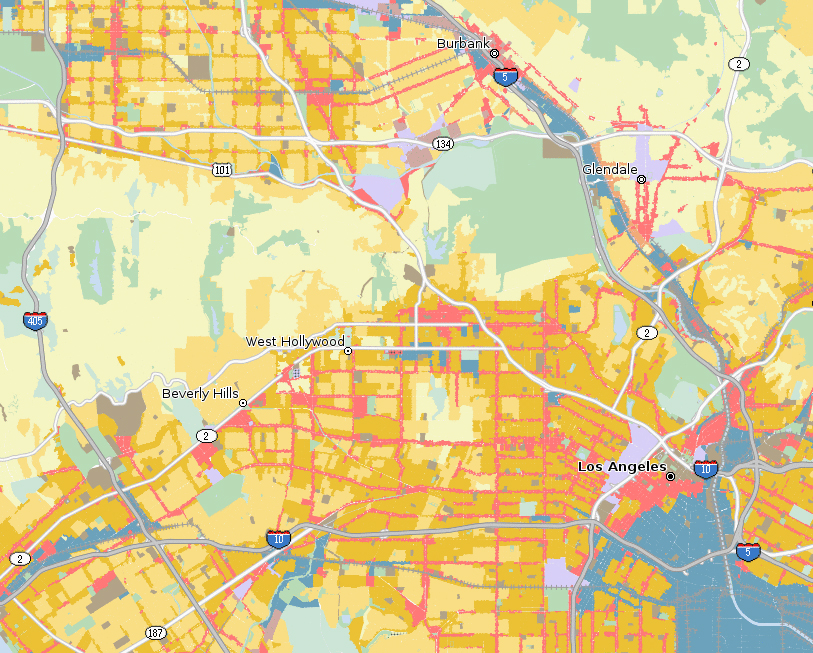
A map highlights the zoning designations for parcels in Los Angeles and adjacent cities. The pink/salmon colored parcels are zoned for commercial use, and were the primary targets of Proposition U in 1986. Image from Property Shark .
Thirty years ago, in 1986, a foreshadowing of today’s fight over “neighborhood integrity” was taking place, culminating in November as Los Angeles residents voted 2-to-1 to cut the development potential of thousands of parcels across the city. Of the 29,000 acres zoned for commercial and industrial uses throughout LA, 70 percent saw their development capacity sliced in half, from a floor-area ratio (FAR) of 3.0 to 1.5. Since the city allows housing to be built in many of these zones, it didn’t just mean less office, retail, and manufacturing space, but fewer homes as well.
The ballot initiative responsible for these changes was called Proposition U, and it’s the reason that so many commercial corridors in LA are still characterized by 1960s and ‘70s-era, single-story, dilapidated strip malls. All those arterial corridors were the ones permanently frozen in time by Prop U.
THE PROPOSAL
To my knowledge no one has ever assessed exactly how much this instance of “planning by the ballot” actually reduced the residential capacity of Los Angeles. By my very, very rough estimate, I would put the number somewhere on the order of 1 million homes.* I’m going to proceed with that assumption throughout the rest of this article, but whether the actual number is 1 million, 500K, or over 2 million, the conclusion is the same: If we want to keep Los Angeles affordable for residents at all income levels, we should repeal Proposition U.
Repealing Proposition U would achieve several important aims. Since we’re talking about arterial, commercial corridors, the repeal would dramatically increase the supply of transit-oriented housing over the next several decades—something we desperately need at a time of **record-low residential vacancy rates**if we’re to have any hope of limiting continued rent increases. It would reduce development pressures on existing communities, directing development to underutilized corridors with little to no housing on them, rather than funneling developers into single-family neighborhoods to build mansions and small lot projects. And it would generate massive amounts of value that could be used to fund affordable housing, permanent supportive housing and other homelessness resources, improved transit and transportation infrastructure, parks—you name it.
Repealing Prop U would directly address the two biggest challenges facing Los Angeles when it comes to preserving affordability. First, it would provide us an avenue (many Avenues, actually) to address our housing shortage. If we can’t build enough market-rate housing, nothing else matters. Second, it would fund the construction of tens, perhaps even hundreds of thousands of affordable homes for low income and homeless households, all at no cost to the city.
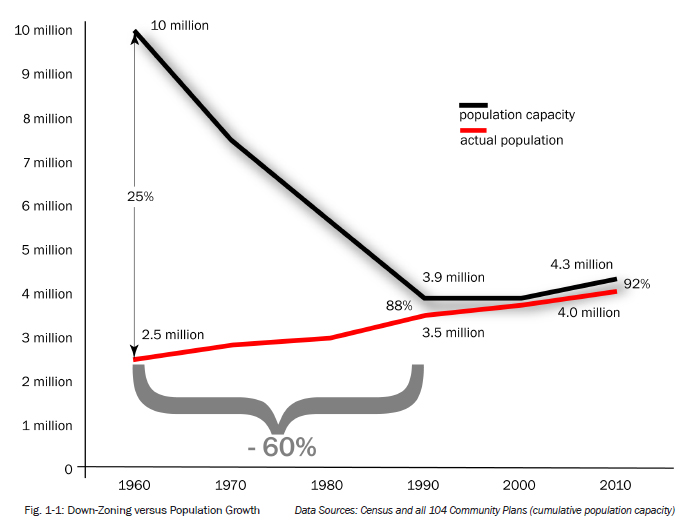
LA and its voters dramatically reduced the residential zoning capacity of the city over the 30-year period from 1960 to 1990, creating an artificial housing scarcity that has helped drive up housing prices for decades. Prop U was one contributing factor in that reduction. Chart from dissertation of UCLA PhD student Greg Morrow .
FUNDING AFFORDABLE HOUSING AT NO COST TO TAXPAYERS
As a city, we’ve been looking at a variety of ways to fund or mandate affordable housing. They’re are all problematic in their own ways, and I won’t get into the details here. What I will say is that, even if we could raise a billion dollars that would only be enough subsidize the construction of 10,000 affordable homes, at most. That amount of money isn’t even really on the table with any of the schemes currently under discussion. Even if it were, we’d still have to build them somewhere and opportunity sites are in short supply. Our prospects for building more affordable housing simply by spending more money are very, very poor.
What would make a repeal of Proposition U truly groundbreaking, and the idea that’s really at the heart of this proposal, is to pair it with some means of value capture—something that says: “Okay, Property Owner. By increasing development capacity on your land we’ve effectively handed you a check for thousands, perhaps millions of dollars. If you want us to sign that check, i.e. if you want to actually use that development capacity, you’ll need to return most of that added value in the form of on-site affordable housing, in-lieu payments for off-site construction or acquisition of affordable housing, streetscape and park investments, transit improvements, etc. Deal?” And they will take that deal. They win a little, we win a lot.
Value capture could take a number of forms. The Cornfield Arroyo Seco Specific Plan, in the Chinatown area of Los Angeles, requires specific thresholds of affordable housing to be provided in order to take full advantage of zoning capacity in the area. The proposed Exposition Corridor Transit Neighborhood Plan has similar requirements, with tiers based on not just affordable housing but investments in community amenities like open space, mobility centers, streetscape improvements, and childcare centers. Even a 10 percent affordability mandate provide us up to 100,000 new affordable homes over the next several decades. That’s $10 billion the city can spend on something else like schools, roads, trains, or sewer lines.
Another option would be to establish an Enhanced Infrastructure Finance District (EIFD) that covers every parcel affected by Proposition U. After it was established, property tax increment could be collected above a baseline growth rate, similar to how Community Redevelopment Agencies operated before they were abolished by Governor Brown in 2011. EIFDs were only recently developed as a streamlined, more impactful version of the IFDs which preceded them—and were little-used due to shortcomings in the design of the law.
The city (or voters) could choose to institute a combination of both of these strategies, and I’m sure that others are available. The advantage to the two discussed above is that they cost the city and its taxpayers exactly nothing. The affordable housing mandates would be funded by the added value delivered by increasing zoning capacity. Tax increment financing would “cost” the city in the sense that it would divert property taxes that would otherwise go to the general fund, but the increased property taxes would never have been realized without the repeal of Prop U, because all of these commercial corridors are not currently viable targets for development.
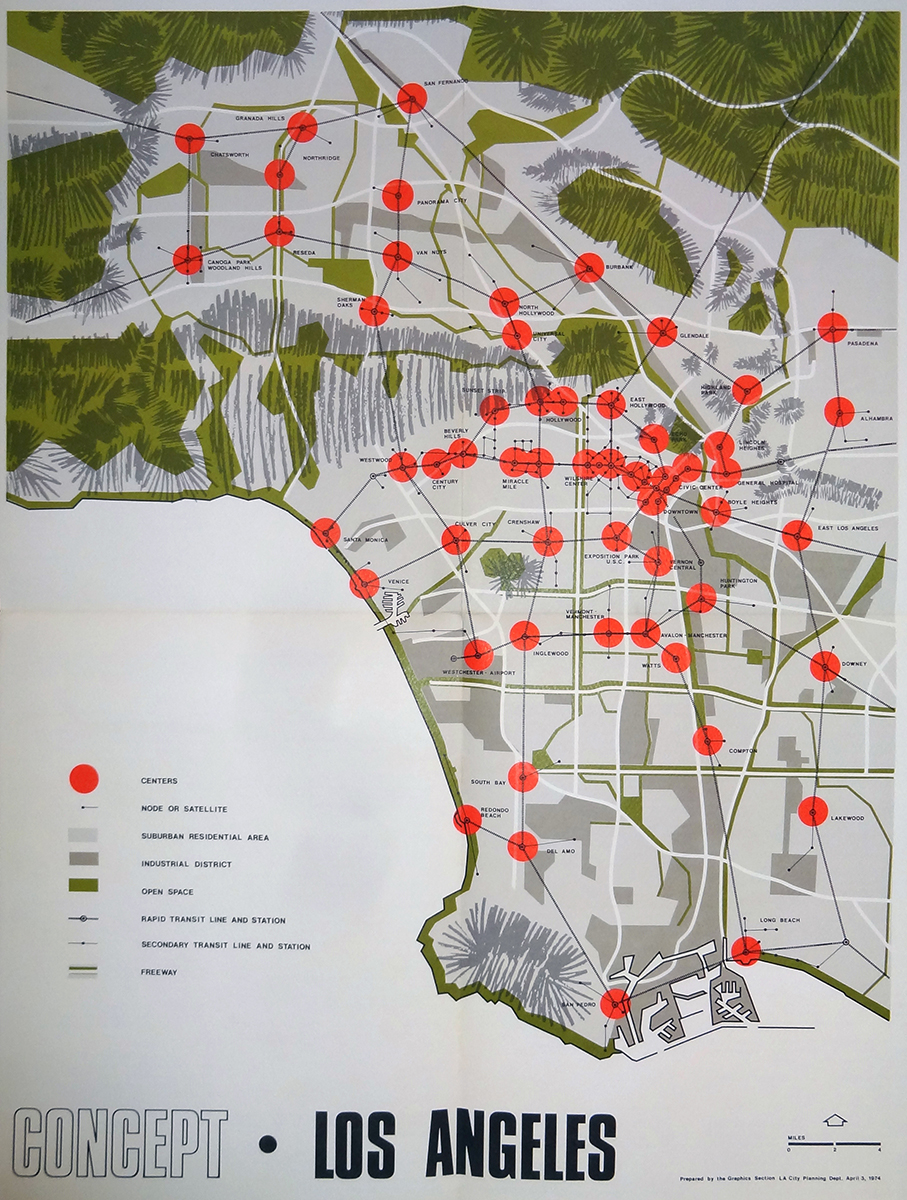
A concept plan for the polycentric growth of Los Angeles, approved in 1974. Proposition U made the development of many of these corridors illegal, making the plan impossible to implement. Image from Recode:LA .
CONCLUSION
We won’t solve our affordable housing crisis—nor our crises of environment or economic inequality—by burying our heads in the sand and hoping that if we can just preserve our built environment, everything else will stay the same too. Proposals like the Neighborhood Integrity Initiative are the equivalent of closing our eyes, sticking our fingers in our ears, and yelling at the top of our lungs. Throwing a fit won’t solve anything.
This is a proposal that would directly address our two greatest affordability challenges: a shortage of supply and a lack of funds to assist our neighbors most in need of help. It also has the added benefit of being good for the environment, good for transit use, good for parks and open space funding, and good for the economic productivity of our commercial corridors. It faces our problems head on and seeks to find win-win solutions rather than creating a zero-sum situation where the only way for some to win is for others to lose in equal measure.
There’s a lot of history behind Proposition U and a lot’s happened since it passed in 1986. This is an idea in its early stages and so I welcome constructive criticism and ideas for how to make it even more effective. Perhaps I’ve overstated the benefits. Perhaps I’ve understated them. Maybe there’s a fatal flaw, or maybe all it needs is a simple fix. I’d like to hear from you, whether for your commentary on this idea or your ideas for others. Instead of spending our time working to stop change from happening, let’s talk about how to make change work for as many people as possible. Those are the kind of conversations I want to be having.
*Methodology: I came to the estimate of 1 million homes starting with the 29,000 acres figure. With 70 percent of this land affected by Prop U, the amount of land affected was around 20,000 acres, or 871 million square feet. An FAR of 3.0 across all of these parcels would allow for about 2.6 billion square feet of development. Assuming that the average FAR for existing developments was 1.0—meaning that there was the equivalent of a single-story building built across the entire parcel, or a two-story building covering half of the parcel—at the time Prop U passed (which is generous), that’s a gap between what exists and what could be built at 3.0 FAR of about 1.75 billion FAR.
If we assume the average size of a new apartment or condo is 800 square feet (again, pretty generous), that’s enough development capacity to build about 2.2 million homes. Lots of those would never be built because some of the development capacity might be used for retail or office space, schools, parking garages, open space, etc. Some parcels also just might not be great locations for development, whether because of the parcel itself or the neighborhood its located in. Or maybe the owner just wants to keep it as it is. For the sake of being very conservative in my assumptions, and because round numbers are nice, I cut that 2.2 million by 60 percent to arrive at my rough 1 million homes number.

7 comments
Archived from the original site. Commenting is closed.
<p>The people that rolled back prop U were correct in doing so. There are no state laws in place that would insure low income mid income housing. To roll back Prop U without state laws in place to insure low and mid income housing is secure is stupid. We cannot depend on greedy mayors and politicians like Mayor Garcetti or Jan Perry to ring in on creating a solid infrastructure for low income or mid income housing.</p>
<p>I think you're mistaking what Prop U was. We didn't roll back Prop U, we instituted it and that's what reduced the amount of development capacity in LA, and ultimately contributed to its unaffordability.</p>
<p>I'm not proposing that we roll it back and let happen what may. I'm proposing that we roll it back in a way that pairs it with value capture, such as the inclusionary zoning or tax increment methods described in the blog. Those packages could be explicitly written into the initiative. I'm not a big fan of planning by the ballot box, but that's what we did in the first place with Prop U and this would be a way of undoing the damage and capturing the benefits for the community rather than purely for property owners.</p>
<p>Shane, great piece. One issue that I have with planning by ballot is that it applies such broad conditions on zoned areas that have very specific needs. The nuanced ability of zoning and specific plans to tailor development in areas is completely lost. It's like trying to do calligraphy with a bucket of paint (does that make sense?).</p>
<p>To be fair, an issue that I have with TIF is that if programming for the funds cannot keep up with the collection, you end up with a plump fund that becomes a target for representatives whenever a budget deficit occurs. That's what partly killed the CRA.</p>
<p>I think it can be successful, not only for these transit corridors, but for other areas of the city as well. If written well, this legislation could reserve the funds specifically for low income housing, infrastructure improvements, etc. A far better approach then blanket "redevelopment", which can end up serving luxury developers only.</p>
<p>Thanks Jonathan. I'm really not a fan of planning by ballot, but this is mainly about undoing previous planning by ballot, not adding new stuff on top of what's already been done. In an ideal world what I'd really like to see is a provision that allows the city to come up with the best value-capture method—the initiative would only repeal Prop U and mandate that SOME value-capture be instituted. The problem would be the inevitable lag between repeal and implementation of value capture, during which time property owners would be able to cash out. Or if the initiative said that none of the changes to FAR went into place until Council had decided on a value capture plan, it could take years to make any progress. Tough issue.</p>
<p>I think the inclusionary zoning would be more important than TIF, but you make a good point about not having any specific goals for the TIF fund. In the future I'll be writing about an idea for acquiring existing buildings for use as affordable housing (as opposed to focusing exclusively on new construction), and that might pose opportunities. For TIF, rather than just having a slush fund you could say "50% goes to acquisition/conversion of affordable properties, 20% to streetscapes, 10% to parks, and 20% to a more general fund." The TIF wouldn't necessarily be the entire increase in property tax collections on these parcels - it could just as easily be less so that a good chunk of the money still went to the City's general fund, which has genuine needs.</p>
<p>Good point about the lag between repeal and implementation. The increase in property assessment alone could generate funds for the city, but you can bet it won't go towards local improvement in the community that generated it.</p>
<p>I agree that allocating a portion to the General Fund is necessary. That way the each Council member doesn't feel like their constituents aren't beneficiaries of this program. As long as the TIFs are intelligently spread out across the City, you can bet on full Council support, without holdouts who would demand special exemptions from the legislation (a la the latest Mobility Plan amendments). </p>
<p>Inclusionary zoning is tricky. Too much of it, and developers howl that you're waging unholy war on their profits. I feel like it would have to be defined carefully, so that developers are still attracted to the area, but their density bonuses are held to low/very-low income units only. Maybe adding the option of zero/very low parking minimums? Makes sense in a transit corridor...</p>
<p>The city cut land owners value in 1986 by "slicing in half " the zoning potential that was previously in place. Now the proposal is to undo the "dezoning" and give back that value but only if the owners give most of it again back to the city? The city took at no compensation from landowners and will only "give back" if landowners are forced to give the bulk of the increased value right back to the city in the form of affordable housing. Unfair!</p>
<p>Very informative. Thank You!</p>