The people who live in coastal urban cities tend to be a pretty liberal bunch. We’re leading the country on minimum wage laws, paid sick leave, climate change mitigation, and a host of other important issues. We care deeply about equality of opportunity, and we’re willing to invest our time and money to advance that effort—even if the people we help don’t always look like us or come from the same neighborhood, state, or even country. I’m proud to count myself among their number.
New housing under construction. Photo by Stephen Rush .
And then we turn to housing. Maybe it’s just because we’re doing great on so many other fronts, but when I look at our inability to solve the housing crisis in places like San Francisco, New York, and Washington, D.C., I’m left feeling nothing but depression and hopelessness. It’s all the more frustrating because unaffordable housing might be the most important economic problem facing residents of liberal U.S. cities, and we’re perfectly, comprehensively, and unmistakably blowing it.
It’s not for lack of caring. We tend to say “the right things” when it comes to housing: we want to protect the environment; we scorn those who are motivated by greed; we want cities where everyone can afford a home and have access to good jobs; we want beautiful neighborhoods and spaces for residents to be healthy and active.
But when we look beyond the words to the results of our housing policy choices, we see almost nothing but incredible, unmitigated failure. According to a 2015 NYU Furman Center report, rents and housing prices have climbed much more rapidly than incomes in places like NY, SF, and LA, while incomes rose faster than (or at about the same pace as) rents in places like Dallas, Houston, and Atlanta. Even without referring to the data, we’re all painfully aware of how quickly places like D.C. and San Francisco have become out of reach for lower-income, working class, and even many middle class households. This has had a disparate impact on people of color, the elderly, and other disadvantaged or vulnerable populations—and it’s happening in exactly the places that claim to care most about supporting these individuals.
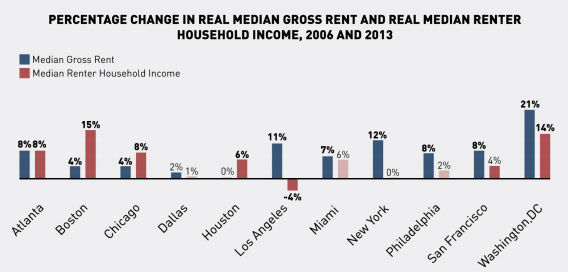
Rents rose faster than incomes in more liberal, coastal U.S. cities, while incomes rose faster than rents in more conservative cities such as Houston and Atlanta.
The causes of this failure are too numerous to ever fully enumerate in a single blog post, and, admittedly, some are out of the hands of cities themselves. But I don’t want to be too forgiving—state and federal policy plays a role, for example, but liberal U.S. cities are also typically located in liberal U.S. states, and federal policy applies equally to all, including the cities that have managed to remain affordable. There’s also the impact of global capitalism on a few world class cities, but it’s hard to feel genuine pity for places where foreign investors are willing to dump billions of dollars. Boo-hoo.
At it’s heart this is a problem of liberal governance and/or policy, and we need to face it head on. We can’t blame this on someone else. It’s our fault. There really is something inherently flawed in the way we’ve approached housing policy for the past several decades (at least), and I would argue that it comes down to a kind of cognitive dissonance on three key issues. In the following ways, our policies just don’t align with our stated ideology:
| Liberal Ideology | Liberal City Policy |
| We are pro-environment… | …but anti-growth and density |
| We are pro-immigration… | …but anti-migration |
| We are pro-equity… | …but anti-housing |
Quick disclaimer: “Liberals” are not a monolithic group, and these views won’t be representative of every individual who identifies as liberal. That said, in my experience they are fairly representative of many if not most liberal city residents that I have met and discussed housing policy with. Your mileage may vary—though I doubt it will by much.
With that disclaimer out of the way, I’d like to get into some detail on these three policy/ideology disconnects, and why they’re so harmful to the goal of broad-based affordability in our cities.
Pro-Environment, Anti-Density
Cities have a reputation as dirty places. All those people, buildings, cars, pavement—it’s an environmental tragedy, right? Many well-meaning liberals seem to have taken that view to heart, and for decades have wielded environmental protection laws to keep buildings small and relatively spread out, and populations as low as possible—all in the name of preserving the environment.
But on a per-person basis,dense urban centers absolutely crush the suburbs on environmental-friendliness. We have smaller homes, often with shared walls, floors, and/or ceilings, all of which helps to reduce heating and cooling costs. We’re more likely to walk, bike, or take transit when we get around. And we share may public amenities, like parks, libraries, and roads, with many more of our neighbors. The map below is just one example of the environmental impact of dense housing, showing just how stark the difference in household carbon emissions is between the dense boroughs of New York City and the suburban communities that surround it.
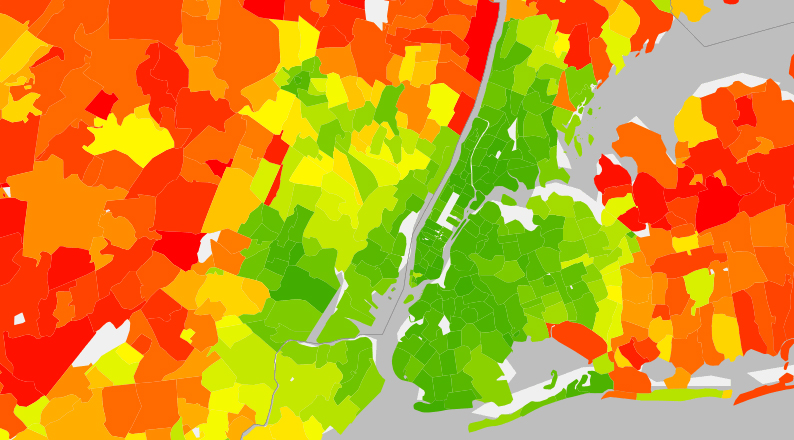
Average annual carbon emissions per household in the New York metro area. Dense, “dirty” New York City produces about half as many emissions, per household, as the “green” suburbs beyond. Image from Berkeley’s CoolClimate maps site .
The real problem here is that housing is never just a question of “build” or “don’t build.” It’s “build here” or “build somewhere else.”And if you live in a coastal U.S. city, somewhere else is usually way worse for the environment. People don’t disappear just because they can’t move to our cities; they move to the suburbs of Texas, where housing continues to be produced in abundance and, as a result, costs have stayed reasonably low.
Opposing development on behalf of the environment is essentially “greenwashing,” and we need to acknowledge it for the lie that it is. It’s an environmental crime, not a triumph. We don’t celebrate the environment by moving into its midst and paving it over.
In many metro areas, household emissions in the suburbs are roughly double those of city households. Another way of putting that: In terms of environmental impact, each time we turn away a person from our green, efficient cities, we’re effectively cloning them and shipping them off to the suburbs of Texas to do twice as much harm.
Pro-Immigration, Anti-Migration
Sticking with the “global thinking” theme, consider the different approaches that liberals take to immigration into our country versus migration into our cities.
On the one hand we offer our full-throated support for liberalizing federal immigration laws and creating paths to citizenship for undocumented workers. We do so because we recognize that immigrants add value to our country, that at our core we are a country of immigrants and this is a source of strength and resilience, and that most immigrants are simply moving here in search of greater opportunity, which we can all appreciate.
On the other hand, when a person wants to move to any of our thriving coastal cities in search of greater opportunity—whether they’re citizens or not, rich or poor, immigrant or migrant—well sorry, pal, but we’re all full up. We understand that the United States is a symbol of hope and aspiration for people around the world, and we welcome immigrants to our shores with open arms, but only so far as the borders of our city. If they want past this border, they’re gonna have to earn enough to displace a poor person, because we’re damned well not building any new housing for them to live in.
The timing is ironic, in a way. As we look with scorn upon Donald Trump and his plan to build an impenetrable wall between the U.S. and Mexico, we’ve erected a wall around our cities—no less effective for its invisibility—to protect existing residents from the invasion of “outsiders.” Our country is open, but our cities are full.
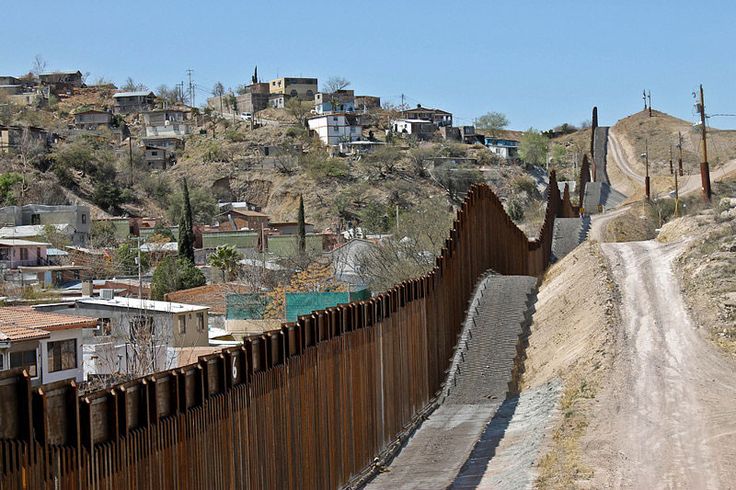
Wrong for the U.S.-Mexico border, but okay for cities. We shouldn’t complain about people coming to our country with different cultures and values, but it’s okay in our neighborhoods. Photo from World Tribune .
To be clear, none of this is intended to equate the challenges faced by new residents (many of whom contribute to gentrification, if unwittingly and unwillingly) to those of poor immigrants or families at risk of displacement in coastal U.S. cities. The issue is that we’re pitting new residents against old ones when 90% of the problem could be resolved by simply building enough new housing to accommodate all comers.
We’ve allowed mostly wealthy, mostly white homeowners to dictate our future and leave us fighting over the scraps of the housing market, even as their homes each increase in value by tens or hundreds of thousands of dollars each year. We debate how to raise a few billion dollars for affordable housing on the backs of new residents—enough to build a couple thousand low income homes, maybe—while the value of single-family homes in Los Angeles County alone have increased by $500 billion over the past 25 years.
We’ve been convinced that the built environment—not the people who inhabit it—is what makes a community; that neighborhood integrity is about the character of buildings, not that of our neighbors. This is not a liberal ideal. Rather than turn these people away, we need to recognize that new residents are just people like us, looking for a better life and new opportunities. Adding enough new homes so that they can find somewhere to live is a very small ask. We have to stop acting as though the subjective value of “neighborhood character” (which has always been and will always be a moving target) is of equal importance to the hard economic realities of unaffordable housing, inequity of opportunity, and homelessness. The latter issues are clearly of greater importance, and if you’re willing to sacrifice them at the altar of “neighborhood character” then you need to take a moment and seriously question your commitment to progressive, inclusive values.
Pro-Equity, Anti-Housing
Some of you may remember the hub-bub in 2014 over Thomas Piketty’s book, “Capital in the Twenty-First Century,” which examined wealth inequality in Europe and the U.S. over the past few centuries. It was an absolute blockbuster (for an economics book), showing that the share of income coming from returns on capital was increasing over time, which was bad news for those of us who don’t earn most of our money on stocks, property, or other capital investments (i.e., most of us). It was a rallying cry for liberals around the developed world.
What you may not have heard about was the critique of Piketty’s work by a 26-year-old MIT graduate student named Matthew Rognlie, who basically said that the issue isn’t so much capital in a general sense, but housing in particular. In other words, the growing value of housing relative to other assets (as well as labor income) is responsible for almost 100 percent of increasing wealth inequality in the Western world. The below chart shows the share of income from capital, with and without housing included.
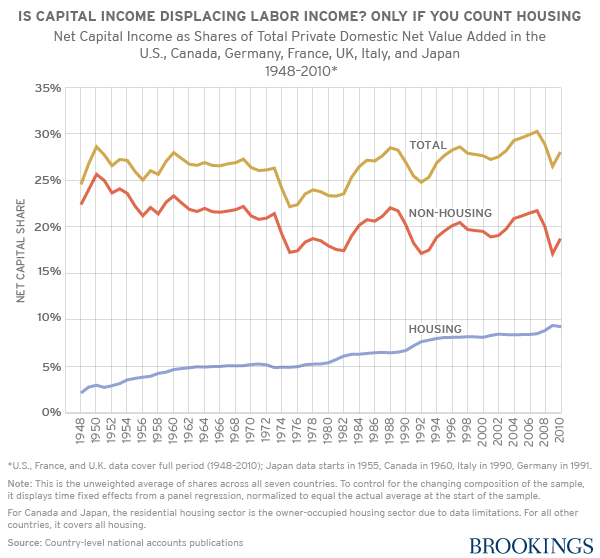
When you look at capital income as a share of all income, the gains of the past 40 years essentially disappear when you remove housing from the equation. In other words, almost 100 percent of the increase in wealth in equality can be attributed to housing. Chart from Brookings .
The reason housing is growing as a share of capital income is because housing has become so much more expensive over the last few decades, especially in coastal U.S. cities. Home and property owners are raking it in. We have a system in which relatively affluent residents in our cities each own a hugely valuable capital asset—their land and the home that it sits upon—which is appreciating at nearly double-digit rates each year, while everyone else just gets to pay more for rent, forever. So long as housing production and vacancies stay low, that trend will continue. There is a wealth inequality crisis afoot, and liberal cities are its greatest perpetrator. San Francisco is the vanguard of this movement: the most liberal city in the U.S., and one in which it is nearly impossible to afford unless you are very rich (enough to afford $3,000/month rents or $1 million homes) or very poor (and therefore eligible for a small number of subsidized housing units). It’s a “poor door” masquerading as a city, and the rest of us are on the same trajectory.
The outcomes of our housing policies fly in the face of our ideology. For those in need, we support providing supplementary income, health insurance, educational support, and other social welfare programs—and then we erase their value by making our cities too expensive for those most in need of these benefits. Either low income residents can’t afford to live in the city at all, or the cost of housing is so high that the value of the benefits is exceeded by the added cost of rent.
By doing essentially nothing but letting things happen, conservative America is kicking our ass at providing opportunities for low income and working classes to build wealth and get ahead. Cities like Dallas, Phoenix, and Atlanta have managed to stay affordable by simply allowing housing to continue to be built as their populations grow, and the result is that people keep moving there. As someone in his early 30s who is wondering how I’ll ever be able to buy a home and build wealth for myself, I see the appeal. And that sucks, because I have no interest in living in any of those places. There will always be a premium to be paid for living in a great city, but the premium in our coastal cities is far beyond reason.
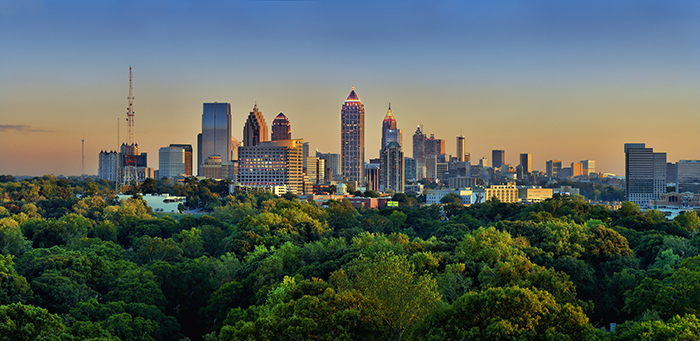
Atlanta skyline. A city with less economic opportunity than many coastal cities, but where owning a home or paying an affordable rent is still within reach to moderate-income households.
For those earning in the $30,000-$60,000/year range, owning a home in a place like Los Angeles or New York is completely out of the question. All these households have to look forward to is to either find a rent controlled unit and hold onto it until they die, or forever face the uncertainty of a rental market where rates can increase 2, 3, even 5 times faster than their incomes. And good luck saving any money for retirement in the mean time. These are not real options; they’re an ultimatum.
So, this is the paradise we’ve built across the liberal cities of the United States. Are we proud? I’m not. We’ve walled off our cities to those of lesser and greater means, making pathetic, often subtly racist or classist arguments about “character” and “culture.” We’ve destroyed any possible opportunity for low income and working class households to build wealth in the same way as their affluent neighbors, or displaced the poor households so that they’re no longer neighbors at all. We’ve enabled the sprawling environmental destruction of cities like Phoenix in Las Vegas by failing to provide alternative, more desirable sites for new housing. We have failed, abjectly—and we’re too blinded by our own biases to change the course.
But hey, at least our hearts are in the right place.

17 comments
Archived from the original site. Commenting is closed.
<p>Liberals also often value local control, such as neighborhood councils because city councilmembers are too prone to influence from "monied interests". Yet they insist on global action for things like climate change, CFC bans, etc. - which of course make sense because they are global. But someone living in the Inland Empire driving 100 miles roundtrip to work has more impact on the environment than a dozen people in China moving from their rural village to a provincial capital. It's like they've forgotten about "think globally, act locally". </p>
<p>Although in all of these senses, it shows that liberalism is more about statism above all else. Wielding state control on behalf of those whom liberals feel are oppressed, whether for legitimate purposes like ensuring that gay people are treated equally at establishments, or for illegitimate reasons like protecting property values and "character" of neighborhoods (never mind that, in an upzoning, land values should go up because the potential development on a parcel just increased).</p>
<p>I actually had a point about "think globally, act locally," but couldn't quite get it to fit in the article. I think it's true though—we could do with a lot more global thinking when it comes to housing.</p>
<p>This is eloquently dumb, if you don't mind my saying so. Near the end you sneak in the counterfactual which sinks your argument like a torpedo into a paper boat:</p>
<p>"... Dallas, Phoenix, and Atlanta have managed to stay affordable by simply allowing housing to continue to be built as their populations grow, and the result is that people keep moving there. ... I have no interest in living in any of those places. There will always be a premium to be paid for living in a great city"</p>
<p>Well...yeah. Obviously. AFAIK those cities are able to sprawl out over vast plains of nothingness unlike NYC & SF, both of which are semi-constrained by geography which is part of the reason for the original settlement, a clear correlate to their ongoing appeal by incubating demand and thus raising desirability, and now the reason for their stratospheric land rates.</p>
<p>And it seems what you're proposing is that everyone just says "yeah cool" when you propose destroying century-old pieces of local history to create a row of 100-storey skyscrapers so everyone can live in the cool place. But then it obviously wouldn't BE the cool place any more and people wouldn't want to live there as much. And this is before you factor in any of the practicalities of infrastructure.</p>
<p>Which mean this article boils down to: "I'm 33 and I want to live in SF but I can't afford it which is unfair!". Yep, life's unfair. Move somewhere new and cool. Portland. Austin. Or live in the burbs and commute. Or rent a tiny place in the city you wanna be in for a couple of years, until you're not bothered about the nightlife so much and you're earning more money and your options change.</p>
<p>I do mind you saying so, for what it's worth. But thanks for calling me eloquent.</p>
<p>Anyway, the geography argument is bullshit. Is it more costly to build vertical than horizontal? Absolutely. But it's not double or triple the cost (or more), and that's what we're paying in coastal U.S. cities. We're paying that much because land is scarce and development rights are even scarcer, and that artificial scarcity is driving up prices. Then you need to pay construction workers more to work in your city, which drives up prices even further, and there you have the destructive cycle of positive feedback.</p>
<p>I'm not interested in your straw man, putting words in my mouth that indicate I support building everywhere under all circumstances. We don't have to tear down historic buildings, by and large, to match supply with demand. Most buildings are not historic and not really worthy of preservation in their own right—take nearly every single family home in America, for example. We're talking about allowing cities to grow by 1, 2, 3 percent a year. That's not a dramatic rate of change, but it's far more than we're allowing in any large coastal U.S. city. The idea that you have to completely demolish a neighborhood to fit new residents in is a lie you've convinced yourself of so that you don't have to actually address the issue. So feel free to do that, but have the honesty to do so straightforwardly. This isn't even about people who want to move to cool cities as much as it's about allowing people who already live there to continue doing so even as their neighborhoods become more popular (and, with no new housing stock, more expensive).</p>
<p>Your last sentence is either myopic or extremely callous, because many people don't have those options. They just want to stay roughly where they're at, not face the prospect of their rents doubling over a single decade, and ideally purchase their home at some point so that they can build some wealth. Liberal U.S. cities like SF and Los Angeles COULD do that, but maybe too many of them have bought into the idea that we're full up. The massive range of densities between these cities reveals the lie of that argument; there's always more space, we just need to make it. Your attitude is essentially to accept that this is inevitable and encourage those with the resources and mobility to spread the same impacts to cities that are earlier in the cycle. I reject that.</p>
<p>Apologies for the insult.</p>
<p>You say the geography argument is bullshit but then IMMEDIATELY concede "We're paying that much because land is scarce".</p>
<p>I said that it SEEMS you're okaying always prioritising densifying housing over 'neighbourhood character', because you said anyone who thinks unaffordable housing, inequity of opportunity, and homelessness should ever come second to neighbourhood character isn't progressive or exclusive (i.e. liberal). I'm not putting words into your mouth, you're putting words into mine. You haven't shown any semblance of balance, hence my extreme example. And honestly, if after some bristling back & forth, your more considered point is that city planners should do more to allow 1-3% growth, I don't think anyone would disagree with you, with most of us in SF having already read countless articles expounding the multitude of historical and bureaucratic deadlocks that are stymieing progress here and that many people are dedicating their lives to overcoming.</p>
<p>Since your core point seems to have shifted, I think we agree on some issues. I believe poor/self-interested long-term housing planning has accelerated the rise of living cost in geographically-restricted cities. Regional & city planners need to ensure building rules are recalibrated so as to allow organic growth and densification while maximally preserving the environment and to neighbourhood character / city values. But those planners are not obligated to meet the full demand that such places unavoidably create. To whit: the concept of 'fullness' as regards population size & density vs city character & amenities is a genuine one. SF LA & NYC are not "full" and urgently need to increase their housing stock. However, they are QUITE full, and not capable of neverending growth: I agree that there's more space, I disagree that there's "always more space".</p>
<p>We in 'fly-over country' welcome coastal liberalism. It's pushed my employer and several new friends my way instead of me having to go to them. Thanks!</p>
<p>/cries</p>
<p>We in D.C. are experiencing this city wide. The Zoning Commission reduced development rights for 35,000 row houses last year in order to stop conversions of these "single family" homes to small apartment houses. Now they are in the process of carving out 150 more row houses for similar treatment in an area that is overwhelmingly made up of larger apartment houses already. Advocates opposed to downzoning were always outnumbered but we thought the commission might value property rights and moderate growth potential over NIMBY sentiment. We were wrong. Those interested in reading more can go to the Neighbors Against Downzoning website.</p>
<p>Thank you for calling out this behavior and mindset for what it is ... cognitive dissonance at best, selfish hypocrisy at worst. Great post.</p>
<p>You absolutely nailed it, and I say that as a left-leaning person in Greater Los Angeles. These "progressive" NIMBYs need to get their heads screwed on straight, embrace walkable urbanism, and stop using "the environment" as an excuse to block projects that challenge our car-dependent status quo. I really think that if you understand progressive values correctly, we should be giving a massive green light to building tons of housing in existing cities. It's the greenest, most inclusive possible way to house people and make sure that people aren't getting crushed by high housing costs. </p>
<p>Where progressives might do things differently than conservatives is to pass something like an inclusionary housing requirement or incentive so that some of the new units are below market rate, but that should coincide with lots of market rate housing as well. If we're more relcuctant to allow sprawl as progressives, then we have to be more welcoming to infill development in existing cities. Otherwise it's just "I've got mine, eff everyone else."</p>
<p>Thanks for this article. We've replaced racial segregation in this country with income segregation (a distinction with little difference), and the only point where I'll disagree with you is that I think this has been a conscious decision for many "progressives". It's my suspicion that for every genuine (misguided) progressive, there are 3 or 4 who proclaim such ideals as a means of status signaling - which explains an awful lot. I extend my invitation to come on over to the dark side ... we have cake!</p>
<p>I will point out that your rent vs. income chart does not match the text - I am not sure which is incorrect, but hope that the chart is your original and you simply got a few things turned around.</p>
<p>It's refreshing to see liberal writers finally starting to see the failure of liberal urban housing policy that right leaning economists have been writing about over the last three decades. A very welcoming article, I hope more liberal policy makers read articles like this and act on them.</p>
<p>You seem to have omitted the power of corruption - Portland, OR is not exactly a coastal city but it's a main port (or was before gentrification). In the past couple decades the 'working waterfront' was allowed to become glass and steel luxury high-rises, with the proviso that affordable housing be 10% of the build. Sounds good on paper - 20 years later, NO affordable units built! It's a total scandal, and Portland has a liberal council... but money continues to wield incredible power. Portland at least has an urban growth boundary (regularly decried by conservatives and big business) - but it's now pricing itself right into the same class as NYC and SF - destroying the very character that brings so many to settle there!<br/>But not to worry, coastal cities - in about 20 years you'll be underwater more often than not - property values will soon be low enough...</p>
<p>I'm wary of anyone who blames poor outcomes primarily on corruption. My experience with most people in government is that they are trying to do what's right, and by and large it's the policy, not the individuals, that drives outcomes. I don't know enough about Portland's regulatory framework or circumstances to say what's caused no affordable housing to be built, though I'd bet there's more to the story.</p>
<p>All that aside, this isn't really about subsidized affordable housing specifically. If Portland were building enough market-rate housing, costs for existing units—homes that have been around for 30-50 or more years—wouldn't be climbing in prices so quickly and the need for subsidized affordable housing would be reduced. Subsidized affordable housing and market-rate housing are really completely different things, and it's the supply (or lack thereof) of the latter that really has the most impact on affordability at a city/metro/regional level. Affordable housing is important but if you don't get the supply right it doesn't do much good to keep pumping more money into a system that requires larger and larger subsidies for every unit built.</p>
<p>Do you have solutions?</p>
<p>Solutions: Don't allow foreign investors, especially Chinese, to buy a house that is in the top 40% of house prices. They are buying the most expensive homes, all-cash, and making a few real estate agents rich. Also, don't let them pay all-cash in the first place, if they don't live in the country. Third, don't let kids who are not 2nd generation Americans accept "gift money" from parents, as that's just a way of parents buying the house instead of the kid.</p>
<p>Foreign investors invest in the best cities in the most expensive locations. Their kids fake that they don't have money. The Americans and middle-class that are affluent sell to them, then move to more Conservative cities. That drives the price up for Conservative cities. Eventually, it will affect all Americans, as the class divide is accelerated by foreign investment. For those investors: no biggie, it's still more equal and free than their own country, and we have liberal activists fighting to be more accepting of other nationalities. It's obvious that most of the internationals in this country have money, thus that's why they were able to move across the country. The middle class "stays at home." They are not as poor as they pretend to be. They vote liberal because they want to feel comfortable in this country, and hide their wealth. They are conservative internationals, and playing the ultimate checkmate on our country.</p>
<p>I think that blaming "foreigners" for our problems is, in general, a dangerous road to take. While foreign investment plays some role in housing affordability challenges, there's not much evidence that it's a major contributor. And besides which, I don't think we need to target "outsiders" to fix the problem: there are lots of people here at home that own multiple properties that take housing off the market and drive up prices for everyone else. We should just tax unoccupied housing, regardless of national origin, so that any homes purchased are actually occupied rather than sitting empty most or all of the time—or if they do sit empty, the owners pay a hefty fine that discourages them but makes the city a lot of money to fund essential services (or affordable housing) if they still want to hold the properties as vacation homes. In either case, the city/community wins.</p>
<p>Your suggestion that we prevent the children of immigrants from receiving gifts is especially troublesome—as though immigrants and their children don't already have enough to overcome in many cases. Rather than treating this as a zero sum, us-vs-them issue, we should identify that root causes and try to fix the system such that this kind of activity is discouraged regardless of national origin. First and foremost this comes down to a national policy orientation in which we celebrate homeownership and promote housing as an investment vehicle, which is perfectly contrary to promoting broad-based, long-term housing affordability. Singling out certain groups of people as the cause of our problems is not only un-American (in terms of our highest ideals if not our actual history), it also prevents us from addressing the root causes because it lets us pretend that the problem is fixed by scapegoating someone else.</p>