In city planning there’s a popular phrase: “Stop sprawl, preserve existing neighborhoods, maintain affordability. Pick two.” It’s a poignant observation of the relationship between these three goals and the tension between them — how in a place like Houston, homes remain affordable and neighborhoods maintain their character as long as sprawl can continue unabated; or how London can enforce an urban growth boundary to prevent sprawl, but without significant new construction in older neighborhoods its housing prices have reached astronomical heights.
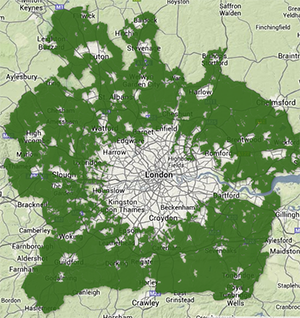
The London green belt, one of the world’s most famous. Image from cobhamgreenbelt.org.uk .
For the uninitiated, green belts — sometimes known as urban growth boundaries — are undeveloped regions that surround many cities and limit sprawl while preserving green space. And as the Guardian notes, “[a]lmost anyone you talk to on the subject agrees that the green belt is one of the great successes of planning, anywhere in the world.” They encourage more efficient use of developed land, keep nature close to home for city residents, and prevent the interminable sprawl of low-density development that characterizes many U.S. metro areas, especially in the Southwest.
But green belts have a dark side. London, home to perhaps the best-known green belt in the world, also has the dubious distinction of being the most expensive rental market in the world, recently overtaking Hong Kong as the city with the highest residential and commercial rents****. As with any other artificial limits on the supply of new housing in an ever-growing city, green belts are at least partially to blame for London’s affordability crisis. Some have also claimed that Portland’s rapid increase in housing prices is partly a result of their urban growth boundary. The question is, then, how can we maintain access to green space and limit sprawl, while still allowing cities to grow naturally, in sync with demand?
One potential answer is to discard the idea of green “belts” and to replace them with “webs” — green space spread throughout the city that connects rather than contains it.
The problem with green belts, aside from the supply restrictions they impose on new housing, is that they’re not particularly accessible to a large number of residents. Using London as an example once more, it’s clear that residents of Central London are too distant from the green belt to consider it valuable as an open space resource, and ideally they would have other parkland at a more accessible distance. Green belts are undoubtedly wonderful resources for those that live within a mile or two of them — those that can afford to, that is — but inner city residents don’t typically get to enjoy them, and for those that live beyond the green belt they simply add more time to each day’s commute. It may be prettier than the average commute, but there’s very little “green” about it. It would be much better to have them living nearer their work, in denser, more energy-efficient housing.
For a great example of what a green web could look like, **Amigos de los Rios**have a proposal for us in, of all places, Los Angeles County. The project is called the Emerald Necklace Vision Plan, named in honor of Frederick Law Olmsted, Sr., who designed New York’s Central Park and **Boston’s Emerald Necklace**park system, and his son Frederick Jr., who helped create a vision for LA parks in 1930 that was, unfortunately, never realized. The Emerald Necklace Vision Plan is pictured in part below:
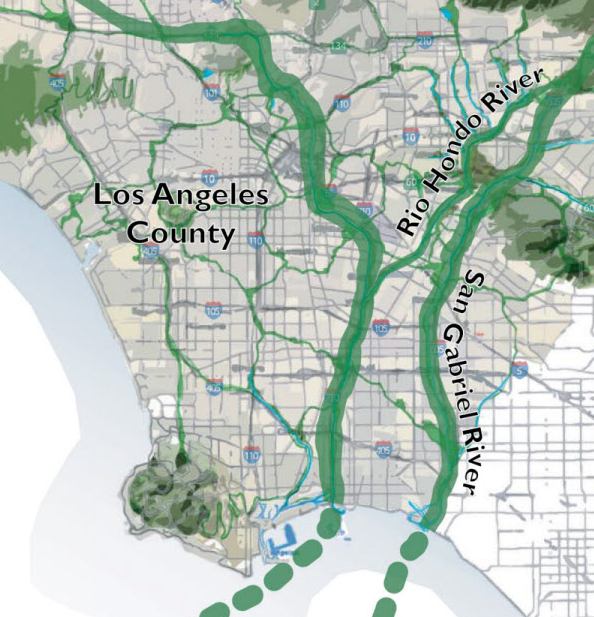
In the Emerald Necklace Vision Plan, green space connects residents throughout Los Angeles. Image from Amigos de los Rios .
Taking advantage of several existing LA initiatives, including the Army Corps of Engineers’ billion-dollar LA River revitalization program, the Greenway 2020 Plan, and plans for a 38-acre park on top of the 101 freeway, the project would create a network of green space throughout the region and put parks within easy reach of millions of LA County residents. Just as importantly, it would provide safe, convenient routes for walking and bicycling throughout the city, and create value to promote the development of more homes and businesses near the trails, rather than in the suburban/exurban Orange, San Bernardino, and Riverside Counties.
LA is surrounded by water, mountains, and other cities, so it lacks a green belt, but the appeal of a “green web” is that it could have value in nearly any context. For Los Angeles, the number of properties that would need to be destroyed could be replaced 20 times over with new (re)development near green space — including affordable housing, which could be funded by (e.g.) a partial tax-increment on park-adjacent land. We’d have thousands of new, energy-efficient units near world-class active transportation corridors, and if there’s one thing LA needs right now, it’s more housing.
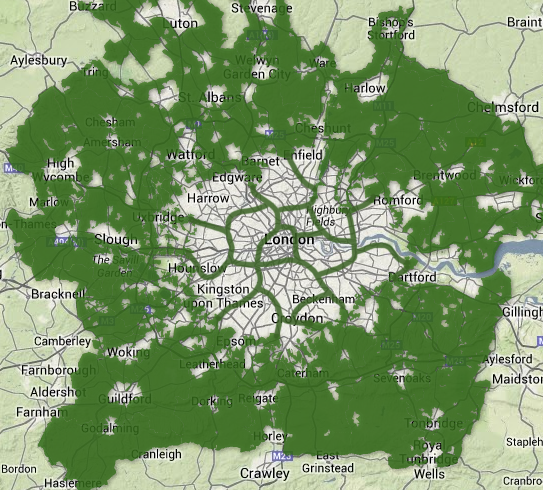
Rough example of a London green web, in which much of the outside green space could be opened up for development.
Cities like London and Portland have it easier, because they can build out their network by expanding development beyond their growth boundaries and leaving stretches of undeveloped space to create “strands” within the green web. The growth of the web into the existing urban fabric could then be funded by proceeds from selling off land and development rights in the green belt. The large majority of the green belt could be maintained while bringing much more accessible green space to residents nearer the core of their cities.
In cities with or without green belts, there are opportunities to use green webs to create value throughout a region, and unlike isolated park and infrastructure projects, they can cast a wide enough net to limit the impact of gentrification in individual neighborhoods. They can add desperately-needed housing in some of the least affordable regions, increasing density in some locations and spurring new investment in historically disinvested neighborhoods. They can provide residents with a wealth of green space that doubles as a transportation resource, and is, most importantly, actually accessible. Best of all, they can build off of existing plans, the Hollywood cap park being an excellent example.
[Feel free to comment if you can spot any weaknesses or opportunities for improvement, because this is very much an idea in progress. For example, how would this be funded in lieu of a tax-increment type funding source? Since full expansion would require condemnation of many homes and businesses, how do you go through that process in a fair, equitable manner (or is contrary to the whole idea of eminent domain)? If this sounds totally politically or physically impossible, can you suggest what might make it more plausible? Any ideas for names that are better than “green web”? Thanks!]
Related link:****http://seattletimes.com/html/opinion/2024979208_markwinstonopedbeesxml.html

7 comments
Archived from the original site. Commenting is closed.
Boston's emerald necklace shows some of the potential as well as the flaws. Most of the emerald necklace has been turned into disgraceful highway, with crumbling and disconnected paths for pedestrians that are clearly unimportant to the managing agency in question (namely, the incompetent and irresponsible DCR). Your green web would, I imagine, rapidly suffer the same fate.<br /><br />Furthermore, the emerald necklace is dangerous at night, when illicit or unsavory activities take place in numerous hiding spaces. Olmsted was a gifted park designer but he was not a great urban planner. Unfortunately many people forget that green space can have a very dark side when improperly handled in an urban setting.<br /><br />I do not think cities like London would be improved by tearing the urban fabric apart like this.<br /><br />Also, green belts serve another purpose: substantial natural land together in a coherent whole is much different from manicured city park. One cannot replace the other.<br /><br />Having land remain in a natural state, or at least a farmland state, immediately outside the city borders is also more traditional than urban sprawl -- green web or not.<br />
<p>Matthew,</p>
<p>You raise some good points, however, as someone living in a city with a considerable greenbelt as well as some aspects of the green "web" I can tell you that these spaces do not increase overall crime. Of course, a dimly-lit park can be a good hideout for criminals and other unsavoury characters but this seems to be no more than a reflect of the baseline crime level of the surrounding neighborhoods.</p>
<p>Nor is it necessarily the case that green webs' linear parks must be poorly maintained. Again, this is more a reflection of the larger context than a quality specific to the parkland. A city with poorly-maintained infrastructure will have poorly-maintained parks. A city with well-managed infrastructure can have well-managed parks.</p>
<p>One thing I do agree with is that it cannot be a net zero equation. The existing of a green web or linear parks in no way replaces the need for a green belt, growth boundary, let alone actual contiguous wilderness spaces and national parks.</p>
<p>One should complement the other. In an ideal world they would create a hierarchy of mutually-accessible green spaces which not only creates enormous recreational potential (e.g. imagine biking from an urban park to the mountains or the sea RE the LA plan), but also helps to satisfy the requirement of creating green or even wilderness corridors.</p>
To your first point, many cities already have challenges paying for regular park upkeep, so it's a fair enough argument though far from inevitable. Just because parks haven't been funded well enough in the past to be kept up well doesn't mean that's the way things will always work.<br /><br />As to the danger and poor urban planning, again, these are things that can certainly be mitigated. I'm with you on the Jacobs school of thought though, that a bad park is worse than no park at all. The two above points aren't really arguments against it though, they're just arguments for good planning and good management -- not easy, but far from impossible.<br /><br />I didn't get into the point about maintaining substantial natural land, but I agree that that has value. However, I don't see the reason it has to be a cohesive ring around a city. You could preserve areas of thousands and thousands of acres -- many square miles -- at various locations throughout the existing green web. Within those areas you would have a complete nature experience and nothing would have to be manicured. I didn't really have a percent in mind, but I was thinking of developing at most 50 percent of the green belt, leaving most of it as is, and a small amount retained for use as linear parks ("webs").<br /><br />Not sure what you mean with your last point, but if the choices are to provide more dense housing in the city or to maintain a green belt and force that development out into the suburbs and exurbs -- and to be clear, those ARE the choices -- then I'm all for the former. Just because you or I may not see the impact of pushing development out to the exurban fringe doesn't mean the environmental (and economic, and health, and...) impacts aren't real.
I would argue two things. One, urban growth boundaries aren't the problem, the zoning codes and NIMBYs inside them are the issue. Portland still sprawls inside the UGB. So should we blame the UGB for that? The "preferences"? <br /><br />Additionally, this is an issue not just of being connected to nature, but rather of biodiversity. You can't preserve migration patterns for birds or even medium sized animals with just fingers rather than complete habitats. That is a large problem with sprawl, the broken habitat breaks up the natural environment, which isn't good for ghgs or the other inhabitants of this planet that are not human.
It might be worth investigating how things are in Dallas/Fort Worth with the Trinity River (in large parts of the central city, there's a mile-wide green belt where the river floods - in Fort Worth they've actually put bike trails through this green belt, and there's a few stretches in Dallas as well), and in Houston with the various bayous (which seem to have bike trails as well). I suspect that in these cases, it's flooding that led to the network being preserved (though I don't know why it had such a different effect in these cities than in Los Angeles), but it's still striking that the pattern you're talking about appears to be most well-developed in Texas.
I agree that zoning codes and NIMBYs are the main issue, but that doesn't mean that other things don't contribute to the problem. Even if you densified as much as physically possible, you run up against the fact that higher density development is more expensive per square foot -- though, to be clear, few regions are actually anywhere near the level of development where this is a huge problem.<br /><br />Your point about preserving biodiversity and complete habitats is well taken, and that's why I want to make it clear that I'm not saying we should turn ALL green space into green webs/paths, just a goodly share of it. As with the case of London, you could easily take half of the green belt and make 90% of it new development, roads, and infrastructure and the other 10% green pathways/parks, then leave the other half of the green belt as it is and you'd still have massive preserved habitats of literally thousands of acres. I think it's more of a technical issue than anything, easily overcome.
<p>I don't think we should do away with greenbelts at all in the name of bringing the green spaces closer to the people at the inner core of the city. In fact, green belts should be emphasised more at a time where urban sprawl is increasing, going in tandem with projections that most of the population will be urbanized by 2050. </p>
<p>Greenbelts will provide areas where air circulation is maintained in it natural order, and areas where there is minimal vegetation disturbance. Most vegetation within the city centre, although good in greening the city among other benefits, suffers the need of constant maintenance due to the pollution and human activity in those areas. At a time finances are getting tighter, having a green space that uses minimal human care while providing optimal natural benefits should be stressed while also searching for ways to expand the green web further inwards and outwards. Samuel</p>