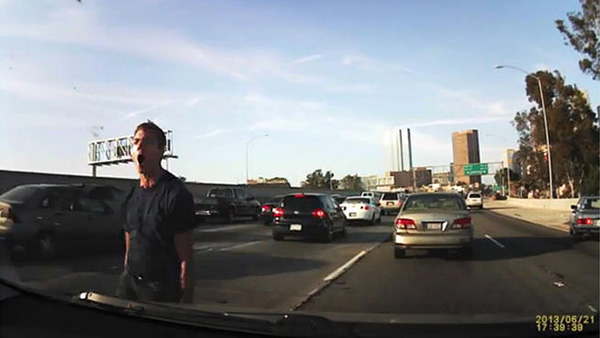
Still shot from
of a man seriously raging on an LA freeway.
One of my fellow classmates moved to Los Angeles recently, and this was how she summarized her experience thus far: “People here are all so laid back, but as soon as they get in their cars they go insane!” She’s from New York, so I’m sure “laid back” is relative, but she’s right: people change when they get in their cars here, becoming more aggressive, easily (and visibly) frustrated, and meaner. Highway congestion tends to get the brunt of the blame for this, and that’s understandable, given that
.
Often overlooked, however, are the local and arterial streets in the region, which seem to be designed with the specific intent of frustrating drivers, pedestrians, and bicyclists alike. They often encourage dangerous, aggressive behavior and breed animosity between those in vehicles and those on foot. I’ve been in LA a month; here’s what I’ve seen so far.
Left-turn signals
This was by far the most surprising difference between LA and other cities I’ve been to. In most cities, if left turns are allowed at major intersections they have left-turn arrows that turn green for a few seconds, then they turn red and the forward-traveling traffic is given the green. Here, when you need to take a left turn at an intersection, you are usually given a turn lane, but no light to accompany it. You wait until all the traffic in the opposing lanes clears out, then you go. Or, if it never clears, as is the case at hundreds if not thousands of intersections across the city, you wait until the light turns red and then you go, as do one or two people behind you. If you
don’t
run the red light, expect to be honked at vigorously and angrily, because obeying the traffic signals while making a left turn in LA is
just not done
.
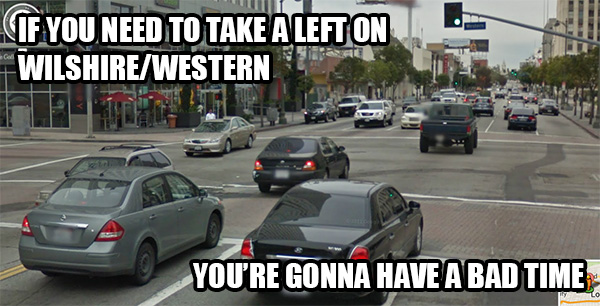
I’m kind of making light of the situation here, but make no mistake, this is an incredible dereliction of duty on the part of city traffic engineers (or whoever is ultimately responsible). Not only does it make drivers needlessly anxious and angry with one another, it’s also ridiculously dangerous. The city has given drivers literally no alternative but to blatantly ignore traffic laws, at great peril to themselves, other drivers, and pedestrians. I’ve already seen several
very
near misses as a result of this—it’s just a matter of time before someone really slips up and gets themselves or someone else killed.
I assume the reason this is so common is throughput: several lanes of traffic can travel at once with a catch-all green light, rather than giving an extra signal turn to a single lane of left-turning drivers. It probably does have some positive effect on traffic. (At least, if you ignore delays caused by collisions with other cars or people.) But—and I really shouldn’t even have to say this—encouraging people to illegally drive through several lanes of green-lighted cross-traffic
and
a crosswalk that people may have already started moving through is
not
the way to improve traffic flow.
Push-button crosswalk signals, aka beg buttons
People may not give much thought to these since they show up all over the city, even very pedestrian-heavy areas like downtown and Koreatown. If you don’t walk often, or don’t really think very hard about how these buttons work, as a pedestrian you might think these buttons are in place for your benefit. In truth, they exist to optimize vehicle travel, not that of pedestrians. (Gary Kavanagh at Streetsblog LA has
a good recent writeup on the subject
.)
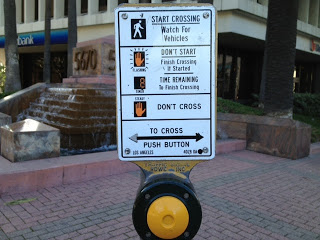
In cities with good walking infrastructure it’s taken for granted that there will be pedestrians waiting to cross the street, so they’re automatically given a turn when traffic moving in the parallel direction is given the green light. This does have an impact on traffic. Since pedestrians cross the intersection slower than cars, the green light for cars may often stay green longer than it takes for all the cars to get through. This slows things down for cars waiting in the perpendicular directions, but it gives pedestrians sufficient time and safety to cross the street.
By comparison, at many intersections in Los Angeles there are buttons you must hit if you want to be given the walk signal. If you don’t manage to hit it before the parallel traffic gets a green light, you’re out of luck. The green light will be shorter for cars, and you’re instructed to wait for a whole new light cycle. The thing is, there’s no functional difference in the way traffic is moving through the intersection when you don’t get to the button in time—the difference is that you have less time to cross, cars see you have a red “don’t walk” signal at the crosswalk, and they don’t necessarily expect you to walk. I and many others still do because it’s completely safe, so long as we’re aware of what the cars around us are doing and we’re across by the time the cross-direction traffic is given the green. But drivers who see a pedestrian walking against a stop signal may get angry that they’re being blocked from turning since they’re unlikely to understand how the signal works. Combine this with a busy intersection with no left-turn arrow for cars and you’ve got a recipe for road rage. And that’s to say nothing of how unnecessarily dangerous this can be.
As a side note, getting rid of all of these crosswalk buttons would also be cheaper in the long run, as no more would need to be installed, nor would they need to be maintained any longer. And when they
do
break, what are pedestrians to do? In those cases they’re left with no safe means of crossing the road.
Right turns on red
This is by no means unique to LA, but in tandem with other street design problems in the city, right turns on red just add to the madness. They don’t belong in big cities, LA or otherwise.
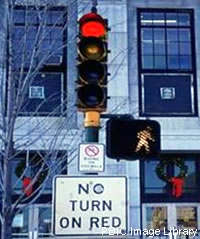
If you’re waiting in your car at a red light in Los Angeles you can take a free right as long as the crosswalk and the lane you’re turning into are clear. This causes a huge amount of collisions with other drivers and with pedestrians, which is problem enough, but it also causes endless annoyance and frustration to drivers in pedestrian-heavy areas.
The reason is that rather than just wait 20 seconds, drivers are encouraged to try to inch through the intersection when a gap in pedestrian traffic shows up, but anyone who’s tried to navigate this delicate maneuver is familiar with the heart-in-your-throat feeling you get when someone seems to jump out of nowhere and you have to stop abruptly (or when someone just
needs to hurry the hell up and get through the crosswalk)
. Now there’s a pedestrian angry with you—and rightly so, since they probably feel like you could have seriously injured them—or you’re angry at the inconsiderate ped, or both.
It may sound counter-intuitive that limiting the rights of drivers would make them better off, but in this case some paternalism is warranted. The time savings you get from threading the needle through a group of pedestrians is meager, of course. More generally, this fits with a street design ethos that seems to expect professional-level driving skill from the entire population—as does the lack of left-turn signals at intersections. If the
90% of drivers who think they’re above average
were actually correct, this might be okay, but in the real world building your roads so that only the most skilled can use them safely is a recipe for disaster. (As a side note, this might also discourage people from “cruising” in high-traffic areas looking for parking—
estimated to be responsible for as much as 74% of downtown traffic
—since the penalty for constantly circling around the block taking right turns would be much higher if you had to wait at every light.)
In either case this just adds to the stress of driving. If you’ve tried driving in an area like downtown you’ve almost certainly been yelled at by a pedestrian; it was probably as you blocked the crosswalk and they flipped you off and walked around your car. It wasn’t intentional, and you felt appropriately contrite, but I can almost guarantee you ended up in that position while trying to take a free right turn. Once again, the city’s design pitted you against the pedestrian and the results were predictable.
These are mostly easy fixes in the grand scheme of things, both in technical difficulty and expense. Maybe some of the congestion savings yielded from the
massive traffic light synchronization effort
can be used to improve safety and reduce the tension and stress of commuting.
I’m still a new resident to Los Angeles and sure to have missed some things. What other street design problems have you seen here, or in other cities? Have you seen any particularly innovative solutions?

17 comments
Archived from the original site. Commenting is closed.
It's not impossible to make a legal left turn: you just enter the intersection while your light is green, and complete the turn when your light turns red and the light for the street you are turning into turns green. This approach is actually safer for pedestrians, because you are never crossing a crosswalks where the pedestrians have the "walk" light.<br /><br />This only works for a couple of cars per cycle, though; that's why left green arrows are needed when more abundant left-turning traffic is expected. But for intersections where usually only one or two drivers per cycle want to turn left, the maneuver outlined above works fine.
Yeah, I'm not trying to make the point that these need to be at EVERY intersection, but there are many where multiple cars go through after the red light because otherwise the line just gets longer and longer. <br /><br />And sure, in comparison to turning during the general green light it's safer for pedestrians (maybe), but it's much more dangerous for drivers. I'm mainly concerned with vulnerable users on this blog because they're the ones most likely to be ignored or treated unfairly, but that doesn't mean I don't care if some guy gets injured or killed in his car.<br /><br />And the other problem with general green lights on left turns is that if you DO find a space you're more likely to gun it to thread the needle, which means you're less likely to be cognizant of pedestrians in the road at that time, or to miss them if you even bother to look.
"If you don't run the red light..."<br /><br />It isn't running the red light if you're already in the intersection when the light turns red.<br /><br />"If you don't manage to hit it before the parallel traffic gets a green light, you're out of luck."<br /><br />Cars have to deal with the same issue. If your car doesn't trip the sensor in time, you have to wait for the next cycle to go through the intersection. Should we get rid of sensors and just put everything on timers?<br /><br />I agree with you on right turns on red.<br /><br />A related issue is that when roads have both high speed limits and also many intersections, the road isn't very good at moving traffic despite the high speed limit, and it also isn't very good at being a destination at the end of your trip because the high speed limit reduces walkability. Roads should have either high speed limits or many intersections, but not both at the same time (google "stroad").<br /><br />Another related issue is when you're crossing at an unsignaled crosswalk across a road with heavy traffic, it can be impossible to cross legally because there's no break in traffic during which you can enter the crosswalk, and traffic doesn't have to wait for you unless you've already entered the crosswalk which you can only do when there's a break in traffic.
It's not legally running a red light for the first person, that's correct. Maybe not even the second person, sometimes. But the third always is, and there are often (VERY often) three people going after the traffic in the opposite direction has stopped.<br /><br />But that's secondary. My concern isn't following the law for the law's sake, it's following it for safety's sake. It may be legal to go after that red light, but it's unsafe.<br /><br />I'm not sure you're correct about the sensors. If you mean when the light is already green if you don't make it to the light in time, then yes it won't stay green for you and you'll have to wait for the next cycle, but that's a different problem that pedestrians have. <br /><br />I believe the way car sensors generally work is that they'll keep traffic in one direction flowing until a cross-traffic car sets off the sensor, then they'll trigger the green light. In some cases the green will remain indefinitely for one direction until a crossing car triggers that sensor, but the difference is that the mere presence of your car can extend the length of your green cycle, and that if your presence at a red light will actually affect how quickly you get a green. As a pedestrian, hitting the beg button doesn't actually make anything go faster or help you jump a queue, it just makes sure that the light doesn't completely ignore you. It's not the same thing.
The problem is simply that there aren't enough left turn signals. The City is in the process of installing left turn signals at more and more intersections, but there are 4000 of them in the City, so of course, unless you want to zero out the budget for everything else in the City, it takes time. It's technically not an illegal turn. You are allowed to enter an intersection when the light is green or yellow and clear it after it turns red. Generally two cars can fit in in intersection waiting for traffic to clear, and so that's why two cars generally go. The illegal turn would be the driver who enters the intersection after the light turns red. There is also generally not a conflict with pedestrians on those turns because the left turn driver is crossing the crosswalk at the end of the time allotted for the pedestrian to pass, not at the beginning. It does become a dangerous situation if a pedestrian tries to dart out at the last minute before the light changes though.<br /><br />I think your complaint about right turns on red is also misplaced. The right turn on green is just as much if not more likely to force the driver to "thread the needle" through a group of pedestrians travelling parallel routes as the right turn on red is with respect to pedestrians travelling perpendicular routes. In other words, as a driver, when your light goes green, pedestrians going in the same or in the opposite direction get a walk signal at the same time, forcing you into the same situation of having to "thread the needle". Why is that any better or worse than having to do so with respect to pedestrians walking from the left or right as you take a right on red? And wouldn't it contribute to "road rage" when the right turning driver HAS to find a way through a crowd of pedestrians travelling in parallel directions or face waiting through another full light cycle, with no guarantee that they'll be able to get through on the next one either?<br /><br />All this is not to say that I don't think you raise good points. We have a big job in LA of trying to re-orient our local and arterial streets away from just moving through traffic as quickly as possible towards streets that are safer and work better for everyone. Just not sure these particular ideas get us there.
It's very much not a cheap solution, and I don't mean to imply that the city is doing nothing to fix it. There's a very long way to go though, and I think it's important to keep the pressure on, and raise awareness.<br /><br />I addressed the left turn issue in a comment above, but I just want to note that people keep saying "Well, it's not TECHNICALLY illegal." This indicates to me that people know it's unsafe and not good practice, even if it isn't going to get you a ticket.<br /><br />I actually wanted to get into that issue on rights on red but didn't want to drag out this post too long. The real problem is that when making a right turn you have to travel through two crosswalks, which almost always means traveling through one where pedestrians currently have the right of way. One solution would be to extend green lights for several seconds beyond the end of the walk signal (I have seen several lights that do this in LA, actually). It's not a complete solution, but it at least avoids the issue of turning while having to watch for both pedestrians AND cars. A big problem is the prospect of hitting another car, or more likely being hit by one, because that can very easily lead to a deflection that then rams its way through multiple pedestrians either in the crosswalk or on the sidewalk.
"It may be legal to go after that red light, but it's unsafe."<br /><br />Cross traffic and pedestrians are legally required to wait for traffic to clear the intersection before they are allowed to enter it. So finishing the turn after the light turns red is only unsafe when someone else does something illegal.<br /><br />"In some cases the green will remain indefinitely for one direction until a crossing car triggers that sensor, but the difference is that the mere presence of your car can extend the length of your green cycle..."<br /><br />Are you saying the pedestrian "walk" signal should remain active indefinitely until a crossing car triggers the sensor? That's not a bad idea.
I agree with most of the deficiencies of LA streets pointed out in this article, but its funny that they used an image of Wilshire/Western for the part about the lack of left-turn-arrows, because that particular intersection has left-turn-arrows on all 4 sides.<br /><br />Source: I live at Wilshire/Western
Ha, I actually live there too Chris, but I don't ever drive so all I really notice is the people who are turning after the general light turns red. Good catch! That's another drawback of having so few green arrows where they're needed though: people get in the habit of running the red lights everywhere else, so they end up still doing it even in places it's not completely necessary.
To your first question, while that may be true it's not the case in most other places I've lived that you have to wait 3+ seconds after your light turns green to finally start driving. Again, my concern isn't so much with what's strictly legal, but whether our laws and street design encourage unsafe and/or antisocial behaviors.
LA's roads where "designed"? They are no purpose? Really?
It's a lot easier to walk and drive in Orange County. There are left arrows everywhere and the walk cycles are longer than in L.A.
The real problem with right-on-red is that the motorist is looking to the left for oncoming traffic, possibly around a car in the next lane that's obscuring their line of sight. This means that motorists often have to end up blocking the crosswalk just to attempt the maneuver. It also means that they're much more likely to be looking left than at their path of travel when they do start moving, which increases the chance of not seeing a pedestrian crossing from the right. Or a car making a U-turn on that side, for that matter.
As to crossing at intersections as a pedestrian in downtown LA. Once the light has flashed to "Don't Walk" if you step off the curb you can be subject to a hefty jaywalking ticket from our city's finest, regardless if you have otherwise made it across with the light still green.<br /><br />Enforcement is random so it makes it all the more of challenge to ensure Mr Motor Officer doesn't have his motorcycle parked on the sidewalk waiting.
You actually aren't legally allowed to pull into the intersection if you can't make the turn before the light turns red - <br />http://apps.dmv.ca.gov/pubs/hdbk/traff_lgts_sgns.htm#traffic_lights<br />"Solid Green– Give the right-of-way to any vehicle, bicyclist, or pedestrian in the intersection. A green light means "GO." If you are turning left, make the turn only if you have enough space to complete the turn before creating a hazard for any oncoming vehicle, bicyclist, or pedestrian. Do not enter the intersection if you cannot get completely across before the light turns red. If you block the intersection, you can be cited."
The light in the Wilshire picture looks like the kind that has a protected left turn arrow, which then goes yellow and is replaced by an all-green (as shown). Notice it's extra wide and has five lights on it. The two on the left are the protected left lights.<br />Looks like this: http://www.nngov.com/engineering/images/eng-flashingyellow2
I have now lived in LA for 3 years. It's not just traffic lights. Everything LA public sector is dis-organized, least forward thinking, ass-backwards run place for EVERYTHING.... and they are the most grossly overpaid & pompous on top of it. The DOT is no different. One, some LA city blocks are literally miles long (especially in the valley) so where you would have 4-5 streets as options in, say Seattle, you will have only one in that same area here, causing massive congestion. And the worst is the lack of left hand traffic signals. On a busy morning you may have to wait behind 20,30 even 40 cars all needing to turn left ... and the traffic is bumper to bumper, so not a single car can go while the light is green. Generally 2 at most 3 cars make it thru each cycle of the light (all on a red ... the last two barely escaping peril). We're talking 15 minutes to make a friggin turn ... frequently. Moreover, it holds up traffic going straight, too. Most of us know that when the light turns green we need to wait a bit, or risk a likely major accident.<br /> Does the city care? Nope. They're too busy collecting there bloated union paychecks (on our dime) to care. Besides, of the millions of people in the city, few have the ability to speak, or write English, so who's gonna complain? .... oh, btw, most roads haven't been paved since the Eisenhower administration, so there's that fiasco, too.<br /><br />Could be worse ... the LADWP or LAUSD could be in charge. <br />