Last week I wrote about 7 of the most important reasons to oppose the Neighborhood Integrity Initiative(NII), a misguided and deceptive ballot initiative that seeks to halt most new housing development in Los Angeles. It got around to the anti-growth folks at City Watch, and they predictably freaked the eff out.
Their responses, for the most part, had little to do with the language of the initiative itself—which was the focus of my article—and instead relied on ad hominem attacks and conspiratorial assertions about corruption in City Hall. Based on their comments you’d think we lived in the era of Tammany Hall, and that I was having my undoubtedly lavish lifestyle subsidized by the greedy developers who are tearing our lovely city to shreds. I think their reaction should give readers an idea of how intellectually bankrupt this initiative is.

We know what The Coalition to Preserve LA’s future city doesn’t look like, but what is their actual vision for the future, and how will the Neighborhood Integrity Initiative help them achieve it? Image from AIDS Healthcare Foundation.
Most of the people I interact with who oppose growth (or investments in bicycle and transit infrastructure, or just about positive change in the city) have a very narrow argument: Someone we don’t like is doing something we don’t like, and so we need to stop them. What they rarely seem to recognize is that maintaining the status quo is itself an affirmative choice. Preventing new development will not stop change, it will just force that change to manifest itself in other ways.
That’s exactly what’s happened across California for the past 30 years, as we’ve continued to grow but built very little housing to accommodate the newcomers—with predictable results. We thought that if we stopped building housing, people would stop coming. As it turns out, the people still came. And instead of having new homes ready to accommodate them, they had to compete with the rest of us for the housing that had been built 30, 50, 80 years ago. Prices for those older homes—which were becoming an increasingly scarce resource—went up. The pressures of evolution and change exist regardless of our efforts; the only power we have is in how we choose to channel those forces, whether for good or for ill.
For this reason, I always respond to these individuals with questions about their vision for the city. How will they channel those forces—or will they just stick their heads in the sand and hope that they disappear? You don’t want a subway through your neighborhood, or multifamily housing within a 1/2-mile of your home, fine. Then what? What happens next? What are the impacts of that decision; what is your vision for Los Angeles in 5, 10, 20 years, and how do your proposed policies help us to achieve that vision? Things staying exactly the same as they are today is not an option.
With that in mind, here are some of the questions you should ask supporters of the Neighborhood Integrity Initiative when they try to make the case for their anti-growth agenda.
Question 1
Most of the subsidized affordable housing being lost in Los Angeles is due to expiring contracts with the city, not demolition. What will the NII do to increase the supply of affordable housing and protect housing from losing its affordable status?
Question 2
Does your initiative have the support of affordable housing developers—those who know the most about what it takes to bring housing to low and moderate income families? What are affordable housing developers saying about the NII?
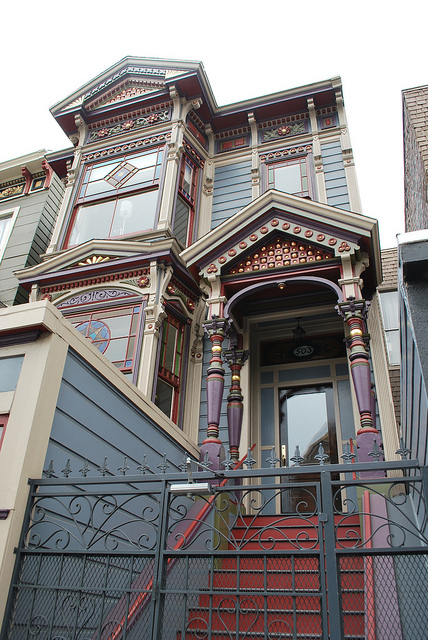
San Francisco: Great character and “integrity”—but a city we want to mimic? Photo by Andrew Napier .
Question 3
Other cities, notably San Francisco, have done a great job of preserving their neighborhood character over the years by limiting new development and density, but they are also prohibitively expensive for all but the most wealthy. **What about the NII sets us on a different course from cities like San Francisco?**If new people move here, where will they live without displacing lower income households or crowding more people into the same units?
Question 4
What will happen to the ~200,000 people employed in the construction industry in Los Angeles County? Will they find work in some related field, or will they lose their livelihood and have to leave the region?
Question 5
There are some pretty strict on-site parking requirements in this initiative, and new structured parking usually costs $30,000-$50,000 per space, which means adding about $200-400 per month in rent. **What do these parking requirements mean for affordability?**And with car-share growing and driverless vehicles on the way, what will happen to all of these spaces in 10 or 20 years?
Question 6
If this is really about reigning in City Council’s power and preventing them from giving sweetheart deals to developers, why does it have so many other unrelated provisions? Why not just limit spot zoning and stop there, instead of also making it so that communities can’t choose to grow their “islands of density,” reduce parking requirements, shift toward mixed-use development, etc.?
Question 7
What will this initiative do to help the city address its homelessness crisis? We need almost 20,000 permanent supportive homes just for the homeless individuals in our city; where will they go if the NII is passed?
More Ideas?
These are just the first few that come to mind. Make your own suggestions in the comments below; if there are some really good ones, I may update the post to add them to the list.
To read my earlier article discussing the top reasons to vote against the Neighborhorhood Integrity this November, click here.

5 comments
Archived from the original site. Commenting is closed.
<p>1.<br/>The City is currently building very little affordable housing. Over the past 15 years, if we compare the number of new units built against the old units lost, we see a very small net increase, which has not met the demand posed by population increases. The City has has done a pathetic job of addressing the affordable housing crisis, and most of the new units being built start around $2,000 a month. It's difficult to build affordable housing because real estate prices have been driven sky high by rampant speculation, which the City has encouraged by freely handing out zoning changes and variances. If developers can by a parcel for one price, knowing that they can double its value with a zoning change, it only encourages speculation. The NII would reign in this practice, and hopefully create a more stable market. The overheated market is one of the main barriers to the construction of affordable housing.</p>
<p>2.<br/>Some affordable housing developers do oppose the initiative, but we have to remember that they need the support of the City, which certainly wants the initiative to fail. It was widely reported that Larry Gross of CES opposes the initiative, but the media failed to include his harsh criticism of the City and the development community for their failure to support affordable housing.</p>
<p>3.<br/>Of course we need to build more housing, but it has to be affordable for the citizens of LA. Again, the City and the development community have done a terrible job of responding to the housing crisis. The so-called "market price" units are not built to meet the needs of the average LA resident. Do you really believe that projects like Millennium Hollywood, The Vermont, and 8150 Sunset are accessible to the average Angeleno? And according to postings on Yelp!, buildings like The Jefferson and Eastown have a high vacancy rate, which the owners are dealing with by offering units as short-term rentals. Building illegal hotels is no way to address the affordable housing crisis.</p>
<p>4.<br/>The Neighborhood Integrity Initiative will not stop construction. By-right projects can still be built. The initiative only targets large projects that need zoning changes. It is a myth that construction will stop dead if the initiative passes. Current zoning still allows for plenty of growth.</p>
<p>5.<br/>The initiative actually makes only small changes to current parking requirements. And though many developers have suggested projects with reduced parking, it's usually pressure from the community that makes them adhere to current standards. I agree we need to separate the cost of parking from the cost of housing, but that's a whole other issue. I doubt the NII will have a huge impact on current practices regarding parking.</p>
<p>6.<br/>The initiative is designed to make the City actually do some serious thinking about its zoning. The planning code is seriously out of date and needs to be revised, along with the community plans. The re:code effort is a thinly veiled attempt to give developers carte blanche. The City needs to do the hard work of updating its general plan and its community plans. And it needs to involve the communities in the process.</p>
<p>7.<br/>Why don't you ask what the City of LA is doing to address homelessness? Until just last year, the City's response to the homeless was to destroy their property and throw them in jail. After losing three court challenges, the City of LA finally decided to create a plan to address homelessness. The homeless crisis is in large part the result of the City's failure to create adequate affordable housing. Aside from allowing the demolition of thousands of RSO units, the City has also allowed the conversion of thousands of SRO units to high-end housing. By itself, the NII will not solve the housing crisis, nor was it designed to. But it was designed to reign in the speculative practices that have led to the housing crisis.</p>
<p>Thanks for the thoughtful replies Casey. I'll try to give them the attention they deserve and have some responses for you by tonight/tomorrow.</p>
<p>As promised Casey:</p>
<ol>
<li>Saying that housing prices are driven up by rampant speculation is a statement with no evidence whatsoever to back it up. I don’t doubt that speculation has an impact, but how does that explain the increasing value of single-family homes? In the vast majority of cases there’s no prospect for them being turned into multifamily units, and yet they keep going up in value right alongside under-developed parcels with multifamily potential. Why? Not because of speculation, since all you can turn those single family units into is bigger single family units (and often not even that because of mansionization rules). It’s because there are a lot of people who want to live in LA, and there are very few homes to choose from—that is, vacancy is extremely low.</li>
</ol>
<p>And to some degree you’re answering a totally different question than the one asked. I wholeheartedly agree that we need to build more affordable housing and that the city has done a fairly lazy job of it, but that’s also because residents in many neighborhoods have been opposed to having “those people” in their communities. It’s disgusting, but it’s the reality of the city we live in. But as I noted in question 6, there are a lot of aspects of this initiative that have nothing to do with Council’s ability to change the general plan—things that disallow communities from changing their character, changing their zoning to allow for more housing, reducing their parking requirements below an arbitrary threshold (regardless of future changes in technology), etc. These are all things that drive up the cost of housing through additional costs and decreased supply. If this were an honest initiative it would take away the power to spot zone and leave it at that—it would address what you’re claiming is the cause of increased prices and call it a day, mission accomplished. Instead it’s making that change, which there’s no real evidence to support as a cause of high costs, and then adding a bunch of new impositions and regulations that are guaranteed to increase prices. It baffles the mind to imagine how providing less housing for a market already starved for it will somehow make things better. </p>
<p>2.<br/>Some affordable housing developers? I suspect the number is closer to zero. And now suddenly the affordable housing developers are also in the pocket of the city? Gods man, I suppose the only people you can trust these days are the homeowners, right? The people who have already made billions of dollars on the rapid appreciation of homes over the past few decades, which in turn has been driven by an artificial scarcity of housing in the region. And again, totally agree the city hasn’t done a good job with affordable housing. This initiative does nothing to solve that, and in fact will only make it more challenging—hence the complete absence of support from affordable housing developers.</p>
<p>3.<br/>I don’t take my economic advice from Yelp reviewers. Your problem is that you’re mixing up correlation with causation—seeing a bunch of new, relatively fancy developments and imagining that they must be the cause of unaffordable housing. As I wrote in my previous post, the reality is that they’re a symptom of a starved market, not the cause. We have failed to build enough housing for going on 30 years, and now we’re looking for a quick fix. Sorry, but that’s sadly not going to be possible. And blowing up the whole system certainly won’t fix things.</p>
<p>Perhaps more to your point, if you look at the two cities in the U.S. that are building the most housing, Seattle and Denver, they also happen to be the two cities that have experienced a definite decline in average/median rent in recent months. D.C. is in third or fourth place, and they’ve just started seeing their rents stabilize. Just like LA, these cities are booming, and they’re building almost exclusively to the top of the market, because that’s always the first place you go in a market (think of Tesla). It’s working there; is there something so special about LA that would make it impossible? We obviously haven’t made a serious effort of it yet, given that we’re still at a sub-3 percent vacancy rate, while these other cities are actually pushing vacancies back up.</p>
<p>And once again you didn’t really answer the question. How does this prevent us from becoming San Francisco? There’s nothing in this initiative that would do anything but cause us to build less housing in less areas, just like SF has successfully done for a long, long time. They’re the toughest city in the country to build housing in, and the first or second most expensive. If you think that’s a coincidence, you’re kidding yourself. Voting for this initiative is a rage-vote, akin to voting for Trump. As someone told me yesterday, it’s voting with the middle finger. What we need is thoughtful policy based on actual solutions, not platitudes and anger.</p>
<p>4.<br/>In Los Angeles over 60 percent of new housing units are now being provided in projects with at least 100 units. I couldn’t say how many of those have required a zoning change, but I can tell you that, as a renter, I’m very happy that they’ll be on the market and taking the heat off me just a little bit. You’re also ignoring the fact that LA has been down-zoned for decades, to the point where our zoning barely allows more housing than we’ve currently got, even though it once was zoned with enough capacity to house 10 million people (instead of less than 5 million today). There may be a small amount of by-right development that can continue for the next decade or two—though definitely at a reduced pace, at a time when housing has never been in shorter supply—but the reckoning will come. The initiative prevents any kind of meaningful changes to density anywhere in the city; at a certain point there will be nowhere left to build, and that time will not be in the distant future.</p>
<p>5.<br/>I think you’re mixing up “small” with “simple.” The change is just one sentence, but it’s implications are dramatic:</p>
<p>“Under no circumstances may the required on-site parking be reduced by more than one-third (including by remote off-site parking) from the number of spaces otherwise required to be provided by any other applicable provisions of the Los Angeles Municipal Code.”</p>
<p>It’s possible that the impact in the short run might not be huge, but imposing these kinds of requirements is exactly the opposite direction that Planning departments throughout the U.S. are moving. There are a massive costs associated with over-supplying on-site parking, and this is guaranteeing that that practice will continue—to the detriment of affordability for all new housing—despite impending technological advancements and social changes that are making car ownership and the need for dedicated personal parking increasingly unnecessary. This ties our hands, and rather than leaving it up to communities to have their input on these decisions (as you’ve suggested they currently do), it takes that power away and assumes that every community will want as much parking as possible, in perpetuity. It’s dishonest and disempowering of communities to decide their own fate.</p>
<p>6.<br/>This might be the most dishonest thing you’ve said. Once again, you wrap this initiative in rhetoric about community involvement and transparency, but it goes so much further than that. Updating the zoning plans is a great idea and I fully support hiring the city staff necessary to update Community Plan Areas every 5 years (e.g.). But with all the extra restrictions imposed by this initiative, the community plan process will be a sham. It forces the city to update its plans, but puts so many limitations in place that the plans can basically never change—what we have now is all we’ll be allowed to build or zone for. What’s the point of community plans when the backers of this initiative have dishonestly included a host of requirements that prevent any meaningful change? For all that they’d ever need to be updated, we might as well etch the Community Plans into the stone of City Hall itself if the NII were to pass.</p>
<p>7.<br/>I’ve already addressed this: speculation is not the primary cause of housing unaffordability. If it were, then rapidly growing cities like Dallas and Phoenix would also be unaffordable, and yet they’re some of the cheapest growing metro areas in the country—because they’re building enough housing so that scarcity doesn’t drive up the price of land. Again, that’s scarcity, not speculation.</p>
<p>It’s good to hear that you’re admitting the NII has nothing to do with housing affordability, but I don’t think you’ll hear Jill Stewart or Michael Weinstein admit the same. This is about personal battles, greed, and anger at City Hall. And the anger, at least, is somewhat justified. The problem is that the personal battles and greed are carrying the day in the actual policy of the initiative. You started with a good idea, which was to limit spot zoning and require updates to the community plans. Then you got greedy and put in a whole bunch of policies that have nothing to do with affordability, and will actually actively undermine it. You’ll slow down projects applying for permits and going through environmental review (in my view, taking over a year for environmental review is enough), reduce the total amount of housing built in the midst of a crisis-level housing shortage, and make things more difficult, expensive, and prone to litigation for everyone, including affordable housing developers. You should have stopped once you’d exhausted the good ideas. I just hope that the rest of our city sees through the cynical approach of the Coalition to Preserve LA and is able to envision a more positive, inclusive future for Los Angeles.</p>
<p>Hi Shane,</p>
<p>New reader here. I just have one small suggested edit to question #3. You write:</p>
<p>"If new people move here, where will they live without displacing lower income households or crowding more people into the same units?"</p>
<p>Really, this isn't a matter of if. New people will continue to move to LA. There's nothing stopping them. We shouldn't be presenting this as a possibility, but an inevitability. How about:</p>
<p>"AS new people continued to move here, where will they live without displacing lower income households or crowding more people into the same units?"</p>
<p>Cheers,<br/>Andrew</p>
<p>Ah, crap typos. Should be "As new people continue to move here..."</p>