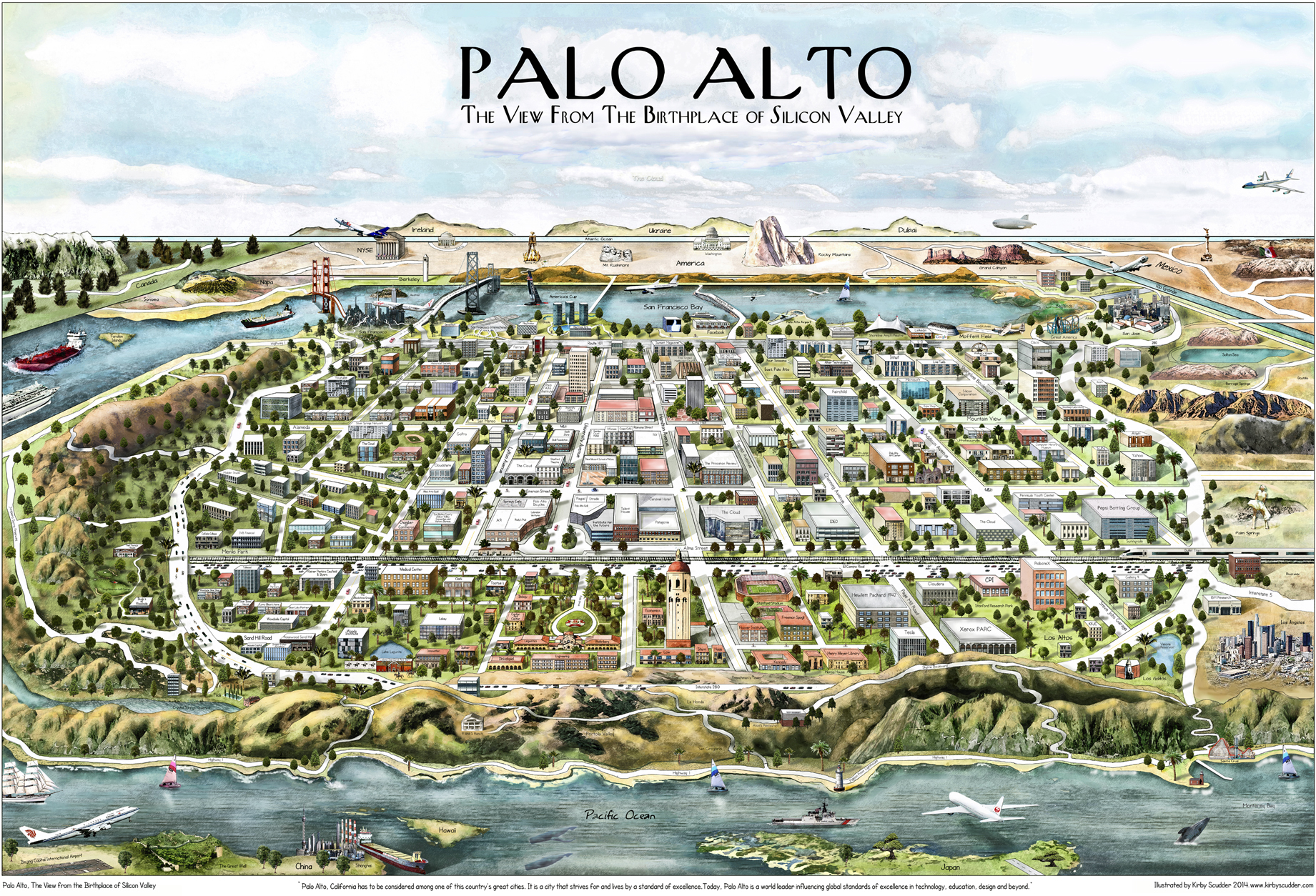
Palo Alto, now and forevermore.
Last week, Palo Alto resident and planning commission member Kate Vershov Downing made waves when she posted her public resignation, citing the insane cost of housing in her community and the unwillingness of the Palo Alto City Council to take meaningful steps to address the issue of housing affordability.
The letter was powerful in and of itself, and I strongly suggest you check it out.
What really drew me in, though, was a quote from Vershov Downing in a CityLab interview published this morning. It really captures the hypocrisy of the anti-growth movement, and the entitlement of those who would knowingly condemn future generations to a poorer quality of life than they themselves enjoyed.
Here it is:
I come from a family where we always wanted and expected to see future generations do better than us. What you see in Palo Alto is the opposite. You hear people saying, “My kids can’t afford to live here, and I’m OK with that.” Or, “If you can’t afford to live here, it means you’re not working hard enough. You don’t deserve to be here.” Or they say, “Why don’t you just keep renting forever? You’re not entitled to own a home.”
The reason for the history lesson is: We paved over the orchards to make way for the Baby Boomers, and now the Boomers are fighting with Millennials who want to turn one-story strip malls into four-story apartments.
It’s so jarring. When the Boomers were in their 20s and 30s, the government made it a priority for the middle class to be able to own a home. We created all these incentives to help make the American Dream come true. It’s such a core part of the Boomer generation. Now, these same people say, even though you’re highly educated professionals, you should be OK with renting for the rest of your lives.
This is what we’re up against. And clearly, this doesn’t describe all baby boomers (hashtag NotAllBoomers), nor are boomers the only ones holding up the redevelopment and growth of our neighborhoods. But I hope that the more open-minded members of the Boomer generation will align themselves with a sensibly pro-growth agenda, because they still hold most of the political power in our communities—and because it’s the right thing to do for the environment, the disadvantaged, and the next generation. I hope that voices like Vershov Downing’s make it clear what it’s costing younger generations to have our cities frozen in time, clinging to a flawed past rather than striving for a more equitable future.
There are legitimate reasons to oppose development in certain cases, but that’s not what’s happening in places like Palo Alto. Or, frequently, in LA, San Francisco, and many other cities around the country. This is about a group of entitled, self-interested homeowners who **[mostly lucked into incredible wealth](Last week, Palo Alto resident and planning commission member Kate Vershov Downing made waves when she posted a public resignation letter, citing the insane cost of housing in her community and the unwillingness of the City Council to take meaningful steps to address the issue of housing affordability. The letter was powerful in and of itself, and I strongly suggest you check it out.What really drew me in, though, was a quote from Vershov Downing in a CityLab interview published this morning. It really sums up the hypocrisy of the anti-growth movement, and the entitlement of those who would willingly condemn future generations to a poorer quality of life than they themselves enjoyed.Here it is:I come from a family where we always wanted and expected to see future generations do better than us. What you see in Palo Alto is the opposite. You hear people saying, “My kids can’t afford to live here, and I’m OK with that.” Or, “If you can’t afford to live here, it means you’re not working hard enough. You don’t deserve to be here.” Or they say, “Why don’t you just keep renting forever? You’re not entitled to own a home.” The reason for the history lesson is: We paved over the orchards to make way for the Baby Boomers, and now the Boomers are fighting with Millennials who want to turn one-story strip malls into four-story apartments. It’s so jarring. When the Boomers were in their 20s and 30s, the government made it a priority for the middle class to be able to own a home. We created all these incentives to help make the American Dream come true. It’s such a core part of the Boomer generation. Now, these same people say, even though you’re highly educated professionals, you should be OK with renting for the rest of your lives. This is what we’re up against. I hope that the more open-minded members of the Boomer generation will align themselves with a sensibly pro-growth agenda, because it’s the right thing to do for the environment, the disadvantaged, and the next generation. I hope that voices like Vershov Downing’s make it clear what it’s costing younger generations to have our cities frozen in time, clinging to a flawed past rather than striving for a more equitable future.There are legitimate reasons to oppose development in certain cases, but that’s not what’s happening in places like Palo Alto—or, frequently, in LA, San Francisco, or elsewhere. This is about a group of self-interested homeowners who mostly lucked into incredible wealth—people who were given an opportunity to build that wealth through the radical transformation of the built environment, from orchards to suburbs—)**who now knowingly deny that opportunity to future generations.
Worse, these are people whose wealth was only possible through the radical transformation of the built environment, from orchards into suburbs. They’ve got theirs, so the next step in the city’s evolution is off the table. Paving over the orchards was fine, but strip malls are precious, you see. The rest of us can go live in the desert or on formerly agricultural land, destroying wilderness and living more carbon intensive lifestyles without access to quality transit or a reliable source of water. And who really cares? The Boomers won’t be around to see the worst impacts of climate change anyway. And it’s all about them, after all.

17 comments
Archived from the original site. Commenting is closed.
<p>Disclaimer: I am not a Boomer. I am an urban Gen-Xer involved in transit advocacy. I am pro-density and a YIMBY.</p>
<p>"""you should be OK with renting for the rest of your lives."""</p>
<p>Perhaps it is off-topic, but perhaps the answer to that question is: Yes. Is Home Ownership really a great wealth building strategy? It has certainly failed, badly, for a whole lot of people. Much like the Automobile the House has myriad generally unaccounted costs, in addition to its future value not being guaranteed. A House is not an Annuity - generally your savings is better off as savings [especially in something like a 401K]. The House-as-Wealth really only worked <em>because</em> of all those artificial incentives. I try to have that conversation with Boomers as often as possible ... they usually don't get it.</p>
<p>That's a surprisingly tough question Adam. If you've seen my earlier writing, you'll know that I have serious concerns with the fact that housing as a wealth-building strategy is fundamentally incompatible with long-term affordable housing. You just can't have both. So in that sense, I think renting for the rest of your life SHOULD be okay, but the way things are structured right now it most definitely is not—at least in many parts of the country. (Renting was arguably a better choice than buying over the past few decades in Detroit, for example.)</p>
<p>If we were providing an adequate supply of housing, we would need to abandon the idea of housing as a wealth-building strategy. The good news is, we'd have a lot of extra money in our pockets so that would actually be a viable choice. What's happening in places like Palo Alto is that the people who have already benefited want to keep hoarding all of that growing wealth, which continuously shrinks the pool of people who can buy into that opportunity. For those people, renting is the option that only gets worse every year, because they keep paying more and get nothing in return, until finally they can't afford / put up with it anymore (a la Vershov Downing) and they leave.</p>
<p>It completely depends what city, and what part of the country we're talking about, but renting can be a very risk proposition in the long run. At least with ownership you know how much you're going to be paying each month, even if it doesn't turn out to be a great investment. If we can get renting to have that kind of stability, even for those who need to move from one neighborhood to another (i.e., rent stabilization isn't enough), then I think being a lifetime renter looks more reasonable. Getting that kind of stability requires having enough housing though, which, as I wrote about above, there's a huge amount of hypocritical opposition to right now.</p>
<p>If you allowed all the development in the world with no zoning laws, just a free market, buying a house might still be a wealth building strategy. </p>
<p>The price of any durable good is going to go up with inflation, so the land value will not decrease. With population growth, and increased urbanization the land is going to increase in value further. </p>
<p>The value of the structure is going to be in constant decline as it ages, but with home ownership you play the game of trying to get by with less than average wear and smart maintenance; which should net you over what a landlord pays.</p>
<p>You wont see people going from rags to riches on their family homestead unless they buy into a very fast growing city, but home ownership wouldnt be a loser. </p>
<p>Look to Japan, where land in cities is zoned for just about anything in the world. A huge percentage of Tokyo residents own their own home or condo. The structures are a purely temporary 30-40 year affair but they get value out of them in less costly capital+maintenance than rent and in slow land appreciation.</p>
<p>I am a bit curious how much anti-growth sentiment there was when the growth was benefitting the boomers. Were farmers and semi-rural folks pushing back then?</p>
<p>I'd guess so. People have been fighting against change as long as change has existed. The difference is that today there are so many levers for stopping or delaying change—which, to be clear, isn't always a bad thing. It would've been great if communities of color had more power to resist the demolition of their neighborhoods for the construction of the highways, for example. But this is just pure selfishness.</p>
<p>Interestingly in local history, what is now Newhall was developed because of the property taxation regime at the time, which was highest and best use (pre Prop 13). Thus, Los Angeles County assessed the land for subdivisions, and rather than piecemealing off land they chose to master plan a community. http://www.scvhistory.com/scvhistory/signal/worden/lw021997.htm Some reformers are saying that they want to force denser development by assessing for highest and best use, which IMHO actually encourages sprawl. </p>
<p>Also, in North LA County you have people fighting off sprawl all the time. Acton and Agua Dulce want to stay rural with horse ranches and no street lights. That is why you have a 20 mile gap in suburban development between Palmdale and Canyon Country. </p>
<p>Ideally you would have price stability for homes like is found in places like Houston where home prices haven't increased dramatically because supply keeps expanding. The problem is now people are coming in from 40 miles away on 18 lane monsters like the Katy Freeway, or neighborhoods keep changing due to denser development (as is going on inside the 610 Loop), or both.</p>
<p>I think Lisa Schweitzer is right when she says that people have a resistance to change, and it's not always Fischel's homevoter economic motivations. Witness the current activism in Boyle Heights. I think that some areas need to be up zoned but not all. Another danger is Sanphilippo's "density without urbanism." Whether a libertarian land use regime will solve that problem, or whether we need a little push from local government to solve it, I don't know. As Leinberger reminds us, it's not just City Hall; Wall Street and the lending community have their nineteen products they will lend on, and really mixed use is not one of them.</p>
<p>My understanding is many or most farmers rented the land they farmed. When the landowners decided to sell to developers, or become developers themselves, the farmer was powerless. No EIR back then...</p>
<p>Boomers didn't pave over Palo Alto. It was pretty much built out by the time Boomers where old enough to buy houses. Suburbia is a creation of the "Great Generation".</p>
<p>I think the fact that orchards are not equivalent to people is a weakness in this analogy, though I agree with the overall thrust of your point. Something to keep in mind with specific example of Palo Alto is that Stanford has a HUGE amount of land it is keeping vacant in order to maintain its pastoral charm or otherwise devotes to low-density development. The one-mile stretch of land immediately adjacent to the west of Palo Alto's main train station is occupied mostly by trees in order to preserve Stanford's pastoral entrance to their campus, and while the university has over 8,000 acres of land, most of the non-university land is devoted to uses other than housing, like a mall, hospital, etc. Stanford could be doing so much more.</p>
<p>Map: https://lbre.stanford.edu/luep/government_jurisdiction_map<br/>Land Use facts: https://lbre.stanford.edu/luep/general_land_use_facts</p>
<p>They are updating their land use plan this year, but I doubt they will add much more housing despite the large amount of land they have.</p>
<p>http://news.stanford.edu/2016/05/06/stanford-kicks-off-land-use-planning-process/</p>
<p>Eh, I mean, orchards usually have farmers working and living on them, so someone was "displaced." And unlike today's homeowners, who wouldn't be forced to sell and would make hundreds of thousands of dollars (if not millions) in the transaction, those farmers probably didn't have much say in the matter.</p>
<p>Listen, maybe it was OK to pave over stuff WWII (not really). But at some point you have to stop. We are well past that point</p>
<p>Completely agree! That's why we need to be allowed to build bigger and more densely on land that's already been turned over to human development—suburbs and urban centers alike—so that our footprint doesn't grow even further.</p>
<p>I am a Boomer. I grew up in the richest economic time in world history; everyone could afford a home, one paycheck paid the bills.When I was 18 years old, I made a prediction that the Boomer Generation, having sheer numbers during our childhoods (where we effected valid social changes and prompted rich consumer culture), would as we aged, become insufferably reactionary. Our entitlement, along with the fact that we were always right, dovetailed with the natural aging process to produce a generation that eats its young.</p>
<p>I'm disappointed by the visually nonsensical, paint-by-numbers "homage" to that famous New Yorker cover that appears at the top of this post.</p>
<p>I am a boomer who grew up in the central valley of California. There are so many misconceptions in the comments on this article I hardly know where to start. Most of the agriculture in the valley from lodi to Tehachapi was owned by the people who farmed them. For many years up through the late 1960's the central valley was known as the "Market Basket of the World". Most farms were family businesses that tended to be passed on from generation to generation. The value of the land lay in what it could produce not in selling it off. This was before the ability to ship fresh fruits and vegetables was readily available i.e. Pre-interstate highway system. In the late 1970's we catered a luncheon for a group of executives from Caterpillar Inc headquarters in the Midwest. They were stunned to find fresh strawberries on the buffet in February. But more on topic, it is not necessarily the property owners of today being greedy when they want to preserve their lifestyle. It is all the restrictions that come from land use and planning visions and goals that stymy development and redevelopment that should be a natural progression. Building suburbs on prime agricultural land is just as wrong as preventing farmers from growing the food we all need to live.</p>
<p>But they're not being denied home ownership. These people can move out of state and comfortably own homes. After WWII thousands of GIs uprooted themselves from expensive, now Rust Belt, cities and found new places to live.</p>
<p>These children can easily take their education and move back to Chicago, Cleveland, Philadelphia or even down South and enjoy lower cost of living and home ownership.</p>
<p>If you're going to make an argument fair enough but then argue why they have the right to live in California any why their parents should lower their life quality to allow them to do so.</p>