
Graffiti on a development rendering in San Francisco’s Mission District. Photo by Flickr user Torbakhopper .
The fact that San Francisco is home to the most obscene rents in the country is old hat by now; it’s not really news to anyone. That said, the latest battle in the affordability war—currently being waged in the Mission between those that believe more housing is needed and those that want a moratorium on nearly all new construction—got me to thinking about where this is all leading. And those thoughts are bleak. San Francisco, by any reasonable measure, is doomed.
More than a year ago I wrote about the general phenomenon that rents tend to be more stable than housing prices, and that rents very rarely actually decrease, whereas housing prices can swing wildly. Short of a mass exodus of residents, which is unlikely for a variety of reasons, current demand for housing in San Francisco is unlikely to decline. Even if it did, the immediate response would be for developers to lose interest in building more housing. They would bide their time, waiting for demand to pick back up and profits to return before constructing any more new housing. It’s very hard—probably impossible—to go back to the good old days.
The Bay Area is still booming despite the incredible housing crunch, and for all I or anyone else knows, that may very well continue. But it definitely weighs on the minds of potential future residents and workers, myself included, deterring future talent that’s interested in someday owning a home, or even just paying less than half their income on rent. I’m sure that many current residents say to that “good riddance,” but this extends to new industries and employers as well. The region may have a lock on the tech sector, but startups for unaffiliated industries would generally be foolish to locate in the Bay Area. San Francisco is on its way to becoming a monolithic populace, not just socioeconomically but commercially as well.
TWO PATHS, BOTH BAD
Since rents are unlikely to ever dramatically decline in San Francisco (or just about anywhere else—even Detroit’s median rent has consistently increased over the past 25 years, while home prices fell by about half from 2006 to 2011), there are really two possible outcomes. In one, the supply-siders get their way and lots of new market-rate housing, and a decent share of affordable housing, is built in the Mission and across the city. In the other, the anti-development folks get their way and very little new housing is built in the coming years, with most new construction coming in the form of affordable housing constructed with city, state, and federal funds. The first outcome is extremely bad, the second is utterly disastrous.
Path 1: Increased Supply, Increased Short-term Displacement, Bifurcated Population
If the supply-siders’ dreams come true, San Francisco will get off its ass and at least make a show of trying to build enough to meet the phenomenal demand for housing in the Bay Area. The city’s housing production hit a 20-year peak in 2014, with 3,514 new units in a city of about 850,000. Seattle, a smaller city of about 670,000 that has also struggled with rent increases (though not nearly to the degree of San Francisco and other Bay Area cities), built 8,311 new units last year.
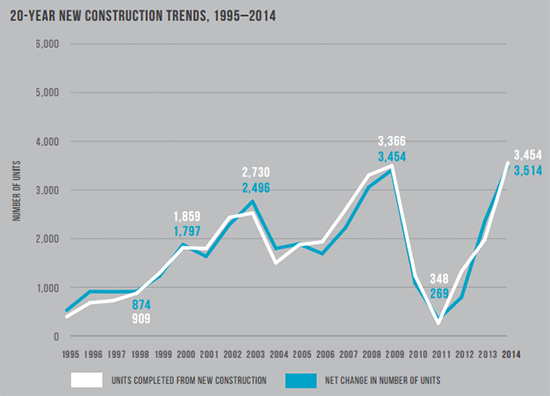
20-Year new housing construction trends from 1995 to 2014, from the 2014 San Francisco Housing Inventory .
What many anti-growth, pro-moratorium advocates fear—justifiably—is that more new construction will need to more displacement of existing residents, many of whom are low income and could not afford to rent a market-rate unit in nearly any part of the Bay Area, to say nothing of San Francisco itself. Owners of some apartments will evict current residents in order to build larger multifamily developments—those residents are generally compensated by up to $50,000, though even that maximum payout is not enough to afford unsubsidized rents in the city for very long. A share of those new units must be set aside as affordable to low income households, but the number of new affordable units may or may not exceed the number of households that are displaced.
Following this path, more total housing is provided in the city, which somewhat moderates rent increases in the long run. A pretty sizable amount of affordable housing is built, funded entirely by private investment, because of the inclusionary zoning program mentioned above. The majority of homes are market-rate though, and with median prices of $3,000 or more per month in many areas, they are far out of reach even to middle class households. In neighborhoods with a lot of development, we end up with a lot of rich people housing and a decent amount of poor people housing, and basically nothing in between.
Path 2: Limited Supply, Decreased Short-term Displacement, Homogeneous Population
At the other extreme there is the anti-growth path, which I should note is not necessarily the long-term vision of all those in support of the Mission moratorium—instead, it’s viewed by many as a “cooling off” period where the community and city planners can create a framework for more equitable development. That said, in a regional market that’s not providing enough housing overall, there’s not much one neighborhood in one city can do to limit rent increases in the long run.
If moratorium supporters succeed at limiting the pace of development for years to come, it will be a Pyrrhic victory. Fewer residents will be evicted to have their units torn down or renovated, which is no doubt of great value to those that are protected, but that won’t mean the neighborhood will maintain its character. Rent control only stays in effect as long as people stay in their units, so when they move out, those units will revert to market rates, forever out of reach for low income residents. Many of these units will be fixed up as rent controlled residents move out, pulling even higher rents. For those who don’t move out, well, no one lives forever.
Private development is a relatively cheap way to provide income-restricted affordable housing, and there’s just no way that fully publicly-subsidized construction is going to fill the gap at upwards of $300,000 per unit. Nor should San Francisco or any other city want to rely on public funds for all of its affordable housing needs: Every dollar spent on affordable housing is one that isn’t spent on education, parks, public health, or infrastructure. Over time, without a meaningful amount of private housing construction, the city will consist of essentially nothing but luxury housing—or rather, pretty standard housing at luxury prices. The transition will take longer than in Path 1, but the transformation will be absolute in a way that even private sector developers cannot hope to match.
The Third Path: Something in Between
The examples above are, to some degree, two extremes on a spectrum of infinite possibilities. Many of the in-between approaches are probably superior to either of the extremes, and I imagine that many of the pro-moratorium advocates and community members are just looking for some breathing room to develop an in-between framework that suits their needs and recognizes the validity of their concerns. A revised development framework has the potential to affect the lives of real people in positive ways, so I don’t mean to discount it entirely. But whatever the outcome, it will amount to tinkering at the edges compared to the scale of the problem.
Anyone who’s read my blog knows that my opinions are decidedly on the “build more housing” side of the argument, but this post isn’t about villainizing moratorium supporters in the Mission. It’s about acknowledging the fact that rents are very unlikely to decline, and that, as a result, things are unlikely to get any better for San Francisco or its low income residents. No city can afford to subsidize the rent for half its population.
San Francisco is in a particularly unenviable position because, despite its failures, it has actually done more to combat increasing rents than other Bay Area cities—places like Palo Alto and Mountain View that have greedily attracted tech employers while leaving the un-sexy, and much more costly work of providing housing to their larger, more compassionate neighbors. Not to absolve SF entirely, but no single city should be forced to completely transform itself to appease the greed of its neighbors, especially when those neighbors make no sacrifices of their own. Because of the limited size of San Francisco relative to the Bay Area as a whole, even a complete “Manhattanization” of the peninsula might only have delayed its fate in lieu of similar efforts from Oakland, San Jose, and all the smaller cities in between. San Francisco was never in a position to fix the problem of housing affordability all by itself, but this is not the case for many other places in the U.S.
So, growing coastal cities throughout country, take note.
THE LESSON FOR OTHER U.S. CITIES
Nothing new here: Growing cities need to build more housing where and while they can, period. The more they build, the less competition there is for each available housing unit, and the less rents will increase. Period. More development also means more opportunities for inclusionary zoning and other value capture mechanisms. The takeaway here isn’t anything you haven’t heard a million times before, but hopefully this framing adds some sense of urgency for cities that are still in the early and middle stages of across-the-board gentrification.
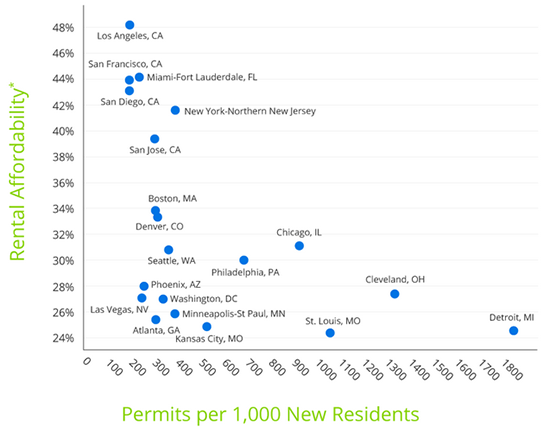
Rental affordability is clearly related to the supply of new housing, captured here by the housing “permits per 1,000 new residents” metric. Graph from Zillow .
San Francisco is a harbinger, but the fate it foreshadows is not an inevitable one, as Tokyo and other cities have demonstrated. Places like Los Angeles and Seattle are on the cusp, and Chicago and Philadelphia are moving in the same direction, but they’re all still salvageable. Boston and Washington, D.C. are further along than even LA or Seattle, and they’ll have to adopt a regional housing strategy to address housing supply in their regions. This will be considerably more challenging than a go-it-alone approach, but their small size necessitates partnerships with neighboring cities that share responsibility for the affordability and equity of their respective regions.
These and many other cities have significant control over their fates because they represent a much larger geographical footprint in their respective regions, though they’ve yet to really take advantage of it. They have more of an opportunity to allow for redevelopment while still not growing at an unmanageable rate. Even Seattle, which has done a decent (though still not quite sufficient) job of providing lots of housing to respond to surging demand, has only grown by a few percentage points each year recently—and that’s with only a tiny slice of the city’s total land available for redevelopment.
As demand cools off in the coming years, homes built during this boom will serve as a buffer against future rent increases and filter down from high-end to middle-income markets. Better still, if we “overbuild” during the boom years, when the current real estate cycle ends—they always do, sooner or later—there is a good chance of rents actually declining somewhat. Not enough to dramatically change the landscape of any city’s affordability, but every little bit helps.
Cities change, and for some people that’s not good news. Those committed to sticking with their cars might deal with more congestion even as other transportation options improve. Those who love the feel of a largely low-slung neighborhood—or even those who prefer a five-story streetscape to a ten-story one—might have to accept the change and just make the most of the new shops and park space that accompany increased density. Call me selfish, but if it means I don’t have to pay the majority of my income on rent, or fight to secure a rent-controlled unit and squat in it for the next few decades just to stay in the city, or watch my neighbors leave the city and never have enough money to come back, I’d say that’s a pretty small price to pay.

11 comments
Archived from the original site. Commenting is closed.
So what do you think will happen to rent-controlled tenants in the Mission once the Moratorium is in place? Greed is a moving target; I suspect that the speculation focus will simply focus from "tear-down-ready sites" to the "Ellisable and Flippable" - this potentially means even more evictions. Moreover given you're dealing with tenants already marginalised, and already dependent upon gatekeepers for civil advocacy, they all the more vulnerable to displacement via sharp practices (technical for cause evictions, arson, etc.)<br /><br />I think SF can still focus on protecting those who still live here and on at least attenuating the price rise for future generations.
I think that's definitely possible, but I suspect the market for condos is a little more limited given the insane cost of homes in SF. Even if you're making $100k a year at a tech company, that doesn't mean you've got $200k put away for a down payment, nor that you're willing to lock yourself into place in your prime earning years, especially in a neighborhood that's still very much in transition.<br /><br />It's absolutely possible though! My point was more that regardless of what's done, rents probably aren't going DOWN, and over time a greater share of units will be rented at current or future market rates, which means a smaller and smaller share of lower and middle income households.
While Path 1 is perhaps at the edge of what currently seems possible, I don't think it's enough of an extreme to be considered when speculating on the future of SF house (I'm a fan of the 'Overton window' theory of how to move political debate). So—with that in mind, here's my proposal:<br /><br />Suppose California were to pass a ballot initiative that replaced the current property tax system with a land tax, and other zoning reforms, that encouraged property owners to maximize the value of their property. (For argument's sake, let's say that all current property owners were exempt, but when the property is sold all protections are removed). <br /><br />Since there's such a high demand to move to San Francisco, developers would buy low-density housing, raze the buildings, and put up high rise buildings. Within a few decades, San Francisco would go from a density of 17,000 people per square mile to something significantly higher. (Think Singapore, or Hong Kong)<br /><br />At some point, San Francisco would be so dense that it would no longer be seen as a desirable city in which to live, and would instead be more of a gateway city, which people pass through and then leave in search of more space. New York, which had a higher population density a century ago, once functioned in this way.<br /><br />The problem, to me, with housing policy is that home owners and city residents have an array of tools to limit the growth of housing supply. If you reduce their ability to stop new construction, I think the housing crisis in our major metros would abate for a long time and, possibly, for ever.
It's an interesting idea Louis, but I'm not sure it's likely in today's environment.<br /><br />Back in the early 20th century, places like New York were so dense not because there were more units but because it was full of overcrowded, unsanitary tenements. It was also undergoing population growth that makes today's "booms" look like a joke, to the point where the city legitimately couldn't keep up with demands on infrastructure.<br /><br />Even if development were allowed to increase dramatically so that populations grew much faster, the new buildings would still be of high quality by historical standards—clean, safe, spacious, etc. In developed countries at least, I don't think we'll ever see places quite like the NYs and Chicagos of the late 19th and early 20th century.
But—again, in the spirit of Overton's window—why not repeal anti-density building codes (parking regulation, minimum apartment sizes, etc.) and see what happens? Again—east Asia seems to provide a model here. While the market might be small for <a rel="nofollow"> capsule hotels </a>, it's not zero, and having tiny tiny apartments would be a boom for workers moving to SF and NY and starting their careers. (Or, for like people in my situation, in which I live in one expensive city but work in another). <br /><br />I think the left currently doesn't have any good answers for the housing crisis, and density—whether built by private or public entities—would go much further in solving the problem than either of the two current "solutions" (raising the minimum wage, and inclusionary zoning). <br /><br />This is more an aside—but from the ground, there's plenty of space in even SF and NY for future development, but there's no one making people aware of the opportunities that exist. For example—there's still a one-story, gigantic DMV, with a parking lot, in the Lower Haight. Lower Manhattan is full of low-rise buildings, and there's even an entire block of two-story buildings on the north side of Washington Square Park. Now—maybe one could argue that aesthetics must be protected at all costs, but I find that a pretty unpersuasive argument, particularly if it means that large swaths of the population suffers.
I'm completely on board with that. This is as much a commentary on political realities as on the likely outcomes of those realities. The scale and pace of development required to actually lower prices in SF at this point, after decades of deliberately failing to meet demand, is mind-boggling. Even if the reforms are incremental though, like moderate increases in allowable density and abolition of parking regulations, I'm all for them. <br /><br />There's definitely tons of space available for development, but that point about aesthetics is what's really stopping it. Preserving character, quite literally, has been deemed more important than keeping rents from climbing from $1,500 to $3,500 a month for a 1 BR apt.
Great—I wonder if others would be also. And, while the scale/pace of development of SF needed may be mind boggling, it's not unachievable. By targeting a much higher level of construction, even achieving half the goal will be a step forward.<br /><br />What's frustrating about my proposed housing policy is that either party could adopt it (conservatives could frame it as a free-market solution, while the left could argue for the impact of increasing the housing supply) and yet neither has come out front on this issue. And, local activists seem very misguided, embracing the bizarre anti-growth politics embodied in Molotch's "City as a Growth Machine" article from the 1970s. (As I read it, he argues that if activists can stop the construction of housing for long enough, capitalists will give up and leave their neighborhood suspended in amber).<br /><br />I think the solution has to be at the state-level, as states have much broader constituencies than cities/neighborhoods. If there were was a state board, appointed by the governor, who could overturn local zoning decisions if they violate the needs of the greater community, I think we'd end up with healthier economies and better places.
One aspect of the problem not mentioned is the uneven spatial distribution of economic opportunity. If certain cities or regions are growing at a faster rate than the country as a whole, that means some other areas are losing population. If more people are able to find work where they are, we would not see so much migration to currently "hot" cities and regions with all the attendant growth pressure and housing affordability challenges.
Affordable housing is a subsidy for employers who then can pay low-wage workers less.<br /><br />That's kind of cruel, if you think about it. Sadly, few people do.
This article looks at San Francisco in isolation, but housing is a regional issue. <br /><br />It is particularly important to take a regional view in the Bay Area, because San Francisco is a much smaller part of its metropolitan area than most cities. San Francisco has only about one-eighth of the population of the Bay Area, while New York has about one-half the population of its metropolitan area.<br /><br />Once we begin to think regionally, the solution is obvious, though difficult to achieve. Build better public transportation in the Bay Area, and zone for housing around the stations. <br /><br />These new transit-oriented developments could compete with San Francisco for tenants if they are designed properly. Make them like traditional European neighborhoods - walkable neighborhoods of six-story buildings. If they had a walkable street grid and were developed using form-based codes rather than traditional zoning, they could be as appealing as San Francisco. <br /><br />Check out these pictures of a recently developed town outside of Paris, and you will see that we can create new development that is just as appealing as San Francisco. http://preservenet.blogspot.com/2012/07/le-plessis-robinson.html<br /><br />No matter how much housing we build in SF, it won't have much effect on the whole region, but a regional response could hold down housing prices.
Charles, I agree with all that, which is why I say in SF itself the two paths I outlined are the only realistic ones. It's also why I mention that other cities such as Boston and D.C. will similarly have to take a regional approach, because they represent a small geographic footprint within their respective regions—much like SF. <br /><br />The point, though, is that rents tend not to drop, and rents are already so high in SF that it's going to get worse even if rents remain completely stable. Whether you build a lot and stabilize prices, or don't build and rent-controlled residents move out or die over time, either way you end up with a larger and larger share of housing out of reach to lower and middle income residents. Your ideas are all valid and nothing almost any urbanist wouldn't agree with, but they're a regional solution. In my opinion, looking just at the fate of SF itself, there is no good solution because they've let things go too far already; my hope is that other cities take that as a lesson and implement many of the ideas you're talking about BEFORE their cores end up only being affordable to households making $100k+ per year, and they end up needing to spend billions of dollars subsidizing affordable housing rather than much more effective, early investments in transit, education, etc.