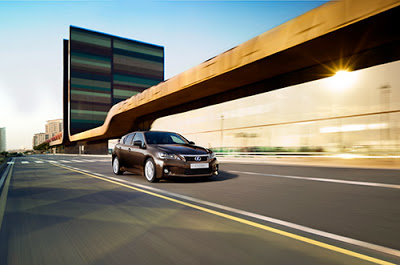
Yeah, that’s definitely what driving is like.
This is somewhat related to
, so I just want to mention it briefly before it slips my mind.
When you take into account gasoline, insurance, repairs, licensing fees, parking, and the cost of the vehicle itself, cars are expensive. AAA estimates that a single car costs families $9,000 a year (
I think that’s sometimes overstated
). That cost is heavily dependent on what you drive, of course, since a $50,000 car is going to average out to a much higher annual cost than a $10,000 one. It’s also dependent on how much you drive.
Looking at things from another angle, the more you drive the more justified you are in buying an expensive vehicle. After all, if you spend 2-3 hours a day in your car (which amounts to more than a month out of every year), your comfort and feelings of safety while driving are probably more important to you than if you only use your car for a few trips a week. A Lexus you use every day seems like a much better investment than a Lexus that sits in the garage 5 days out of the week.
In this sense, it’s completely rational to spend more money on your car the longer your commute—it also exacerbates the problem of overspending on transportation. When you choose to buy a “cheaper” home in the suburbs you spend less on housing and more on transportation, and part of that is because the increased travel time requires spending much of those housing “savings” on daily driving costs (gas, etc.). That additional travel time also means you’re in your car a greater percentage of the day, so why not get a nice car to make it a little more enjoyable? It sounds reasonable enough, until you re-examine why you chose to live in the suburbs in the first place and realize that it was to save money.*
I’ll be the first to admit this is entirely speculative, and that intuitive results aren’t always the same as empirical results. It’d be really interesting to see a study on this, to put together real data on whether—all other things being equal—longer commutes encourage people to throw away more of their money on more expensive cars and trucks.
*Not everyone moves to the suburbs just because they believe they’re cheaper. Some people want what the suburbs have to offer, and that’s okay. Many, on the other hand, are only there because they think they’re being financially responsible.


7 comments
Archived from the original site. Commenting is closed.
Anecdotally, this is totally true for me. I very rarely drive. My car is 13+ years old and I spend practically zero on it. My friends that live in the burbs and do these long commutes, they all have "practical" cars, relatively new Hondas and Toyotas mostly. I don't know how they afford them though cause I couldn't and I don't think they make much more money than I do.
We see the same "justification" at work when unemployed people move to larger, more pleasant lodgings because they are home all the time, right?<br /><br />I think Angie has a better take on it: not driving a lot justifies the retention of an older, less desirable motor vehicle, because one uses it so rarely. <br /><br />
This is anecdotally true for me as well. When I lived in the suburbs and I knew I'd be spending 1+ hours a day in my car, every single day, I opted to get a comfortable car with heated steering wheel, heated seats, sun roof, etc. Now that car is getting old and were I still using it regularly I would be tempted to replace it, but since I am not I keep it around.<br /><br />On the other hand, I can tell you definitively it really is cheaper to live in the suburbs, even after transportation costs. In the New York metro area, housing is at least 5 times cheaper in the suburbs, if you compare a 2000 sq ft apartment (considered super huge in Manhattan) to a 2500 sq ft house (considered relatively modest in the suburbs) which offer about the same amount of total living space.<br /><br />Those who have never lived in the suburbs may not realize how much cheaper everything is. No doubt this is due in large part to all the hidden subsidies, from Federal spending on roads and inadequate gas taxes to parking minimums and zoning. Nevertheless, from an individual point of view, you WILL save money moving to the suburbs. It's just a very different kind of lifestyle.
They can afford them because they pay about 1/5 of what you pay in rent, or if they pay more than that, it is only because they have a much bigger place.
I think the view from Angie's perspective is correct as well. You're a little flip in the comment about unemployed people though, because obviously unemployed people don't have the money to make those kinds of choices. Someone who chooses a cheaper home in the suburbs over a more expensive one in the city necessarily has more money to burn, and that combined with the rationale of "well I spend so much time driving" are pretty good inducements to spend more on a car.
No doubt about that, though it varies significantly among metros. New York is a pretty extreme example, and Manhattan is the most extreme example within the city, since there are other parts of other boroughs that are still well-served by transit and are fairly walkable. (It's all expensive though.)<br /><br />I think your last sentence captures my response to the comment you made on my last post too: city homes and suburban homes are very different things, and you can't expect to replicate a 2500 sq foot home + yard + garage lifestyle in the city any more than you can expect to replicate the condo + transit + wealth of amenities lifestyle in the suburbs. I made sure to mention here that some people want one, some people want the other. But if you're indifferent, or if you actually prefer the city lifestyle, then there's a lot to consider beyond just "this suburban home costs $200,000 less than that one in the city."
Thanks for responding, Shane.<br /><br />You can't replicate the yard and garage in the city, nor would you necessarily want to given the transit options. However, living space is living space, and if you have kids,sometimes you just need the space. I know that living in an apartment is more space-efficient, in that you need less space-hogging stuff. Nevertheless, I think the typical middle-class 2500 sq ft home found in the suburbs roughly equates to a 2000 sq ft apartment, and the fact is that 2000 sq ft apartments are not affordable for the middle class even in the still transit-rich and amenity-rich "inner ring" in NYC, such as Brooklyn Heights, Park Slope, Williamsburg, and LIC. Maybe the apartment won't cost you $3M, as it would in Manhattan, but it is still at least $1.5M. I doubt you can find a 2000 sq ft apt anywhere within a 30 minute transit commute of Manhattan CBD for under $1M, whereas $500k is a reasonable price for a 2500 sq ft house in a NJ driveable suburb.<br /><br />All I'm saying is that, for families living in NYC, many reasonably feel they have no choice but to move to the suburbs at a certain point, even if they love the amenities and hate to drive. It really is cheaper, even after factoring in the higher cost of commuting.