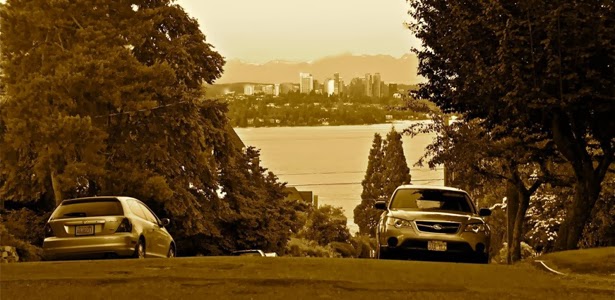
Image from
.
More good news on the economics of living in the city
. A recent comparison by David Hughes, a broker at Mortgage Group Ontario, Inc., calculates that, over a 40-year horizon, living in the city costs about the same as it does in the suburbs. Slightly less, in fact.
Specifically, he found that a house in the suburbs valued at $500,000 will cost about $688k over 40 years, and a two-car household will rack up an additional $688k in vehicle costs over that same time-frame. Total cost: $1,304,995.
By comparison, a home in the city valued at $720,000 will cost $1,031,130 over 40 years. A family that doesn’t own any personal automobiles but spends about $250 a month on transit and another $250 on taxis and car-share will spend approximately $240k in transportation costs over that time-frame. Total cost: $1,271,130, or about $33,000 less than the suburbs. (Tables for each scenario are found
—apparently I don’t have permission to recreate them here.)
As the article notes, this doesn’t take into account the physical and financial costs associated with the stress of longer commutes, congestion, etc. It also misses something even more important by ignoring what these two hypothetical families are left with at the end of their 40-year experiment: the homes themselves.
The surburban and city houses are both completely paid off, but one is worth far more than the other. When all is said and done, the city-dweller owns a home worth $220,000 more than the suburb-dweller, even though they spent $30,000 less in total housing and transportation costs. This is before taking into account the fact that
urban homes increase in value faster than suburban homes
, and that
. It also ignores the fact that, even given equivalent rates of home appreciation, the gap in value will grow over time. (If both increase in value an average of just 2% per year, the suburban home will be worth $1.1 million in 40 years, and the city home will be worth $1.59 million, almost $500k more.)
While
investing in a home as a primary retirement vehicle may not be the best idea
, if we’re talking about spending the same amount of money either way we may as well point out that one option is far superior to the other from an investment standpoint.
on multiple occasions, for all the time we spend focused on housing + transportation (H+T) costs, we spend relatively little time discussing its investment implications. Homes are an asset and vehicles are a liability, and in a country where the majority of people aren’t saving enough for retirement, it’s important that we make this point crystal clear. Yes, living in the suburbs is expensive, unhealthy, unproductive, and bad for the environment. When you earn enough to afford a home, it’s also a terrible investment decision.


2 comments
Archived from the original site. Commenting is closed.
I don't know what Toronto is like but it seems clear to me that you are not going to find the same kind of house available for $500,000 in the suburbs for just $720,000 in the center of a large city. More likely a comparably-sized house or very large apartment would cost about $3 million, or at least that is the figure I would use for New York City and NJ suburbs.<br /><br />Having lived in both the city and the suburbs, I can say definitively that there is almost certainly a huge cost advantage to living in the suburbs, even after factoring in higher commuting expenses. What you gain by living in the city is time, access to amenities, and a different kind of lifestyle. For the time being, at least, you will almost certainly have to pay more to live in the city.
In many Toronto suburbs, $500,000 doesn't get you that much. In the most expensive new area (Patterson area of Vaughan), there is zilch with townhomes being the cheapest housing type at $600,000.<br />http://www.realtor.ca/propertyDetails.aspx?propertyId=13733781&PidKey=1114285854<br />In other areas it will get you<br />http://www.realtor.ca/propertyDetails.aspx?propertyId=13540580&PidKey=-1801099735<br />http://www.realtor.ca/propertyDetails.aspx?propertyId=13453281&PidKey=-83684788<br />http://www.realtor.ca/propertyDetails.aspx?propertyId=13724744&PidKey=836197103<br /><br />In the city, you can get a 3-4 bedroom 1200-1800 sf home on about 1/20 acre near transit in the East or West end or a ~1200 sf condo right in downtown.<br />http://www.realtor.ca/propertyDetails.aspx?propertyId=13596152&PidKey=-381288679<br />http://www.century21.ca/Property/100912100<br />http://www.realtor.ca/propertyDetails.aspx?propertyId=13773780&PidKey=1384364197<br /><br />The cheapest homes (per sf) in the suburbs are usually about 30 years old on small lots, starting around $200/sf in Brampton. Most expensive are the ~50 year old bungalows often on moderately large lots which due to their low density and location often closer to the inner city (high land value) are around $400-$500/sf. When sold, they often get torn down to build larger homes. New homes will vary from around $250-$350/sf. In the inner city, it's probably around $400/sf for older housing and $500-$600/sf for new downtown condos.<br /><br />Difference in lot sizes is not that significant, you're looking at about 1/14 acre in the suburbs vs 1/20 a couple miles from downtown, and much of the extra lot in the suburbs is lost to garages and driveways. Toronto is not NYC, the price premium for living in the core is much smaller, and in the suburbs, I'd say its pretty similar, though with smaller lots in Toronto's burbs.