It’s time to abandon the daily, weekly, and monthly pass system and adopt a fare structure built around spending caps. Transit users in Los Angeles would continue to pay $1.75 per ride, with a daily spending cap of $7, weekly cap of $25, and monthly cap of $100—but the possibility of overpaying for transit use would be completely eliminated. It’s all the benefits of pay-as-you-go and none of the drawbacks of daily, weekly, and monthly passes.

LA Metro TAP cards.
Most of us have been there: We need to get around the city for the day, so we load some money onto our TAP card for our bus or train fare. We don’t know how many transit trips we’re going to take for the day, so we play it conservative and buy a fare or two, saving a few dollars off the all-day pass. Come the end of the day, we’ve taken half a dozen transit trips and spent twice as much as if we’d just bought the day pass in the first place.
Or maybe you’re more familiar with the reverse: You expect to use transit quite a bit over the next week, so rather than pay a few bucks for each ride you decide to spring for a weekly pass at a cost of $25. Things come up, plans change, and suddenly you realize you’ve spent 25 bucks for 7 dollars worth of bus rides. It’s the gym membership of transportation spending.
In most cities, LA included, we’re expected to make a prediction about how we’ll use transit for the next day, week, or month (or even year), and make our fare purchase based on that prediction. If we overestimate our transit usage, we overpay; if we underestimate our transit usage, we overpay.
For infrequent transit users these situations are bearable, though inconvenient and frustrating. The worry that you might make the wrong choice is an annoyance, but little more. If you’re a low income worker, a student, or an elderly resident on a fixed income, however—someone who can’t afford even minor financial mistakes, or who doesn’t always have the cash flow to put up $100 at the same time each month for a 30-day transit pass—this is a serious problem.
It doesn’t have to be this way, and it’s time the LA Metro and other regional and municipal transit agencies adopt a more equitable, fault-tolerant payment structure. For an example of what it should look like, we can look to Christchurch, New Zealand. (Hat tip to Darren Davis for the example.)
Pay-per-trip, with daily, weekly, and monthly caps
In Christchurch, there are daily and weekly spending caps that eliminate the possibility of overpaying for transit service. This has allowed them to do away with daily and weekly passes entirely.
Instead of purchasing daily or weekly passes, you simply use your fare card as an e-wallet and pay for each trip directly. When you reach the spending cap for the day, any additional trips you take that day are free, exactly as if you’d purchased a day pass—but without the requirement that you pay for all your rides up front. The weekly caps work in exactly the same way.
Per the table below, Christchurch’s daily cap is set at $5, and the weekly cap is $25.
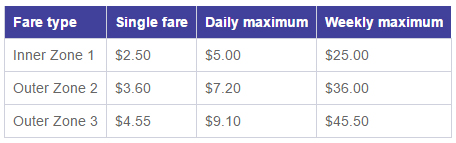
Fare structure for the Metrocard in Christchurch, New Zealand.
What this means in Christchurch is that if you take transit to work and back throughout the week, you hit the cap by Friday evening and transit is effectively free for the weekend—not very different from buying a weekly pass on Monday and using it throughout the week. But if you fall ill on Thursday and miss work for a couple days, you end up paying just $15 for the week, saving yourself $10 on bus or train rides you aren’t able to take that week.
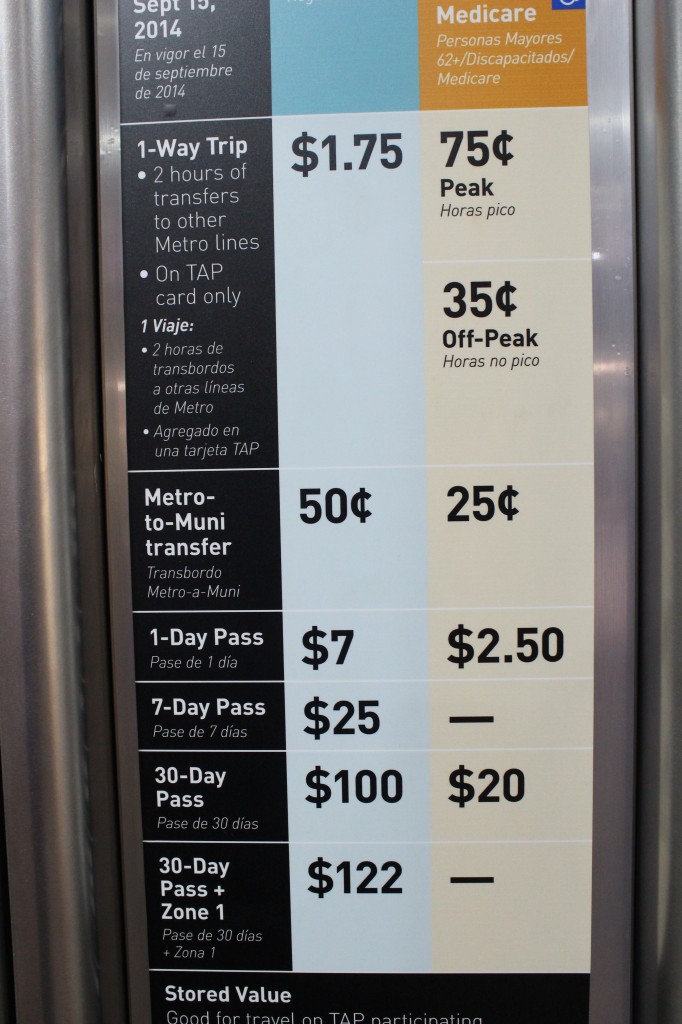
LA Metro fare prices. Image source: The Travel Guru .
Daily and Weekly passes in Los Angeles are currently $7 and $25, respectively, so the weekly spending cap would be reached earlier here, but the message is the same. With this structure in place no one with a TAP card would ever pay more than $7 in a day, $25 in a week, or $100 in a month using normal service—a claim we definitely cannot make today. It could even capture the additional cost of out-of-zone and premium services such as the Metro Silver Line, without the need to purchase a special pass in advance. We’ve currently got a lot of people unwittingly donating their money to Metro, an organization that absolutely should not be in the business of over-charging its patrons—particularly when the median household income for those patrons is less than one-third the median income of County households overall.
Even beyond concerns for social and economic justice, this fare structure is also just smart policy for those interested in growing the appeal of public transit. It’s yet another step toward more user-friendly transit, eliminating the minor stress of forecasting one’s daily and weekly travel and allowing people to just… go. There’s something indescribably freeing about a transit system that doesn’t require its users to be experts, and the ability to “pick up and go” without any preoccupation is one of the greatest appeals of driving. Transit will need to continually evolve in that direction to compete.
Prior innovations, especially real-time tracking, have dramatically improved the experience of trip-planning and transit use. This evolution in fare policy is by no means so great a leap forward, but it’s an obvious and sensible step forward, and the technology is already in place to implement it. What are we waiting for?


9 comments
Archived from the original site. Commenting is closed.
<p>Are there any American transit systems that follow this proposed type of fare structure? My guess is that most American transit systems are under so much pressure to increase farebox recovery that this kind of overpayment has already been factored into their budgets. I'm not opposed to fare capping by any means, but it's worth keeping in mind that if/when a transit agency implements fare capping, it's likely that agency would also raise most fares to compensate for the lower farebox recovery. Just worth keeping in mind for better or worse.</p>
<p>I'm not sure Alex, but according to Michael Anderson in Portland, OR, Trimet is planning to adopt a system like this in 2017. (I'd have to confirm how similar it is though.)</p>
<p>I agree that cost recovery is a concern, and something that I gave some thought to. Ultimately, though, I don't think anyone can make a convincing case that cost recovery is a justifiable reason to overcharge low-income transit riders for trips they never end up taking. You're probably correct that to maintain exactly the same cost recovery would require a slight bump in ticket prices, but I don't think this overcharging is a massive problem—if I had to guess, this change would probably cost a penny or two out of existing fares. The reason to pursue it is that the benefits are more likely to accrue to riders who can't always buy monthly passes or have erratic schedules (and those people are more likely to be low income), and also because it's just a more user-friendly system, and that's to everyone's benefit.</p>
<p>With the introduction of two hour free transfers, Metro has already abandoned the daily and monthly pass. Under this system, three charges against your tap card means an extremely busy day (and four charges means you came back the same way you want to lunch. Stop it.) Essentially all trips are $1.75, making the basic commuter cost $75.83 per month. In order to exceed the mentioned $7 in fares today, you would have to make five non-transfer boardings. Where would you find the time?</p>
<p>It's a reasonable point James, and I have a few comments on it. One is that the current day pass cost probably doesn't make much sense, for the reasons you described. Anyone who buys it may be very likely to be getting ripped off. That either means we shouldn't have day passes at all, or we should lower the price, but I think my suggestion captures the benefits of each while still maintaining the "travel all you like" spirit of the day pass.</p>
<p>More importantly, if you get past the day pass and consider travel throughout the week, a day pass each day adds up to $49 for the whole week, which is ridiculous. To be more realistic, if you assume someone takes 10 commute trips each week and 8 non-work trips (there and back for three events/errands, maybe 2 of them on a weekend and another 2 on weekday nights), that's 18 trips for $31.50. Once the person hits $25, I see no reason to charge them more since if they'd been able to anticipate that travel they'd have sensibly purchased a weekly pass—they can't really be blamed for being unable to predict the future.</p>
<p>This isn't a huge amount of money we're talking about, but that's also part of what should make this relatively easy to implement. We shouldn't be nickle-and-diming transit riders, especially in LA given how heavily our transit ridership demographics skew toward the working poor and people of color.</p>
<p>On the matter of the potential loss of fare revenue, switching to a more fair fare system with caps as suggested will attract some new transit users. It is possible that the revenue from new users will exceed the lost revenue from those who are technically overpaying now, due to their inability to predict the future.</p>
<p>On The Source, it was mentioned that rolling day passes are not feasible with flexible time periods. You (Shane) had asked why this is the case, and I would argue that programming for a rolling period that goes back 168 hours is going to be difficult because it would require the card to add up all fares or look back within 168 hours from the last usage. </p>
<p>It may also be an issue with the Cubic fare system. For instance, on Clipper, Tri Delta Transit will have to modify its 24 hour pass to a pass that expires at 3 am the next day when they implement the "accumulator". The programming logic for that is fairly simple: if fares paid in (calendar day) to TDT > day pass cost then do not charge until 3am (calendar day + 1). To avoid the farebox doing summing you could have an accumulator increment by one for each fare in a calendar day and charge (day pass cap - fares paid) for the last trip before the accumulator is reached. For the Oyster weekly pass, it would be if fares paid after (Sunday of the week) > weekly pass then do not charge until (end of calendar week). </p>
<p>With a weekly pass, you would have to have a rolling period which would confuse riders. The programming logic would be: if (fares paid in previous 168 hrs) < (168 hour fare cap) then charge full fare; if (fares paid in previous 168 hours) + full fare < (168 hour fare cap) then charge (168 hour fare cap - fares paid in previous 168 hours); if (fares paid in previous 168 hours) > (168 hour fare cap) then charge 0. So, in any given 168 hour period, the fare cap would not be exceeded, but the farebox now has to sum up all fares paid in the previous 168 hour period, since there would be no running total or accumulator as could be implemented in a calendar based operation. You could have the 168 hour period defined as after the first tap, but if someone makes one trip on day one, with most of their trips on days five and six of the 168 hour period, they will only get one day of free travel, with the accumulator resetting in day eight, even if it may have been more advantageous for the period to start in day five and six.</p>
<p>I definitely see that it would be more complex Henry, I just don't see why that's too complex for Metro or their computers. They seem like fairly simple calculations for a computer to make. Even a calculation that took 100 times longer than the existing one would probably be essentially instant from a human perspective, I would think.</p>
<p>I guess a follow-up question would be, if you can only do 7-day and monthly periods that start on (e.g.) Mondays and the first day of the month respectively, are there situations where people would spend more than they do today? They definitely might not save as much money as the rolling system, but I believe the worst case scenario is that they'd be no better or worse off than they are today. (I'd have to think more about the range of possible scenarios to be sure of this.) And even if they saved no money they'd still have the added convenience of not having to think about whether to purchase a daily/weekly/monthly pass or not.</p>
<p>The rolling cap has a huge potential to confuse people, especially since it's not in place anywhere else in life - think of other duration based costs like cell phone bills or parking charges. </p>
<p>As for a calendar based accumulator, the obvious people who wouldn't benefit are people who had a break mid period and could have spanned the calendar periods. An example would be someone who rode days 1-5, took a break and rode days 20-40, and then took a break and rode days 55-60 (assuming a 30 day pass and an accumulator of 15 days = 30 day pass). In a calendar based system, this person would ride free on day 30 and day 60, but would pay for 30 days total. If they chose their own period, then they would pay cash for days 1-5, buy the pass for day 20-40, and pay for days 55-60, thus only paying for 26 days. (In a continually rolling pass system, they would pay for days 1-5 and 20-29, ride free day 30, pay days 31-35, ride free days 36-40, and pay days 55-60, also for a total of 26 days.)</p>
<p>The self selecting rolling calendar pass is a boon for visitors, short term users (i.e. people without cars temporarily), people with occasional transit needs (like someone taking an intersession class that spans calendar periods), and so forth. Automatic rolling periods with a look back (like I describe above) would probably benefit all riders all the time, but would be confusing to explain (I had to do an Excel spreadsheet to understand the amounts paid in my example above).</p>
<p>I see the potential for confusion, but I think for an automatic rolling period with a lookback you can clearly make the point about daily, weekly, and monthly spending caps, then the rest is just details. As long as people understand that Metro won't charge them more than those amounts for a given time period, the specifics aren't so important.</p>
<p>One thing I think that could be confusing in a way that actually matters is how people know when they've reached the cap for a given time period. It would be useful information to know that you've already spent $25 for the week, but the TAP card system doesn't currently have a good way of notifying people of that (the little displays at turnstiles are basically behind you by the time they display your card's status).</p>