Proposition 13, the constitutional amendment enacted in 1978, transfers wealth from young to old, from poor and middle-class to rich, from black and Latino to white, and from renter to owner. As the “third rail” of California politics, reforming the law will be challenging. But there are realistic, workable solutions to the problems posed by Prop 13, and reform has the potential to provide incredible benefits for the majority of California’s residents.
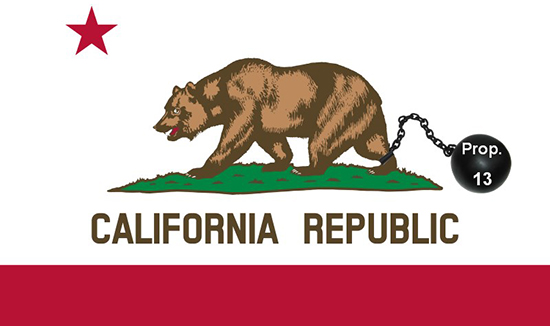
Image source: Capital and Main .
In **Part 1**of this two-part series, I discussed all of the reasons Prop 13 is such a backwards, destructive law: basically, it does a poor job of targeting those most in need of assistance; forces the government to find revenues in other, less progressive places; places a greater burden on young, new, and non-white residents of California; and discourages physical and economic mobility. It also ignores the key fact that people whose homes increase in value virtually always come out ahead. Way ahead. The value of someone’s house goes up by 50 percent and they’re the ones we’re worrying about? In a state with nine million people living in poverty? Really??
Ahem.
So, with the law’s many faults laid bare, I’d like to turn to how we make things better—how to change Prop 13 into something that protects those in need of protection, and creates a fairer, more equitable tax structure for the rest of us.
WHAT TO KEEP
There are two things that people really love about Prop 13 as it pertains to property taxes. First is that it keeps their taxes relatively low by putting a cap on the property tax rate (one percent) and limiting how quickly the assessed value of their homes can increase (two percent per year). Second, and for the same reasons, it makes their property tax payments very predictable—as long as they stay in the same place. These are nice things to have, and people who enjoy them are predictably loathe to give them up.
For primarily political reasons, any reforms to Prop 13 will probably need to preserve these two features: low rates and predictability. If changes result in dramatically higher or wildly unpredictable tax payments for a large number of Californians, they’re very unlikely to be adopted by a vote of the people. Fortunately, it’s entirely possible to resolve many of the worst aspects of Prop 13 without placing any additional burden on homeowners—at least no burden they’ll ever feel.
WHAT TO CHANGE
The most nonsensical thing about Prop 13 is that it treats rising home prices as though they’re harmful to property owners. This is very obviously false. I know this because if I owned a home and it increased in value by $100,000, I would be very happy, not very sad. Even if it meant paying an extra thousand dollars a year in property taxes (which it would, without Prop 13), I would still be really excited about it.
What we need to do is change the law in a way that recognizes the glaring fact that increasing values are good for homeowners, while also acknowledging that there are some who can’t afford significantly higher property tax payments—pensioners and others on a fixed, limited income. And, that while there are quite a few homeowners who could afford to pay taxes on the full value of their homes, they’d rather not. Reform must balance these interests without agitating anyone too greatly.
The way to do that is fairly simple, and it would look like this:
- Let people continue paying property taxes on their homes as though they’re increasing in value by just two percent per year.
- Reassess the actual value of people’s homes every few years, and track the difference between what they’re paying at the two percent level and what they would pay at the full, actual assessed value of their home.
- When they sell their home, collect the difference from the proceeds of the sale.
Under this system, no one is being forced out of their home by rapidly increasing property tax payments. More property tax revenue is collected, allowing the state government to cut income and sales tax rates. Residents are placed on a much more equal footing, regardless of age or tenure. Current homeowners are less discouraged from moving to a new home when it otherwise makes sense for them to do so.
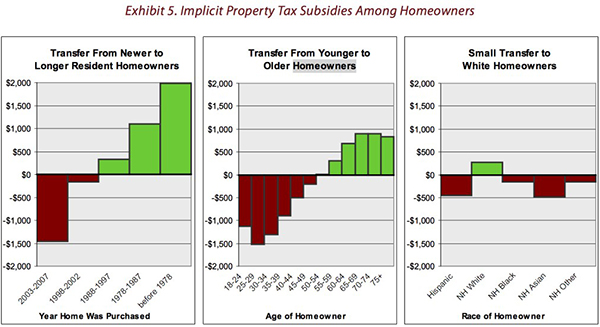
Money is currently being transferred from newer to older residents, and from younger to older and non-white to white homeowners. This is a system very clearly in need of fixing. Source: Dowell Myers, Urban Planning Research .
And people who win big in the housing appreciation lottery still come out way ahead. Take, as an example, a home that’s purchased for $400,000 today. Assume its actual resale value increases by an average of 5 percent per year, but under Prop 13 its taxable value only increases by 2 percent annually. Over a 20-year period the taxable value of the home would increase to $583,000 and the homeowner would pay $107,000 in property taxes.
That home’s actual value—what it would sell for on the open market—is $1.01 million. If the owner sold their home and had to pay the difference between the “true value” property taxes and the “two percent per year” Prop 13 taxes, they would owe an extra $38,500 in property taxes at the point of sale. They’d still come out with a healthy profit of $465,000 on an initial $400,000 investment. If their home’s value instead increased by 6 percent per year, they’d owe $55,000 at the point of sale, but they’d have earned a total profit of $648,000—the faster their property value increases, the larger the difference between their resale value and their total property tax bill. I don’t feel too bad for them; do you?
MORE BENEFITS
Although this system doesn’t raise quite as much revenue as if Prop 13 was abolished completely (since the incremental taxes are collected after the actual assessment, when inflation had eroded some of their value), that’s actually okay. The purpose of this reform isn’t to increase revenue, it’s to level the playing field. Over time the property tax would increase as a share of total government revenues and the state could pare back its contributions to local school districts by an equal amount (or a lesser amount, if we wanted to prioritize education). This would in turn allow California to cut sales taxes and/or income taxes—say, by eliminating the lowest tax brackets altogether, and effectively giving every working Californian a pay raise.
Cutting taxes elsewhere to “pay” for this bill would be a great political sell, too: not only would no one’s property tax bill go up in the short-term, everyone would also get a break on other taxes. The immediate impact would be to put more money in people’s pockets; those tax cuts would be back-filled in the least painful way possible, and by those in the best position to pay. Because this reform’s impacts would take at least a few years to accumulate to a noticeable level, reductions in sales, income, and other taxes would also need to be phased in slowly.
Over time, homeowners would see less need hold onto their homes for tax reasons, and we’d see more of them moving to new homes in locations that were actually convenient for them. This would benefit the homeowners themselves, obviously, but would also help young and first-time homebuyers who are competing in a housing market with extremely limited supply. This in turn could help mitigate some of the demand pressures that are making housing so expensive—for both owners and renters.
CONCLUSION
This is just a general framework for reform; the specifics could well look very different. I think this proposal strikes a strong balance between the interests of current homeowners (who will tend to be supportive of preserving Prop 13 and need to be brought along somehow) and those that rent or can’t afford to own a home (who will tend to be supportive of reforms in whatever form they take). Both groups will be needed to change the law, and so the needs of both must be addressed.
As with everything else I write about, this isn’t the final word on the subject, so let me know what you think of this idea, potential pitfalls, and what you might change to make it work better. And share with your friends, neighbors, advocates, and elected leaders if you think this idea has potential!
Click here to read Part 1: Why California’s Property Tax System is So Broken

11 comments
Archived from the original site. Commenting is closed.
I really like this idea! I had been trying to imagine what a possible solution would be like, and was imagining something where instead of paying taxes in cash, there might be a way to pay the municipality with ownership shares in the property, so that the city could collect when a sale occurs, or so that aging owners could treat it like a reverse mortgage.<br /><br />The solution you proposed sounds very clever to me, and I've been thinking about it for the past few weeks. I just recently came up with a possible worry though - what if people just change the ownership model, so that the home is technically owned by a corporation with a single owner, and instead of selling the home, the person sells the corporation. Then the home never transfers ownership, and the tax collection is never triggered. Perhaps there's a way around this by allowing the tax deferment only for homes owned by natural persons rather than corporations.
This assumes that property values always rise. There is a possibility of home prices rising, homeowners falling in arrears on the tax levied on the fare market value of their home, then the housing market crashing at the same time they sell the home, and therefore not realizing the profit from their home needed to pay for the property tax bill. If this system had been in place through the oughts, we would have seen a lot of people unable to pay their tax bill in '09, '10, and '11. <br /><br />It seems simpler base taxes on a property's market value and allow people to apply for hardship waivers if they can't pay. Although I'm not sure any modifications to Prop. 13 are politically tenable, even if they are much needed.
Grant, I'd agree that a simple system like we see in other states would be better, but it's not politically realistic whereas I think this alternative has promise and is undoubtedly better than the current law.<br /><br />I would also note that a fee waiver system could easily be adopted for those that see a net loss, or a net loss after taxes are assessed, just as there are hardship waivers for normal assessments in other states. The summary I provided above is conveying the fundamentals of the idea, but there would undoubtedly need to be tweaks, offsets, exceptions, etc. for a variety of circumstances. If our options are between a fair system that applies to everyone and includes exceptions where needed, or our current system that basically assumes everyone is an exception and leads to massive transfers of wealth away from poorer, younger, and often non-white populations, I'll take the former option.
<p>You are an idiot socialist liberal wanting to penalize the homeowners for those can't or choose not to buy one. Your idea broken down is simply a redistribution of wealth. California needs to find other ways to lower the income and other tax rates....it should not be on the backs of a small segment of the population. Homeowners already pay taxes that renters do not...WHAT ABOUT THAT!!! Level the playing field..REALLY...how liberal and socialist of you, OBAMA lover.</p>
<p>Ridiculous, renters pay property tax via their rent. Do you think the landlord says "I won't figure in the cost of my property tax into their rent."</p>
<p>That's a major blunder on your part.</p>
<p>As a landlord, I can tell you my renters definitely pay my property taxes through the rent that they pay.</p>
<p>I fail to see why, with your proposal "Current homeowners are less discouraged from moving to a new home when it otherwise makes sense for them to do so"</p>
<p>In addition to the 8% transaction tax (realtor and expenses) and the 23.8% federal + 13% CA capital gain tax on any amount above the primary residence exemption (currently $250,000) they would need to pay back property taxes for the years of ownership, possibly a considerable amount.<br/>A move would be very costly and certainly would prevent owners from buying a home of comparable value to the one they just sold. They would need to downside significantly every time they move ...</p>
<p>So many exemptions for capital gains on homes already in place that you're neglecting. Also a 1031 Exchange. Exemptions for improvement costs. Talk to a tax person.</p>
<p>This is more or less probably important to know as I am considering the possibility of one day moving to San-Francisco or Los Angeles. This would be to pursue a videogame-design career actually.</p>
<p>It looks like the removal of the prop 13 tax protections for commercial properties is set for the ballot in 2020. I’ve often thought that the simplest way to handle prop 13 is to change the law so that it only applies to primary residences. So if you live in it, you get to have the predictability of the limited tax increases offered under prop 13. But if you inherit it, rent it out, or if you are a foreign investor, I have no idea why it would ever make sense to keep the property taxes low. All this has done us discourage home sales, reduced the inventory of available homes am for sale, and driven up housing prices because of the shortage. It’s a total mess. And I’ve heard the arguments people make— they say that if we remove prop 13, that the landlords will raise the rent. Well, I must say that I’m a renter of both commercial real estate and residential. And I say, bring it on! Let’s see them try to raise the rent! People in many areas are already paying half of their income in rent! They simply can’t pay more. If my landlords raise my rent, I’ll simply move to a cheaper place. Granted, I like the area I’m in but in the end, we can only afford what we can afford. And the benefits? Oh my heavens. If you see the guy who posted the other comments you get a sense of the frothing at the mouth rabid fear that these folks have when it is even suggested that they, as landlords, pay their fair share. And do you know why??? Because they know they’d have to sell. Many of them would have to sell. And they would prefer to continue to pay almost nothing towards their local government, and collect thousands a month in rent while their renter’s children go to deteriorating schools. Did you know that in Canada it’s illegal to educate children in trailers? If you visit public schools in other states, you’ll see how bad it is here. Since prop 13, trailers are the norm. It’s disgusting. I’ve rented in LA county and Orange County. And I can tell you that the landlords in this state are squeezing every drop out of every tenant. The idea that they would be able to find tenants if they raise the rent is laughable. The biggest impact here would be the upper-middle and upper class community, because, as the author points out, that’s where the discrepancies between tax rates are going to be the most significant. So where do you think these renters will come from who will pay more? Any landlord will tell you that it’s already quite difficult to find qualified renters. So the landlords would sell. And there would suddenly be a glut of inventory on the market. And people would have the ability to actually negotiate and bargain for a home (instead of having to come in over asking value, which is the current state of affairs). It would be a miracle. California’s schools would be funded. People could buy homes. And when people own a home, they care more about the school and about the community. The California population under 55 has become a state of renters with old landlords who don’t care about the state of the schools because their children were educated before prop 13 ruined the state. Or wealthy heirs who are invested in continuing to skate through on the backs of their tenants and the school children. I pray that someone with some balls will end up in power in this state and end this ridiculous situation.</p>
<p>I really loved the response by the right wing Nazi Trump supporter, that you are a socialist, liberal, Obama lover. As usual, from this type of brain dead moron, they offer criticism but no solutions. Just like their leader and chief moron, Trump. Remember his rant about Obama Care and how he was working on a better plan? What was that plan again?</p>