In a city of 470 square miles, Downtown LA is a speck: five square miles, barely one percent of the total area. And yet, since 1999, approximately one-fifth of all residential construction in the city has occurred in this relatively tiny space. And there’s a lot more coming.
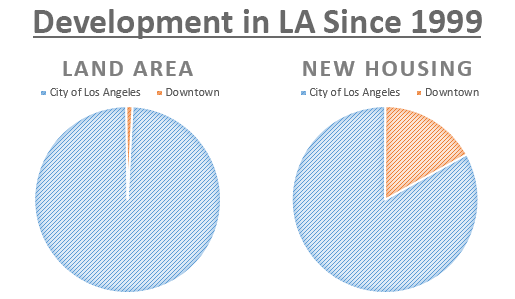
Downtown makes up one percent of the land area in Los Angeles, but it’s accounted for twenty percent of new residential construction since the Adaptive Reuse Ordinance in 1999. Chart by Shane Phillips.
According to the Downtown Center Business Improvement District’s 2014 Market Report, nearly 20,000 units have been built Downtown since the approval of the Adaptive Reuse Ordinance in 1999. Another 20,000 are in the development pipeline, likely to be built in the next 5-10 years. In contrast, data from the California Department of Finance (1, 2) show that the city has added approximately 98,000 new units in the last 15 years.
This focused growth has paid off in a big way, as most locals can attest to, and it’s a testament to what good policy can accomplish. Downtown LA is now a Walker’s Paradise, a Top-Five World Destination, or **America’s Next Great City—**take your pick. In less than 15 years it’s gone from a place to sweep under the rug to a symbol of the city’s evolving embrace of urbanism and multi-modalism.
At the same time, this doesn’t bode well for affordability across the metro area. Part of the reason that so much growth has gone Downtown is because most of the city is essentially off-limits to new development. While other neighborhoods fight to limit the construction of new housing, increasing pressure on the price of existing homes, Downtown has taken a very different tack, attempting to **discourage under-utilization of valuable land**in the urban core.
But one neighborhood can only do so much. Without concentrated, transit-oriented growth across more of the city we won’t make a dent in the demand for housing. And with 500,000 people already spending too much on their homes, the problem is only going to get worse.

3 comments
Archived from the original site. Commenting is closed.
Of course, but it's not going to happen. For the affluent neighborhoods where there's market demand for new housing, there's also out of control traffic and how do they really benefit from it? They don't need "revitalization". For the low-income neighborhoods, they're not all that excited about new development either, but even to the extent that they're open to it, the market isn't there. Some affordable housing gets built because of the subsidies, but the funds for that are limited. So it's not surprising that all of the new housing is in DTLA because it's the only place that both needs it and has the market value to support it.
It depends on the area. There are some places where we really wouldn't want to build more housing anyway, cause transit access there sucks. There are tons of places along high-capacity transit lines (rail and bus) that are very single-family in character, however, and I think there'd be plenty of interest if we actually built new housing in many of those areas. The key is to do so in a way that doesn't utterly steamroll the existing communities. It wasn't as big a problem because so much of Downtown was empty and SRO housing is protected by city legislation, but it'll be a bigger challenge in areas with established communities that are understandably wary of new development. As I've written before though, one of the reasons these changes are often so disruptive to communities is because we're so piecemeal with infrastructure improvements and rezones. Because of that, the gentrification impacts are particularly focused and intense.
No ifs ands or buts, DTLA is the hottest area in the region. Plus to invest in an area that was the laughing stock of the region, so dilapidated really says something.