I’m working on a write-up about how poorly we define housing affordability, but I wanted to put this out there first. This chart shows consumer spending in the U.S., and highlights how much our expenditures have shifted over the past 111 years (data from the U.S. Bureau of Labor Statistics):
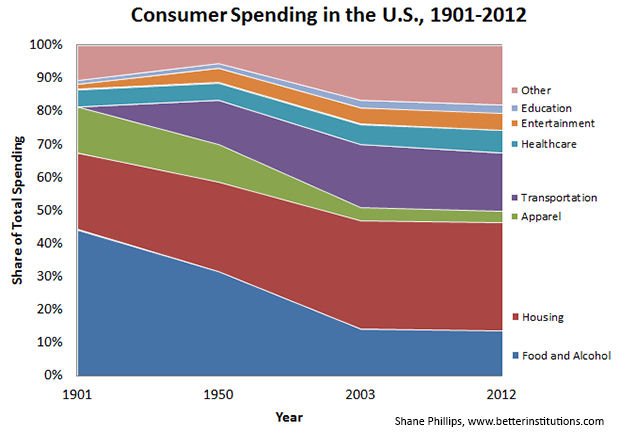
In the early 1900s food and alcohol were, by far, the biggest cost for households; throw in apparel and almost 60 percent of the average family’s budget was already spent. Nowadays, these items account for less than 20 percent of our spending.
Housing, on the other hand, has grown from about 23 to 33 percent of spending since the beginning of the 20th century, and it’s remained at roughly 33 percent throughout the 2000s.
Transportation spending has grown even more, from a negligible expense in 1901 to just shy of 20 percent of total spending in 2003. It had declined slightly, thankfully, to 17.5 percent by 2012.
These are just averages of course, but I thought this provides some useful perspective. A hundred years ago we spent more than half of our money on food and clothing. I think it’s safe to say that we weren’t getting a better dining experience back then, despite the cost, and although the coats were awfully nice, they were ultimately still perishable. Today we spend more on health, education, and entertainment, which frankly are pretty great things to buy from an individual and societal point of view.
We also spend more on housing, which is bad. But as long as people actually have the opportunity to buy—which, in some cities, middle class families really don’t—**owning a home is a much better use of 40 percent of your income**than a bunch of food in your ice chest. That’s not to say that promoting inflated housing prices should be a goal of government policy (as it currently is), or that we shouldn’t do more to make homes more affordable **where people want to live**and where they will have the least negative impact on their environments, but we’re better off today than we were in the past.
At a time when most of us go into retirement with few assets other than the homes we live in, there are worse things than spending a large share of our incomes on housing. For renters in particular, we should continue working for a greater supply of accessible, affordable housing. But even more importantly, we should concern ourselves with transportation costs, which add nothing to the long-term value of our lives or our bank accounts, and have grown in 100 years from nothing to nearly 20 percent of total spending. High transportation costs are no more a given than unaffordable housing in growing urban centers, but unlike with ballooning home values, no one benefits from frivolous, inefficient transportation spending.
UPDATE:
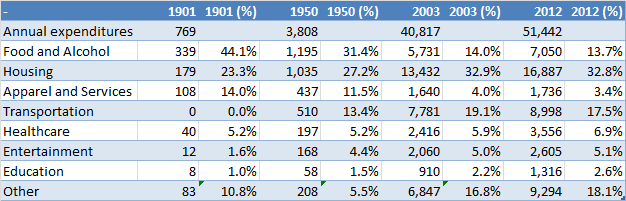
I was asked to include the actual income/expenditure numbers (non-inflation adjusted) that were used to make the above graph. Here’s a table that includes those numbers as well as their share of total spending:


5 comments
Archived from the original site. Commenting is closed.
Interesting. How does this figure with income rates? How about absolute figures (a difficult comparison 100 years apart, I'm sure)?
Is there a version of this chart that includes taxes and what the taxes are spent on? It would be interesting to see if some of these categories are only what the correlations between out-of-pocket spending and government investment are (e.g., considering that federal housing funding plummeted during the Reagan era and never really recovered, is the growth in the consumer cost of housing more or less than the drop in federal housing spending).
Regarding JMS's point, I was also thinking about what it would take to reduce people's share of income spent on transportation, and one of the obvious fixes would be to use more tax money to provide better transportation infrastructure. But it's hard to tell how much of a net improvement that would be, if taxes go up by an amount comparable to the amount that personal transportation spending goes down. (Of course, we would hope that a public transportation system would be much cheaper than millions of personal automobiles, and would also allow less personal expenditures of time on driving - time is really the worse personal expenditure than money.)
Hey Frank, I included that in a table for you just above. A lot of the data can also be found from here originally: http://www.bls.gov/opub/uscs/report991.pdf
<p>Hi great reading your postt</p>