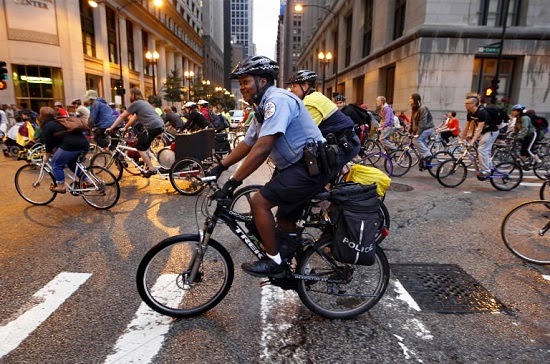
Critical Mass in Baltimore, from the Baltimore Sun .
This is more directed at my fellow urbanists and multi-modal advocates (not that anyone else reads this, of course!), but do you ever get the impression that people just connect more easily to articles and news about bicycling?
In my case, I write about land use and transportation, and while I’ve written specifically about bicycling in the past it’s a pretty small minority of what I’ve done. I’m pro-bike, but I’m no more a bike advocate than I am a transit, pedestrian, or density advocate. Despite that, when friends who are less involved in the multi-modal movement send me links about urban issues, it’s usually things like **inflatable helmets**or electric bike wheels. Almost exclusively. And when someone wants to be snarky, they always ask me “how’s the bike?” never “how’s the bus?” or “how’s the sidewalk?” (Admittedly, those just don’t seem to have the same ring to them.) I’ve also noticed that many bicycle advocates really love *bikes—*not just getting around by bike but the bikes themselves. In comparison, I think transit’s great but I couldn’t name a train or bus model to save my life.
And while some of my posts over the last year and a half have been fairly popular, nothing was shared so immediately and widely on Twitter and elsewhere as my article asserting that bicyclists still don’t have their fair share of road space in New York City. Something about bicycling just seems to grab people’s attention, and sometimes polarize, in a way that other transportation modes rarely replicate. This probably helps explain the success of the bike movement over the past decade or so, and the rapid expansion of bike share programs across the country and throughout the world.
Assuming this is a real phenomenon, I wonder where it comes from. I think part of it may be that many people have absolutely no experience bicycling—at least not as a transportation mode in their adult life—whereas everyone walks and most people seem to recognize the value of transit even if they don’t use or need it personally. This may make it easier to develop an us-versus-them dynamic that, while not always productive, does encourage more loyalty to your own in-group.
Even more, it might be that the experience of bicycling is often so emotionally thrilling, both in terms of excitement and fear—anyone who’s commuted by bike on a semi-regular basis is well-acquainted with each, the balance between them mostly dependent on the safety of bike infrastructure in your neighborhood. Transit and walking are both fairly mundane in this regard, and I’d argue that driving is the second-most emotionally-charged transportation mode, so that could be why the battle lines seem to usually be drawn between bikes and cars, not cars and buses, bikes and pedestrians, etc.
I’d be curious to know if any readers have also felt this way, and if so, what you think might be behind it. And if any of this came across as critical of bike advocates it wasn’t my intent. If anything, I’d like to know more about why bikes seem so much more emotionally charged in order to bring that same passion to transit and walking.

5 comments
Archived from the original site. Commenting is closed.
I'm guilty of being one of those that shared your post on allocation of space to bikes in NYC. I really do think it was one of your better posts, though you've had plenty of other good ones. I'm not sure what does it about bikes/cars for other people, but perhaps it is because bikes and cars are often the fastest and most efficient ways to get around a city for the vast majority of trips. Sometimes a car is faster (particularly for very long trips), and quite often the bike is faster (particularly when factoring in time spent searching for parking/an available taxi). Very very rarely is walking or transit the fastest of the 4. They have other advantages (cost, ability to do other stuff while on the go), but due to their time-inefficiency they are not "sexy". Trains do have some passionate advocates, but modern American trains don't give one too much to get excited about. Even running/jogging has a fair number of enthusiasts, but walking is just too mundane.<br /><br />Also, walking and transit do not require one to own special equipment, whereas bikes and cars generally do (even bike share charges a membership fee, which makes one feel like a part-owner of the system). People tend to get excited about the choices they must make up front to participate in these activities. Taxis may be the exception, but I'm not sure car enthusiasts are equally enthusiastic about taxis.
This comment has been removed by the author.
One major reason bicycling is a hot-button issue, while pedestrians in particular are not, may simply be that bicycling appears to be an actual, realistic threat to that most pervasive and most ingrained of American institutions—car culture—while pedestrians truly pose no such threat. While urban bicyclists, at great personal risk, successfully demand and often hold their few square feet of public space that was previously the de facto exclusive domain of motor vehicles, the equally-vulnerable-but-less-daring pedestrians cower in the shadows along the street edges they've been banished to, making no waves. The result of this state of affairs is that, after 100+ years of repeatedly trying and giving up, pedestrians have miserably failed to make any inroads at all into slowing the encroachment of car culture; yet bicyclists have forced incalculably more, real, useful change over just the last several years alone, just by going about their business and not settling for the status quo (and, of course, by getting organized).<br /><br />Sadly, pedestrians, counter-intuitively, often perceive bicycles, which are relatively safe vehicles (if annoying, startling or even scary in their perceived newness) as "the real threat"—a threat that they don't perceive motor vehicles to be. Rather than continuing to grouse about bikes while hundreds of thousands are killed or horribly injured annually by motor vehicles, the historically ineffectual "pedestrian lobby" should rather be banding together with the demonstrably effective "bike lobby" in common cause against car culture—the real villain that has destroyed cities, climate, economy and lives for more than a century (useless phrases like "war against cars" be damned).
I think maybe part of the reason is that people often think of bikes as toys. People who don't ride them find it jarring that someone would use a "toy" for transportation. On the flip side, why would someone love a bike? I don't know, but there are certainly people who love their cars, and even trains. Are bike lovers more common as a fraction of bike users than car lovers among car users? Maybe, but I don't know. If they are, maybe it's because their love of the bike motivated them to try it for transportation rather than the other way around?
Motorist privilege is all-pervasive in the US, and like all forms of privilege, is invisible to those who enjoy it. Bicyclists by their sheer presence on the road, challenge motorist privilege. This is why it provokes such rage on the part of motorists. Cyclists are clearly weaker than motorists. Any motorist can kill a cyclist if he or she chooses to do so. <br /><br />Cyclists are also clearly judicially weaker. The consequences of killing a cyclist are minimal - other than some scratched paint on your car, all you need are some words of remorse, and you'll just have to pay a fine, usually less than $150 - even less if you're a minor. <br /><br />As a result, some people are angry that their position as motorists is not fully respected by cyclists. Cyclist "get in the way", and when they do not dive into the ditch to avoid getting run over, but force the motorist to actually pay attention to the road, maybe even slow down or change lanes...this lack of deference is extremely irritating.<br /><br />Cyclists do not flout laws any more than motorists do, but the laws that they are more likely to flout are ones for which there are high stakes for motorists, such as running a red light. Therefore, motorists are enraged when they see these laws broken, even if those motorists routinely break laws that endanger non-motorized road users, like speeding. Motorists also fail to recognize that when cyclists break laws, usually the only person who is potentially dies is the cyclist. When motorists break laws, other people die. <br /><br />The ways that motorists are favored in public policy also operates invisibly. From the idea that we need lanes wider than that needed for a bicycle to multi-billion dollar wars fought to protect the oil supply, the needs of motorists are routinely accommodated. When teeny-tiny amounts of money are spent to benefit bicyclists, then again, their privilege is being challenged. Cries go out: despite subsidizing motorists in so many ways, they call for cyclists to pay even more: licensing fees, user fees - there's no end of the additional burdens that are demanded. <br /><br />Some cyclists call for separation. Believing that motorists' inattention and aggression can never be addressed successfully, they ask to be ghettoized into cycletracks and bicycle lanes. Others call for integration, taking the lane and at most asking for sharrows to be painted. <br /><br />What I think would very much help, but because of the deep imbalance of the power equation, would never be adopted: if we had a system of bicycle education and licensing for adults, that was a prerequisite for getting a motorist's license. If everyone had five years to complete a one year, one thousand mile bicycle tire *on the road* (not on the trail or god help us, the gym) experience requirement, then - except for the disabled - everyone would have an idea of what it is like to be a cyclist. Imagine further: that the cost of getting your bicycle education and license would be completely free of charge, and the costs of this would be added to the cost of getting a motor vehicle driver's license. <br /><br />I know, because of motorist privilege, my dream will never happen. But it would really help. Then cyclists would be more likely to seen as "us", not "them". We'd have some chance, maybe, maybe, maybe, of greater equality. We could ride in greater safety. Everyone would be healthier - and dare I say, happier. <br /><br />Yes, dream on. Dream on.