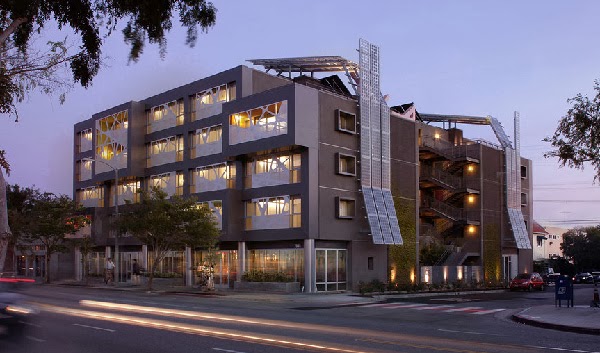
Mixed-use affordable housing in West Hollywood, built for people living with disabilities. Image from
.
I attended the annual Mayoral Housing, Transportation and Jobs Summit this week, held by the Los Angeles Business Council, and wanted to write something about how we pay for affordable housing. Workforce and affordable housing is a critical need, and one that every major city in America is failing to supply in adequate quantities.
One interesting point made by one of the speakers (I believe it was Paul Habibi) was that in Los Angeles, 80 to 120 percent of Area Median Income (AMI) is still too low to support profitable construction, even in areas with pretty inexpensive land—not places like Downtown or West Hollywood, in other words. To house people earning those incomes would require subsidies of up to $65,000 per unit, and that’s assuming the land was given away to developers for free, which is technically illegal. I’m hoping to get into that in greater detail in a future post.
For now, I wanted to get into the issue of how we actually pay for those subsidies. Cities, states, and the federal government each have their own programs and funding streams dedicated to increasing the supply of workforce housing. I doubt I could list all of them if I tried, but suffice it to say that the money comes from a lot of different sources.
Some of these programs, unfortunately, are dependent on market-rate renters and pro-growth communities to bear the burden of subsidizing affordable housing.
One example comes from a panelist at the MHTJ Summit, speaking on the subject of building affordable, sustainable housing along transit corridors. She made a comparison between Los Angeles and San Francisco, claiming that because of SF’s incredible housing prices, market-rate rents can more easily subsidize affordable housing. In Los Angeles, where rents are generally more reasonable (though still high), this is harder to accomplish. Construction costs don’t vary
too
much from region to region, so you can imagine that if it costs $200k to build an affordable unit it’s easier to absorb that cost if your market-rate apartments are going for $4,000 a month rather than $2,000.*
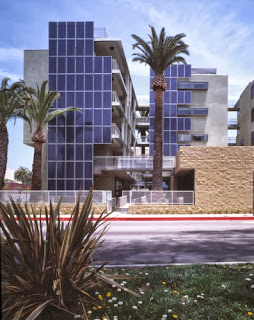
Colorado Court, an affordable housing
development in Santa Monica.
Image from
.
The panelist only intended to demonstrate the relative challenge of paying for affordable housing in Los Angeles, but I think there’s something seriously wrong with the idea that it’s market-rate renters’ responsibility to directly subsidize their neighbors. I don’t mean this in a libertarian, keep-yer-guvmint-hands-off-my-money way. My problem is with a system in which a small group of people—people who have absolutely no direct connection to the need for workforce housing—are bearing the whole burden of paying for it. The cost of providing this public good, something that almost all of us agree is desirable from a public policy standpoint, is not being broadly shared. Renters in older multifamily buildings don’t contribute to this fund, though they do pay higher rents due to the restrictions that rent-regulated units impose on market-rate housing supply. Homeowners don’t contribute at all.
Something similar happens in high-rise districts, like downtown, where developers often wish to build at densities beyond the by-right limits imposed by the zoning code. When they want to build above a 6:1
(FAR), they pay a fee known as Transfer of Floor-Area Rights (TFAR) to buy unused air space from another property owner. This fee can reach into the millions of dollars for large buildings, but has the benefit of being spent on the local community. It can be used for schools, parks, streetscape improvements, public art, or any number of other nice things.
Or it can be used on affordable housing.
I have no problem with public money being used on affordable housing, as I hope I’ve made clear. But again, this is a case where a community like downtown, an area that has been extremely growth-friendly, is being held responsible for providing a public good that benefits the entire city. And they have to do so at their own expense, as any TFAR money that’s spent on affordable housing is money that’s not being spent on other local benefits. Anti-growth neighborhoods benefit from having this supply of affordable housing nearby, but they pay nothing (or at least considerably less) to help support it.
These aren’t the only ways that affordable housing is paid for, and I’m pretty sure they don’t account for the majority of the subsidies in LA or any other major city. Even so, if we agree that affordable housing is desirable we should be willing to pay for it in a more transparent, direct, and broadly-shared way. The burden shouldn’t fall disproportionately on new residents, nor should it fall excessively on pro-growth communities, which are already doing the most to restrain rent inflation by trying to meet the demand for urban homes. If we really believe in the value of workforce and affordable housing, we should all be willing to pay for it, and we should make an explicit commitment to doing so.
UPDATE: I wonder what the impact of
this finding in the California Supreme Court
will be in regard to affordable housing.
*There are also land value costs that must be offset, however.

10 comments
Archived from the original site. Commenting is closed.
I agree that pro-growth areas bearing disproportionate costs for affordable housing sucks. I disagree that you proposed a better alternative. If you go to an existing middle-class taxpayer and tell them that, in the interests of fairness, you are going to raise their taxes to provide a below-market-rate home for a working class person at the end of his street...forget it. Faced with no better alternative, it is better for new development to fund affordable housing than to have no new affordable housing.
I'll admit that I didn't really focus on the solution in this article, but I would disagree that there isn't a better alternative. San Francisco actually passed an affordable housing fund less than a year ago (up to $51 million a year for 30 years) by a 65-35 vote. I suspect part of the reason it was so successful was that it tied other things in that middle class voters would like, like down payment assistance for middle class home buyers and foreclosure prevention assistance. (Source: http://globalsiteplans.com/environmental-design/communityeconomic-development/san-francisco-establishes-affordable-housing-fund/)<br /><br />If anything, my bigger concern is with whether building affordable housing is the solution in the first place. According to the above-linked site, that (up to) $51 million a year over 30 years is expected to only build 4,500 affordable housing units over that time period. Maybe that's better than it sounds, but I question whether it wouldn't be more efficient to just let developers build and subsidize rents directly.<br /><br />Either way, though the issue here is somewhat idealistic, I don't think it's unsolvable. It's just hard.
You are absolutely right that the burden of providing affordable housing should be spread more widely. And the $4000/month rent doesn't necessarily mean the burden is easier, as the sorts of communities with such high rents will often require relatively more affordable housing to be built. In fact, the affordable housing requirement is likely a large part of the reason rents are so high to begin with. Furthermore, not only do homeowners not contribute to an affordable housing fund, they even benefit from imposing these requirements, as it prevents more housing from being built, thus increasing the value of their property.<br /><br />Affordable housing is yet another example of the middle class being forced to pay for anti-poverty programs while the incumbent rich (note: not new rich, since they will implicitly pay for it via the higher cost of a home) pay nothing.<br /><br />As an additional aside, a transparent program funded via broad taxation (e.g. property taxes) would also be able to build MORE affordable units as the cost of housing would decrease, thus lessening the subsidy necessary per unit to make it affordable.
Maybe, instead of worrying about who now to tax to provide the NGO and contractor/developer industrial complex with billions in subsidies for what the author bizarrely refers to as a "public good", we should dispense with the collectivist notion, and let people fend for themselves.<br /><br />Why does someone who chooses a lifestyle with more overhead and less income have a right to a share of mine? Since when does the State get to decide that I pay more and the uneducated, unwelcome family down the road, gets to pay less and live in a nicer abode?<br /><br />This is fundamentally wrong.<br />
I'm objecting on a technicality and not arguing with your broader point, but you bring up two issues:<br /><br />1- Pro-growth communities pay the burden... to the extent that this is the case, agreed<br />2- The burden falls disproportionately on new residents<br /><br />I think point #2 is a bit confused. As I understand (based on your post), the burden falls directly on newly built rental units, and indirectly on all renters, through supply and demand.<br /><br />Where the direct effect is concerned, renters of new construction are not the same as new residents. This means that (if secondary effects don't intervene), new construction costs disproportionately more to rent than older construction. This is something I've noticed on the westside but attributed mostly to parking requirements.<br /><br />As for the indirect effect, it sounds like rent control is the real culprit (in a neutral sense; I'm not expressing an opinion on whether it's a good or bad thing) in shifting more of the burden to new residents.
Fair point Babak - new residents to a city probably aren't any more (or much more) likely to be living in newly-constructed units. And I suspect that parking requirements are an even bigger added cost than parking (especially when even the affordable units are required to have parking), but I've written about that plenty in the past and wanted to cover a topic that gets less notice.<br /><br />To some degree it's probably more accurate to say that renters all pay for affordable housing, because the restricted housing supply drives up rents for all market-rate units. Landlords aren't gonna charge less than they can get for their units just because they don't have to pay for some affordable housing units, they'll be happy to pocket the profit (which is completely their right to do). Maybe it could be said that it's actually the OWNERS of old buildings that benefit relative to the owners of new buildings, not so much the renters in either case. And of course, single family homeowners still are exempt from this cost.
A lot of problems here. First off, you are talking about inclusionary zoning, which is completely off the table and on the run (CA might be the first state to outlaw it, if it is not already). Given the Palmer vs. LA decision it is not on the radar here. But even in a mandatory inclusionary system, I'd argue it is not the wealthy renters who are subsidizing anyone. The $4000 rent is not priced according to cost of development, it is priced at whatever the developer can get at the time. So the assistance to house our teachers and nurses is coming out of pure profit. If there was no profit it in, developers would not be building the housing. We can argue whether inclusionary is good policy or not in that it likely does inhibit some marginal amount of housing growth, but putting up the wealthy renter as the victim is not correct. <br /><br />Neither is the notion that TFARs are somehow terrible because they force a developer to pay for extra density. This model is sortt of an outdated and more limited type of the density bonus, whereby a developer is getting something in return for something the public needs. The public created the value provided by the extra density. Again, we can argue whether zoning downtown makes sense, but I'd argue that when the public is putting in billions in improvements and then creates hundreds of millions in floor area by zoning changes, the public absolutely has a right to ask for some public benefits in return. <br /><br />BTW - I agree with the final point is that affordable housing should be funded more broadly and transparently. We came close with Measure H (65-66% of residents voting to increase their own taxes in the middle of a recession) - but I'd argue those that create low-wage jobs in our City have a special responsibility to pay more. Companies like Walmart and gas stations, convenience stores...
I think the biggest flaw in your argument goes back to a misunderstanding of the panelist's comment. I'm willing to bet that he/she was talking about a specific type of affordable housing called an "80/20" deal where the developer is allowed access to tax-exempt debt and tax credits in exchange for providing 20% of the units at affordable rates. In this case, it is true that the market rents on the 80% need to support the lost income on the 20% of affordable rents, but it's also true that in exchange for providing 20% affordable units, the developer receives an interest rate subsidy and tax credits. The true problem is that in the current interest rate environment, there isn't a substantial enough difference between the taxable and tax-exempt interest rate to make up for the rent differential in most parts of Los Angeles. Needless to say, this is much more nuanced point than you, and certainly many of the other commenters acknowledge.
I would consider 3 principles for the purpose of this discussion:<br /><br />1- Developers will seek the maximum amount of profit they can get and try to rent their units for as high a sum as they can charge.<br />2- There will generally not be any private development unless a profit can be made<br />3- All other things being equal, any fee or tax or any other charge to the developer will result in higher rent and as the argument would follow, lower fees would result in lower rent<br /><br />I'm all for higher fees and higher taxes to provide affordable housing to lower-income individuals but I don't let my ideology blind me to the simple economics. In the long term, any charges would result in higher rent or if competition does not allow for that, for less development leading to less supply and eventually higher rent that would let development resume.<br /><br />You can draw the baseline anywhere you want and say that the developer is actually paying a perk.. well if you gave them the perk without charging them and if there was adequate competition, rental rates would come down so they are effective higher than they would have been under such circumstances. Same difference!<br /><br />I would move forward by deciding:<br />- how much affordable housing we should have (my opinion, a lot more)<br />- how to distribute the cost more justly (I think most of our rules are biased and arbitrary)
Very good point on the first paragraph. It's a bit easy to mix up the issue of how rents are actually set, but you're right that they're basically set at whatever the market will bear--other considerations are secondary. As you say though, things like inclusionary zoning can turn a profitable project into an unprofitable one, and unbuilt housing means less supply, which means higher prices for everything else. On the Palmer vs. LA ruling, is that the exaction finding the state Supreme court just had, or something else? I'm not on top of land use law, to say the least.<br /><br />And I'm not arguing that TFAR be eliminated, or at least that the funding stream disappear, but it would be nice to see a more explicit connection between fees/taxes and what they're spent on. Value capture would be great, but I recognize it's difficult to implement, probably particularly so in a country like the US.<br /><br />As to your very last point, I completely agree. My feeling on low-wage companies is that if your business plan can't succeed unless you can pay your employees so little that they're utterly dependent on the government for survival, that's a shitty business plan and maybe you shouldn't be in operation.