National Center for Safe Routes to School .
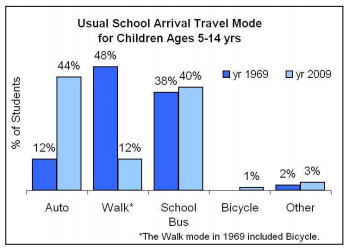
Of all the negative impacts of car-centric development over the last century, few are more stark or disheartening than the decline in walking and bicycling for school-age children. The share of kids getting to school with their own two feet has dropped an incredible amount over the past forty years, from 48% in 1969 to roughly 12% today. Over that same time period, childhood obesity and children driven to school in a private automobile have each increased four-fold, and their freedom to explore the cities they live in has been sharply curtailed.
In response to these troubling statistics the Safe Routes to School (SRTS) program began in 1997 and a national program was established by the U.S. Congress in 2005. The primary goal of SRTS, as stated on their website, has been to “improve safety on walking and bicycling routes to school and to encourage children and families to travel between home and school using these modes.” There’s evidence that they’ve had some success, including one study that showed California schools receiving infrastructure improvements were able to increase biking and walking rates by 20 to 200 percent and another showing a decrease in collision rates by up to 49%.
The benefits aren’t limited to safety and physical activity, either. Cars driving kids to school are estimated to account for 10-14% of morning traffic. Air pollution is often markedly higher in school zones and contributes to other health problems, like asthma, and increases atmospheric carbon concentrations. Kids who walk or bike to school **have measurably better concentration**than kids who are driven. As a nation we spend $21.5 billion a year busing students, which works out to $854 per student. By comparison, many schools in Japan ban car drop-offs and limit busing, choosing to instead spend that money on crossing guards and pedestrian improvements. As a result, 80% of children age 6 to 12 walk to school there (and they do it without adult chaperones, too).
Last year, as part of its MAP-21 transportation package, Congress effectively reduced Safe Routes to School funding by combining it with several other walk/bike programs and reducing total funding by 30%. These cuts will inevitably lead to smaller gains in children’s safety and physical health, and their wrongheadedness is virtually beyond dispute. Instead of harping on that point, which has already been done effectively elsewhere, I’d like to focus on what can be done in lieu of adequate funding. Because even though more is needed, money alone won’t get us back to where we want to be. The question we need to ask is: How can we leverage the people power of schools and communities, not money and infrastructure, to get more kids walking and biking to school, and doing so safely?
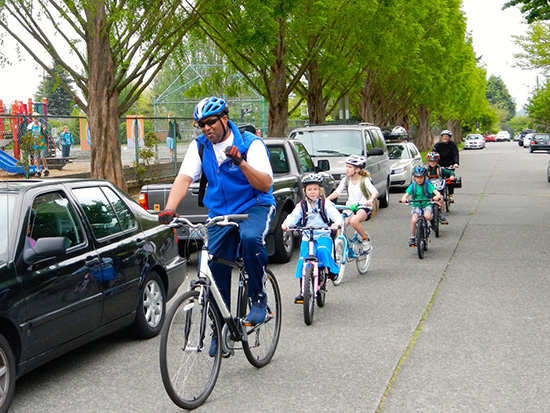
Loyal Heights Elementary principal Wayne Floyd leading a bike train, photo by Clint Loper .
Seattle, like many other cities, has been experiencing something of a revolution in how our children get to school over the past few years, and Seattle Bike Blog has done a great job of documenting the change: on Bike to School day this year **one elementary school had hundreds of students biking**to school as well as a VIP appearance by the district superintendent; several schools in the Ballard neighborhood are promoting biking and walking to work, and even some principals are getting involved; and a new organization called **Walk.Bike.Schools formed just last year**to share ideas about how to increase active transportation to and from schools.
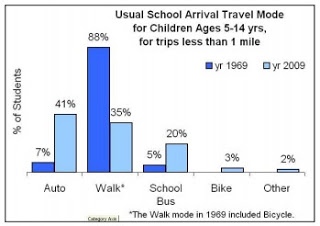
61% of students less than 1 mile away are driven to school!
All of these programs are great news and an encouraging sign of the trajectory of the movement, but at this point they’re much more likely to be big once-a-month events than daily, routine commutes. How are kids getting to school the other 95% of the time? Too often, the answer is still “cars and buses.”
Given the number of students arriving at school in cars, there are clearly plenty of parents with time in the mornings, many of them probably stay-at-home moms or dads. They could be taking some extra time to lead biking and/or walking trains every morning, gathering students as they make their way to school with their own children, but they’re not. With the full disclosure that I’m not a parent and can’t pretend to know exactly what their concerns might be, I think much of it comes down to two related issues: potential parent leaders may not want to take responsibility for the safety of kids they don’t know, and other parents may not be comfortable leaving their kids in the care of someone they don’t know well, even for a 15-minute walk.
The problem here, if it is indeed a part of the problem, is ultimately a lack of community. Most people would never harm a child, but when people don’t know the members of their community they can’t always trust them by default. It may be that school districts or another credible institution can step in to bridge the gap and provide a framework for continued growth.
Schools, teachers, and administrators are extremely well-respected and trusted in America, and they could function as intermediaries in this impasse. (They could also lead these trips themselves, though they shouldn’t be obligated or expected to do so.) They’re in a position to lend credibility to potential parent leaders interested in running bike or walking trains on a regular basis, as well as to allay the concerns of hesitant parents. Bestowing credibility upon parent leaders could take the form of something simple and informal, like a brief interview or background check, or could be a more involved “licensing”-like process with classes and meetings with other parents and children. Though this might be a bit over-the-top in terms of burdening the parents interested in participating, I would argue that if it’s what’s necessary to get kids walking and biking to school every day, it’s worth the trouble. As familiarity with the program and a proven track record of safety was established, the need for such formalized measures would be likely to fade.
There’s also room for technology in solving this problem. Lenore Skenazy, interviewed last year by Salon, captured my thoughts pretty well:
So what’s the antidote? Skenazy has thought about setting up a website, Find a Free-Range Friend, “like a dating site,” she says. “You put in your kid’s age and ZIP Code so you can find another parent and say, ‘OK, you believe in it and I believe in it. Let’s send them to the park together, or they can walk to school.’”
A better analogy might be something like Lyft, the ride-sharing business where people can use their cars as taxis and connect with people who need rides via a convenient smartphone app. In that same spirit, parents walking or biking to school with their kids could broadcast their trip, inviting other parents to contact them if they’d like their kids picked up on the way, free of charge!
As a last note, the emotional pull of how little freedom kids have nowadays, and their utter dependence on adults for transportation, is especially powerful for me. With that in mind, I’ll leave you with this excellent Streetfilms production on how much things have changed over the past half-century:
STREETFACTS #4: Children Have Lost the Freedom to Roam from Streetfilms on Vimeo.

5 comments
Archived from the original site. Commenting is closed.
Good post. This is the kind of effort that probably should be led by the schools themselves, since it's unlikely to occur organically outside of high-functioning, progressive communities. How might it enter the conversation? This is tougher, because schools might be reluctant to add one more task to their current duties, and there is also a possible reluctance to interfere with what school officials may see as something that isn't their business. But as long as it isn't required, I think it might be folded into any current efforts regarding nutrition outreach and other aspects of educating parents on how to interact with their children outside of school.<br /><br />One thing that could also be done is to take speed limits around schools down to 20 mph or even 15 mph and adding speed bumps and other speed-reducers. In addition to allaying parental fears about errant drivers, the lower speeds and inconveniences might send subtle signals that walking is easier than dropping the kid off.<br /><br />
Yeah, while I make a point of schools being important in the process, it does leave things up to the whims of administrators at each individual school or school district. I'm not very familiar with the power structure of the school hierarchy, but it seems like if a principal felt like he/she couldn't afford it in money or time, or simply didn't buy into it, that could shut things down before they even got started. <br /><br />In regard to the concern about not wanting to get into other peoples' business, I think that's why it would need to be a partnership between parents and schools, not just one or the other. Parents, ideally, would initiate the process, while schools would lead from there on outreach and education. I think the idea of folding it into nutrition and physical activity education is a great idea.
I'm surprised you did not discuss the Walking School Bus structure that is already recommended through the SRTS program. Provides great guidance to those wanting to start something in their community. We have some parent groups that have been working to start a walking school bus at two schools in our community. The parent group is leading it, but they are working closely with the school district. <br /><br />I think this will fail if it is expected that teachers or administrators will lead the effort. Most already work over full days with few breaks, often eating lunch while children are in the classroom finishing extra work or for disciplinary reasons. They are stretched thin and few will have time to also organize community walking/biking efforts.
Marie, I agree that the Walking School Bus structure is a good one, and it sounds like what your community is working on is very similar to what I'm discussing here. That is, a parent-driven structure with support from the school district.<br /><br />I'm certainly not proposing that this be run by teachers or that they be coerced into anything, nor that it be mandated against the wishes of parents. Rather, I feel like collaboration between the two groups where warranted could be very productive, and to bridge the gap that seems to be preventing walking and biking to school from taking off more broadly and more rapidly.
<p>U.S. Congress has established the Safe Routes to School (SRTS) program in 1997 through the http://www.essaysfactory.com/rushessaycom-review/. The main purpose of this plan is to provide safety to the school going children during their way to school. The children should reach the schools safely.</p>