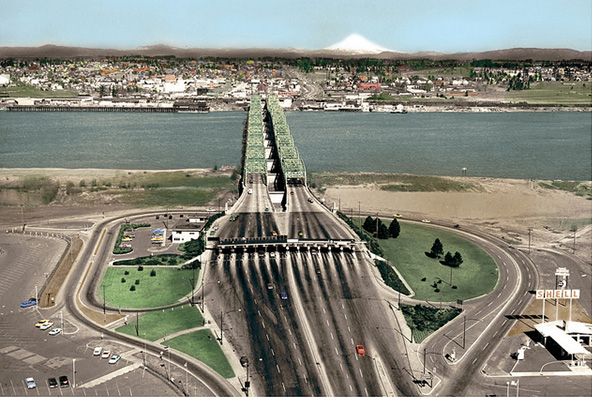
Columbia River Crossing from Vancouver, WA to Portland, OR in 1965, photo from WSDOT .
There seems to be an uptick in freeway news lately, so I put together a highway editionof my semi-daily news roundup last week, including the updates on the apparent death of the Columbia River Crossing, the 1960s-style “Opportunity Corridor” proposed in Cleveland, and a **broader anti-freeway movement**taking hold in the Midwest. The self-defeating nature of highway construction and expansion is noted in each of these articles, as is the physical scarring of communities that usually accompanies these projects. Lost in the discussions of induced demand (focused on the highway itself) and community displacement and segregation (focused on local residents and businesses) is the intersection of these two issues, local traffic.
Induced demand in the context of vehicle capacity simply means that building more space for cars encourages more people to use them. If I live in the suburbs and the city widens the freeway into downtown I might take a few extra trips into the city every month or decide that taking a job in the city is now feasible. The increase in average highway travel speeds also brings more distant suburbs and exurbs within driving distance, which encourages more development at the current sprawl boundary and beyond. These and other effects lead to more cars using the highway until the excess capacity is soaked up and traffic is just as bad as it ever was. According to most studies, about 80-90% of the excess capacity is soaked up within just five years.
This makes for a strong argument against highway expansion, but it ignores the impacts on local streets, which are far more severe. The problem here is obvious: unless 100% of the new highway users are bypass traffic—none of them using the highway to get into the city itself—local roads have to deal with a huge influx of additional vehicles. Many of those vehicles aren’t bypass traffic, of course, so local streets (and their residents) are burdened with their presence and the congestion they bring. And while federal- or state-owned highways can sometimes afford to increase their capacity, local roads usually can’t. Besides being a poor choice from an **return-on-investment**and livability perspective, widening local streets to cope with the increase in vehicles is usually physically impossible—city centers are already built out and, thankfully, few people support tearing down homes and businesses just to expand local roads.
In an effort to visualize this phenomenon, I’ve made this simple graph, which shows a schematic of capacity vs total traffic on highways and local roads before and after highway expansion:
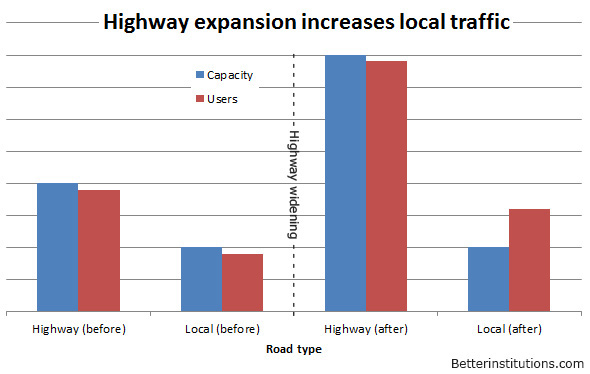
Car use rises to meet increased highway capacity, and this has negative impacts on local traffic.
This illustrates two important facts: first, that increasing capacity doesn’t actually improve the traffic situation on the highway; second, that it makes local traffic worse. The net result is to improve the lot of suburban and outer-city drivers at the expense of close-in city-dwellers.
To see why, imagine this scenario: you live 20 miles outside the city and want to get downtown, so you take the freeway there. The highway part of your trip used to take 30 minutes, but thanks to the new lanes it now only takes you 20 minutes. The last mile of your trip has slowed since there’s a bit more local traffic, but it only increases from three minutes to five. All told, your trip time has decreased from 33 minutes to 25—great!
Now imagine you live in the city, five miles from the city center. It used to take your bus 20 minutes to get downtown, but unfortunately as a city resident you don’t reap many benefits from the additional highway capacity. Instead, your trip is entirely on local roads, so all those extra cars coming into the city only slow you down. The trip that used to take you twenty minutes now takes thirty. The suburban visitor/commuter saved about ten minutes, and the city resident lost about ten, and all it cost was a few hundred millions dollars in construction and millions more in demolished buildings and businesses that are no longer producing revenue for the city. Money well spent, right?
There’s only one way this equation makes sense, and it’s dependent on the view that suburban traffic is more valuable than urban traffic. Tens or hundreds of millions of dollars is a lot to spend unless you sincerely believe that facilitating 30-mile trips is more important than encouraging five-mile ones, and that’s a pretty insane view to take if you care about the economy, the environment, or peoples’ health. Likewise, it illustrates a very clear preference for the needs of (often distant) cars over the needs of (usually local) transit. It also ignores the fact that the person living in the city is probably dealing with local traffic on a daily basis, while the suburb dweller is often only visiting on occasion, so the negative is very likely to outweigh the bad.
City leaders would be much better served spending that money on their actual constituents. If worse local traffic—including for cars—is a price they’re willing to pay for better suburban access to the city (as many appear to be) surely they’d be willing to pay the same price to install a few bus-only lanes in heavily-trafficked regions to ensure that someone in the city actually sees some benefit. As far as I know, road paint is fetching a much lower price than concrete these days.
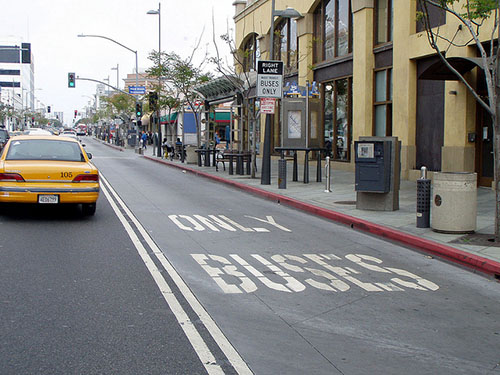
Photo by Complete Streets .


15 comments
Archived from the original site. Commenting is closed.
i find it odd that use is just UNDER capacity both before and after the highway expansion.<br />If the use is UNDER capacity what justified the expansion? or is this number improperly reported?
Prem, there aren't numbers corresponding to the graph, it's just illustrative. The point I wanted to make is that highway traffic will increase to approximately meet capacity, but local traffic doesn't have that luxury.
I don't know which is more jarring to the modern observer: Seeing Mount St. Helens, pre-1980 eruption, or seeing a toll plaza on I-5... or the lack of other development on Hayden Island besides a gas station (today all that land in the foreground is developed, and much of it would have been bulldozed had the CRC been approved).
Ha, good point! Those developments that have occurred since 1965 definitely dodged a bullet, though I worry how permanent the CRC's death is really going to be.<br /><br />That actually makes me think, too... isn't tolling federal interstates against the law? Does that not apply to bridges since they're paid for by the states (at least in the case of this most recent iteration of the CRC)?
Mr. Phillips,<br /><br />It's not the nature of the <i>trips</i> that are being preferenced by the highway construction. It's the color the drivers. <br /><br />Yes, anti-urbanism IS all about race. All the time. <br /><br />
Shane,<br />This post is beginning to get some attention and your graph is convincing, but do you have any numbers to back up this idea? It's does make some sense, but the data I've seen suggests the contrary. A colleague of mine found that (in well-connected street networks) local roads around freeways are actually well below capacity. The general theory there is that freeways serve as magnets for traffic. Sure, the ramps and nearby roads will have to soak up more peak traffic; but the rest of the network can be drained of traffic. Thoughts?
Chris, I haven't made an effort to find solid numbers to back up this point (it's just an argument that makes sense to me), but I do intend to try. In my current capacity as a tuberculosis researcher I'm not exactly certain where to start though--any suggestions?<br /><br />As to the question of local roads around freeways being well below capacity, I have a few thoughts:<br /><br />First, freeways are not pleasant to be around, so there tend to be relatively few destinations adjacent to them. If there's nowhere to go, you won't find much traffic there, car or otherwise.<br /><br />Second, I could see your colleague being correct in regard to streets that are parallel to the freeway (though generally only those within half a mile or so), but not for perpendicular roads. Seattle has actually made efforts over the past several years to vastly widen one perpendicular road through the northern border of downtown--look up the "Mercer Mess". This isn't a highway. Though wide, it's more like a local road, but they've spent over $100 million on the project so far for about a mile of work and it's done absolutely nothing to solve the problem. It's been completely incapable of coping with the amount of car traffic, and the reason most of the traffic even exists is because it's on its way to or from the I-5 freeway. <br /><br />I'd love to get some numbers to get more empirical evidence to back this up rather than anecdotal, but in the mean time I hope I made it clear that this is speculation. (Though very sensible speculation, in my opinion.)
I guess it comes down to what the surrounding street network looks like.<br /><br />In the case of a highly 'dendritic' system (what you're describing), your theory makes perfect sense. You just need the numbers to show it.<br /><br />In a highly connected network, I think you'll see the opposite. See this Master's thesis (http://digitalcommons.uconn.edu/cgi/viewcontent.cgi?article=1103&context=gs_theses, Figure 35, p. 66). San Francisco's Embarcadero Freeway operated at much higher capacity than surrounding roads. When it came down, volumes of surrounding roads increased; but only slightly.<br /><br />Looks like Mercer Street is essentially freeway ramp. The ideal solution in that case would probably be to improve connections to the urban street network so it can absorb traffic. There's a similar (hotly debated) case in New Haven, CT: Route 34 Downtown Crossing. <br />
To support Shane's thesis, however, look at New York City. The number of cars on the Manhattan streets is essentially limited by the number of lanes on the various river crossings. Each time another expressway is built which reaches Manhattan, it makes traffic worse in Manhattan.
And it's worth noting that Manhattan is "highly connected".<br /><br />Shane's thesis should apply to any case where the expressway serves a surburban-to-urban or rural-to-urban function. The Embarcadero Freeway didn't (it was actually an oddity).
There is a commute equilibrium out there in every city - some people take transit, some walk, some drive. Their choices are influenced by incentives and their own personal valuations (what is my transfer penalty, how frequent and reliable is the bus, how reliable is driving). There are plenty of perverse incentives out there that are driving induced demand, and the big elephant is cheap parking. For some reason in Los Angeles, parking is surprisingly cheap; I've paid under $10 a day in downtown. If you are a commuter and your drive is reliable and parking is reasonable, you're going to think long and hard about driving and you're going to support freeway improvements. The classic "we can't improve roads because then people won't take transit" is a terrible idea, and its an excuse for bad transit. There are a zillion commutes in the LA basin (and bloggers who know more about it than I do) that should be transit commutes and are not, but don't blame a proposal to widen the 405. Even in places like LA where it doesn't snow, the pavement wears and the bridges have design lives. For those folks in your graph who live close to your work in Southern California, why are you driving anyway ? In LA, as Ron Livingston would remind us in "Swingers," its always sunny. Its a perfect climate for walking and biking if your commute is less than 2 miles for walking, or really 5-10 miles for bicycle. Furthermore, the age old question - do you think people really want to live in Palmdale and have awful 1.5 hour driving commutes ? Of course not, but through zoning regulations and NIMBYism, those who live in neighborhoods close to urban centers (or in them, in the case of San Francisco or Berkeley) fight tall residential buildings to the death because, you guessed it, too much traffic generation. I got mine; good luck driving in from Riverside.<br /><br />I always thought that Las Vegas should have a betting line for which bridge got replaced first, the I-5 Interstate bridge or the Tappan Zee in New York. A circus surrounds both but I guess I should have bet on the New Yorkers - the Tappan Zee is way ahead in "amount of concrete that actually fallen off the existing bridge" category.
I imagine a city without a central dense core or downtown...all suburbs.<br /><br />In that instance, more highways should drain the neighborhood streets of long commutes.<br /><br />It's the focusing problem of having too many jobs in a downtown designed for 18th century horse and buggies, cobblestones and streetcarts.<br />
I imagine Los Angeles, and the image isn't pretty.
This conversation is beginning to sound funny in the way it's demonizing traffic. Take Shane's initial example, where the local roads are suddenly flooded with 50% more traffic (probably an exaggeration). If we talk about this like humans, then that's potentially 50% more people, which is a good thing - good for business, social life, etc. The problem is that they're all arriving in cars, and with limited route options. This goes back to my point of needing better network connections (Manhattan does a great job of this and it's streets will always be congested; a sign of its vibrancy). But also better options for getting around by other modes - at least locally.<br /><br />P.S. Free parking plays a huge role; I second that.
Chris, I agree that congestion is a good thing (there's a reason every popular city on the planet is full of it), but only insofar as it indicates the success of a neighborhood, city, etc. When it degrades the experience of people traveling by non-car means, then it's a problem, and unfortunately we haven't been very successful in this country at separating the two. We bring more cars in but don't separate uses, so more cars get access and everyone else pays the price, and that's especially unfair when those outside the city benefit at the expense of those inside it (though I don't want to be too parochial about it).<br /><br />As to the matter of more cars meaning more business, social life, etc., I'm not sure how true that really is. I live about 6 miles north of downtown Seattle right now and make a point to never take the bus downtown anywhere near rush hour because the bus routes are so clogged with cars that the trip time jumps from 30 minutes to up to an hour or more. Trading my trip for a car's trip is a terrible deal for the city, all the more so since you can fit 60 of me in the same space as three cars. <br /><br />This is completely dependent on your location of course, but I'm talking about fairly dense cities where a very large proportion of trips to stores and such are already not made by car--making things worse for all those people just to fit a few more vehicles in is a bad deal. In more spread out cities where a higher proportion of customers arrive by car that may be more justified, although I think in the long run you'd regret that decision as well. (Just go to the Strong Towns blog if you need any evidence of that.)