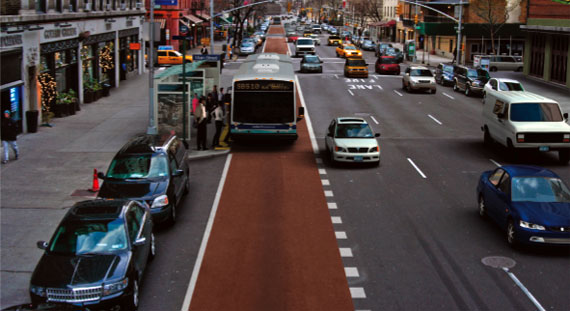
Photo from
.
Short of
, there’s really nothing you can do to make driving a more pleasant experience in dense city centers. There’s not enough space to accommodate the incredible demand there, and there’s no way to expand supply short of paving over the sidewalks and buildings, which would defeat the whole purpose of having a city in the first place.
—buses, in this case—by turning over certain high-traffic lanes to bus-only use.
Of course, it’s never that simple. The reallocation of road space can be a rancorous process, and proposals to convert any road space to a specialized use (bus, bike, pedestrian plaza) are inevitably met with cries of “War on Cars!,” complaints about “moochers” who “don’t pay their fair share,” etc. The shift toward multi-modal travel is still a relatively recent phenomenon in many parts of the country, and there’s a great deal of convincing left to be done. We should start where the job is easiest: corridors on which transit users already outnumber drivers.
Two examples that come to mind are Fanshawe Street, in Auckland, New Zealand, and Wilshire Boulevard, in Los Angeles.
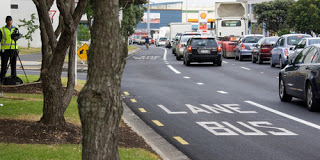
From the
.
Auckland’s Fanshawe Street is a pretty dramatic success story. I don’t know the date the bus lane was installed (though there’s
evidence it’s over ten years old
), but today
it carries two-thirds of all peak traffic
on the road. That’s a number any transit service would be proud of, and it’s all the more impressive for the fact that the bus lane only accounts for one of three total lanes—cars, despite having twice as much space, only make up about 17% of total commuters per lane. The efficiency of buses really shines here, and if the image to the right is any indication, the heavily-used bus lane still manages to stay less congested than the lower capacity car lanes.
Wilshire Boulevard in Los Angeles is a much more recent case. It carries 53,000 bus riders a day, and
they just finished the first 1.8 mile segment
of 7.7 miles of bus-only lanes planned between downtown LA to Santa Monica. The actual length of this corridor is 12.5 miles, but Beverly Hills and Westwood in their infinite wisdom opted out, so transit users will still be mired in car congestion through this stretch of Wilshire. Despite this shortcoming, the 7.7 mile conversion is expected to reduce travel times by 12-15 minutes for bus riders, and has the added benefit of providing a safe route for bicyclists. Importantly, more people travel by bus than by car on Wilshire Boulevard during peak hours. And just like on Fanshawe, this rechannelization still leaves two lanes in each direction for cars.
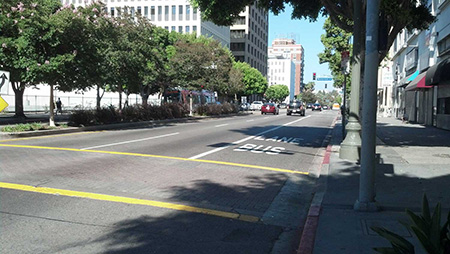
This bus lane will carry more people than both car lanes combined, photo from
.
Projects like these, besides improving service for transit users and safety for all road users, can build support for further expansions of transit infrastructure and service as well as increase ridership. They elevate the standing of local residents relative to residents of other cities and suburbs, or at least put them on equal footing—a worthy goal for any municipality. I know there are hundreds of other corridors around the country that are ready for the same treatment as Fanshawe and Wilshire; unless local and regional transit organizations prioritize studies to identify them, progress will be unnecessarily slow. We need data. Nothing in the world of transportation reform is ever easy, but this should be a no-brainer.

2 comments
Archived from the original site. Commenting is closed.
Fanshawe Street in Auckland, New Zealand is in effect the cityside continuation of Auckland's very successful Northern Busway linking the North Shore to the City Centre. In the morning peak two hours, the 200 buses (or one every 30 seconds) using the Fanshawe Street bus lane carry 8,000 passengers in one lane, while the two adjacent vehicle lane carry 4,000 people between them. The irony of this is that the bus lane, which is vastly more productive than the adjacent car lanes, can seem empty (one bus trundling by every 30 seconds) while the adjacent car lanes are always congested - even though the supposedly "empty" bus lane is doing the equivalent work of four general purpose vehicle lanes. Also of note is that since the Northern Busway and Fanshawe Street bus lanes opened in 2008, the number of vehicles crossing the Harbour Bridge (the link between the Northern Busway and Fanshawe Street) to the city centre has dropped while the number of people being moved has increased significantly. All of the growth and more has been exclusively accommodated on buses.
Thanks for that info Darren! You make it more clear than I managed to, and you bring up a great point about the importance of appearances in shaping peoples' views. Lots of drivers probably get the impression that the bus lane is a waste because it's mostly empty during rush hour, but nothing could be farther from the truth. The bus lane is actually carrying four times as many people as either car lane. This just underscores my point that what we need is hard data to back up our case for more conversions from car lanes to bus lanes--without that data it's very easy to get the wrong idea.