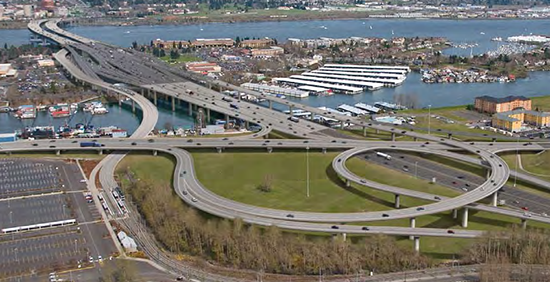
The Columbia River Crossing proposal, in Portland, Oregon.
Any time someone makes the case for new infrastructure investment you can count on two things: 1) use of the word “crumbling,” and 2) an enthusiastic remark about the number of construction jobs created. Jobs are always important, but in the case of investment in roads, rails, bridges, sidewalks, etc., there are few things less relevant to a project’s value. We build and maintain our transportation infrastructure to provide for the movement of people* and goods and to ensure the safety of the users of that infrastructure. These are the primary measures by which we should judge the virtue of such investments; job creation doesn’t even belong on the list.
Just as an example, take the proposal for the Columbia River Crossing bridge between Vancouver, Washington and Portland, Oregon. This **controversial project**would cost at least $3.1 billion(and as much as $10bn) and would provide **an average of 1,900 construction jobs**per year while being built. Even if costs came in at the low-ball figure of $3.1 billion, that works out to more than $1.6 million per new job, and those are jobs that would only last a few years at most. If the goal is cost-effective job creation then this proposal fails spectacularly.
The obvious point here is that the purpose is not cost-effective job creation. Rather, the value of the bridge itself is what will make this pencil out as a good investment, or not. The cost of the bridge must be weighed against its ability to improve mobility (for both economic and social purposes) and/or increase safety; those measurements, along with the much more speculative and therefore secondary considerations of “added value” or ” private investment potential,” are the only things that can yield a good return on investment for a product of this nature, or any transportation project for that matter.
The value of 1,900 jobs—or even 10,000—is insignificant relative to the cost of construction, and if keeping those costs low is one of the goals of the project (as it should be), fiscal prudence may work at cross-purposes to maximum employment. And that’s okay. Construction jobs may be a nice bonus, but they’re only worthy of consideration and celebration after the value of the project itself has been evaluated and maximized. If cost-effective job creation was the goal, we’d be better off paying people $50,000 a year to dig and refill holes all day or pick up garbage off the side of the road.
*The people in question may vary significantly from neighborhood to neighborhood and region to region—this will be dependent on the values of those communities. Some will prioritize the movement of cars and trucks while others will prioritize transit, walking, and/or bicycling. Among these sets of priorities there will certainly be differences in return on investment that should be evaluated critically, but the point is that mobility and safety still must be the primary considerations regardless of who the users of that new or improved infrastructure might be.


3 comments
Archived from the original site. Commenting is closed.
I understand your focus on the cost of infrastructure, particularly car infrastructure, as that is the focus of your blog, but practically every point you make can be said about ANY government spending. We do not train and hire more soldiers to give physically fit young people a job, we do it to defend ourselves. We do not pay doctors and nurses via Medicare to increase the employment of doctors and nurses, we do it to keep our seniors and disabled healthy. Nevertheless, in all of these cases, it is popular at the point to talk about the jobs "saved or created" by a program.
Great point Tal, and I agree. In each of those cases the primary concern is (or should be) what the public gets in return for their expenditures, not the employment itself. I feel the same way about the Postal Service and the structuring of arguments in defense of it being centered mainly around retaining employees and not the value of the service itself (although a few billion dollars a year in taxpayer dollars to employ 500,000 people in a useful task is actually a pretty good deal).<br /><br />I do think it gets a little more complicated when you get into government spending whose main purpose IS to create jobs, i.e. stimulus, but in that case there are plenty of things that are uncontroversially good (at least to sensible people) like hiring more teachers, spending more on food stamps and early education, maintaining existing infrastructure, etc.
Great article. I get mad at both Democrats and Republicans when they talk about environmental regulations. Democrats say that new regulations will spur more jobs to build pollution controls, new green jobs, etc while Republicans say the shutting down coal power plants will kill jobs and high-polluting industries will lose jobs or drilling for more oil will create jobs. While all of these statements are technically true, the cost-benefit analysis should be whether the expected benefits (health benefits, additional open space, etc) are worth the added expenditures (monitoring, change in energy sources, added pollution controls), not the net change in employment. Republicans are right that a shift in energy use may cause structural unemployment, but modern society would not be possible without such changes (production line, cars instead of buggy drivers, less labor-intensive farming, etc).