There’s a **new MIT study**out highlighting the struggles of small- and medium-sized airports, which over the past five years have seen 18.2 and 26.2 percent declines, respectively, in domestic flights. This means that people served by these airports have less options, and also that the costs of their flights have increased faster than those at larger regional airports.
**NPR has more**on the specifics.
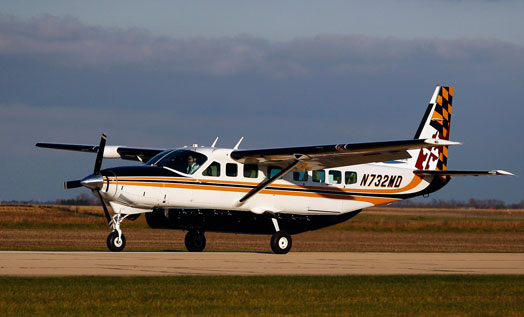
Plane taking off from Decatur airport. Photo from decatur-parks.org.
First, I just want to point out that this means service is objectively worse for travelers over this time period, even with continued federal and state investment in airport infrastructure. Unlike what we see with Amtrak, however, I have yet to hear any politicians threatening to pull the plug on the $4 billion in federal(and who knows how much state) spending on airport construction, or the billions we spend on security and traffic control. Are they okay with continuing to prop up an airline industry intent on withdrawing service from much of the country?
Perhaps a better analog of Amtrak’s service—the unprofitable long distance routes, at least—is the US DOT’s Essential Air Service. It saw the smallest decline in flights of all airport types, five percent. The EAS was created in 1978, coincident with the deregulation of private airlines, and was “put into place to guarantee that small communities that were served by certificated air carriers before deregulation maintain a minimal level of scheduled air service.”
This service costs over $200 million a year, with most of the ~150 affected airports only making a few 19-seat flights a day; you can bet it serves far, far fewer passengers than Amtrak’s 5 million annual long-distance passengers, or its 15 million state-supported route passengers. (Amtrak requested $373 million in operating support this year, a number that has been declining rapidly in recent years as ridership has soared.)
I genuinely have nothing against the airline industry, and actually think their private, deregulated system is pretty effective. As a whole, the airline industry also serves many more passengers every year. I don’t even really mind the EAS much, although there are some cases where it’s clearly being abused. The point is that just as with our system of roads and highways, no travel mode comes without some amount of subsidy (nor should it—mobility is an invaluable public good). Despite this, only rail and transit are portrayed negatively for their dependence on public support.
This double standard is ridiculous, but especially so for the following reason. We spend hundreds of billions of dollars on roads every year and tens of billions on airports and security, and does anyone honestly think either driving or flying has gotten any better? Rail, transit, and bikes on the other hand, the most scorned forms of transportation in this country, and worst funded, are only becoming safer, more convenient, and more popular. I don’t even know who the joke is on.


4 comments
Archived from the original site. Commenting is closed.
Given that outside the peculiar bubble of transport socialism called the United States, airports and aviation in much of the Western world operates effectively without subsidy (see Australia, UK, New Zealand) as a commercial enterprise (being airports, ATC and airlines), as do many roads and road networks (e.g. major highways in France, Austria, Italy, Japan, Australia, Czech Republic), it is really the US that looks a bit strange in undercharging motorists (most countries overcharge them on fuel taxation and toll them again) and maintaining a peculiar fetish for government ownership of airports and ATC.<br /><br />Most developed countries run ATC as businesses, some even by the private sector and think it is weird to rely on politicians to grant funding for what can be, and should be a business. Airlines and other airspace users pay charges to the providers, and service is rendered. Same with airports being businesses, owned by companies from different countries, operating as efficiently or better than many US airports. Many also allow far greater foreign ownership of airlines than the US does, and get thriving competition and low fares as well.<br /><br />It's truly bizarre as to why the US is so resistant to applying market principles where so many others have succeeded.
I suspect the air traffic control component is more a union issue than anything, where the dark side of unions rear their heads in their quest for job preservation at all costs, regardless of utility.<br /><br />As far as airports, I really couldn't say. If the airlines themselves were also quasi-public it might make more sense to have publicly-owned airports, but having the airport be public but the airlines private doesn't really seem to serve a purpose. Air travel is going to have its own rules of course, because it's the only travel mode that has infrastructure nodes but no connecting infrastructure.<br /><br />Like I said, I don't mind subsidizing travel to some degree, especially when it's at relatively low cost, but the hypocrisy of how air travel versus other, cleaner forms of travel are treated is astounding. Where are Darrell Issa's aviation industry oversight hearings?
<p>Good academic assistance for a good price! <a href="http://www.essay-experts.org/">http://www.essay-experts.org/</a></p>
<p>Wow! This post is quite informative and interesting. It is not everyday that I have a possibility to see something like this. Please keep it good posting. You may use www.custom-paper-writing.org as the best solution for all your paper tasks quickly and quality. Just try their help even now!</p>