Via Seattle Transit Blog, bringing this to my attention in the context of the Seattle-Portland pair, here’s a great chart from the Federal Railroad Administration comparing the market share of rail vs. air in eight major city-pairs connected by rail (full presentation here):
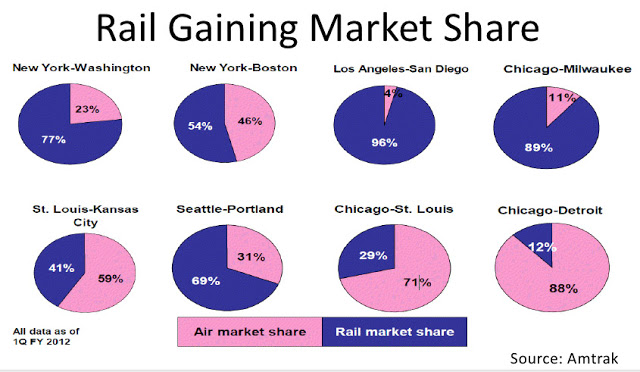
The city-pairs range in distances from about 95 miles (Chicago-Milwaukee) and 300 miles (Chicago-St Louis) away from one another, and the market share for rail varies pretty widely.
Longer-distance intercity rail gets short shrift as a transportation mode in a lot of circles, often treated as more novelty than honest-to-god mobility solution. Air travel, on the other hand, is generally considered completely legitimate. In reality, even with relatively poor facilities by international standards—and massive federal investments in airport infrastructure—rail is competitive with air travel in much of the United States, and in some cases vastly more popular as this chart illustrates.
This is good for everyone, airlines included. Air travel is an incredibly valuable and important transportation mode, but its utility is severely diminished at distances of 100-500 miles. A smaller share of total travel time is spent cruising in the plane; more is spent getting through security, waiting to board, taxiing, taking off, and landing. Rail is also easier to locate nearer the core of dense metro populations (where people usually ultimately want to go), something airlines can’t really do with their huge geographical footprint and noisy planes. Where city-pair distances and populations warrant rail travel, pressure is taken off the airlines to provide these shorter, less profitable domestic routes. This then allows them to provide more international and longer-distance flights, improving airlines’ extremely thin profit margins and reducing overall airport congestion. Air travel is also much more polluting than rail—electrified rail in particular.
Most transit and rail advocates don’t support a truly nationwide network of high speed rail, but the high existing demand for even the shabby rail services we currently provide should make the need for genuine high speed rail clear in a few select corridors: certainly in the Northeast; but also in California; through Chicago to the north, southwest, and probably east; and connecting Dallas, Houston, and possibly other Texas-area cities. For more info on connections that make the most sense for HSR I’d recommend checking out this America 2050 report, the “Top 50 City Pairs” on page 6 in particular. HSR has the ability to provide much faster service to destinations than either existing rail or competing modes, so existing demand should be seen as a floor—the potential is almost limitless. Where true high speed rail isn’t justified, “fast-but-not-high-speed” rail improvements should be made, like those we’re already seeing in places like Seattle-Portland and other parts of the country.
High speed rail has a strong track record of economic success, but that’s just one facet of its value. Neither our nation’s highway network nor our airport infrastructure are “profitable” or fully paid for by their users, but we see their value nonetheless. HSR falls under the same category, with the additional benefits of encouraging more development; further enabling people to live more oil-free, transit-dependent lifestyles; decreasing pollution as well as travel times; reducing the strain on roads and airports; and being safer than most other forms of travel, particularly driving. Each of these direct benefits also has has their own economic returns-on-investment which don’t show up as operating profit but are important to factor in when determining cost vs benefit.
As a side note, here are some additional thoughts on the specifics of the above chart:
-
New York-Washington and New York-Boston are pretty similar in terms of metro population, distance, and public transit culture, so the disparity between rail’s 77% share for Washington and only 54% share in Boston seems to indicate that a lot more could be done to increase the rail ridership to and from Boston.
-
Following up on that same thought, Seattle-Portland is only about 30 miles shorter a distance than New York-Boston, and despite a more car-oriented culture on the west coast, even Seattle-Portland has a higher rail market share. New York-Boston really has a lot of work to do. The upside is that it’s almost certainly not a culture issue holding ridership back—they just need more and better infrastructure to accommodate demand in the region. Especially more.
-
St Louis-Kansas City and Chicago-Detroit are about the same distances from one another but St. Louis-Kansas City is blowing Chicago-Detroit out of the water on the share of rail ridership. This might have to do with Detroit’s awful public transportation system, since it’s much easier to connect to intercity rail if there’s a local public transportation system that can get you to and from the station. Chicago-St Louis is also a similar distance and is somewhere in between.


6 comments
Archived from the original site. Commenting is closed.
Very significant is the speed of the trip (slow on the midwest routes) and frequency of train service (less on the routes with lower market share).
Part of the reason for Seattle/Portland's higher rail share is that Seattle's airport (Seattle-Tacoma: SeaTac) is far south of downtown Seattle, while the rail line runs right to the edge of downtown.
That's very true. By the time you get to the airport you're 20% of the way to Portland already. But as I mentioned in the article, I see that as a point in rail's favor--it's able to get into the actual city, whereas airports, by their nature, have to be located pretty far out on the periphery. People don't often add the travel time to the airport to their total "trip time," but it's significant and shouldn't be ignored.
I'm convinced that although Detroit's poor public transit is a contributor to that poor rail market share, the #1 reason is for this is due to Detroit's Amtrak station (located at 11 W Baltimore Ave, Detroit, MI 48202) being the only one among those city pairs that is not located in or even near its city's respective CBD. Rather, it's just north of the Wayne State University campus.<br /><br />
Part of the problem with taking rail to Boston is the South Station/North Station division. From NYC you arrive at South Station which is technically the end of the line. Through travel requires you to switch to bus or make a slow and circuitous transfer to North Station with all of your luggage.
What would be interesting is to see what intercity bus' market share (both traditional and curbside) is for those city-pairs, especially the ones that have frequent bus service.<br /><br />With the closer city-pairs in the graphic above, of course rail (and more broadly, surface travel) should dominate. Airline travel, due to the security requirements and longer lead arrival time required for travel, makes a lot less sense when you can drive 50 miles in the time you're waiting for your plane to take off.<br /><br />BTW, passenger rail isn't the only mode with infrastructure issues. Many airports and the airspace around them are highly congested, making them more vulnerable to disruptions and delay.<br /><br />P.S. Two other comments about the New York-Boston city pair in addition to the insightful Boston South Station/North Station comment:<br /><br />1) Logan International Airport is relatively close to downtown Boston compared to airports in most other large cities.<br /><br />2) There is somewhat less Amtrak service (both with the Acelas and the Regionals) on the New York-Boston city pair than there is on the New York-Washington city pair.