Even though driverless cars have only been popular in the news for a few years, it’s looking increasingly likely that they’re the future of personal vehicle travel. Already, **California**and **Nevada**have taken steps to approve the use of Google’s model, and Google co-founder Sergey Brin believes autonomous vehicles will be commercially available within a decade. The advantages to driverless cars are numerous and significant, but they raise serious questions about how we invest in infrastructure as the technology matures. In particular, are we wasting billions on highway capacity that will soon be obsolete?
There’s a lot to like about autonomous vehicles. There’s great potential for them to be operated much more safely than manually-driven vehicles, and if this bears out it’d be justification enough to make the switch. They would also reduce the need for parking directly adjacent to destinations, since the car could drop you off and find a space further afield. It’d also be easier to save a lot of money by getting rid of your own vehicle, instead taking advantage of a massive fleet of cheap, robotic vehicles.
Then there’s congestion.
According to a recent study by Columbia University’s Patcharinee Tientrakool, a highway populated exclusively with driverless, communicating vehicles could increase its efficiency by up to 273%. In this scenario almost four times as many cars could travel through a corridor, safely and quickly, as are currently able to do so. This is mainly thanks to the decreased following distances required by autonomous vehicles—about 100 feet at 60 mph for humans, compared to less than 20 feet for computer-driven vehicles—and their ability to coordinate speeds, merging, etc. Although not absolutely equivalent, fully adopting driverless cars would be akin to more than tripling the number of lanes of every highway in the country.
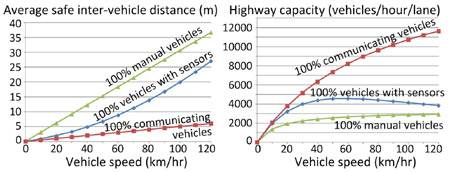
Patcharinee Tientrakool, Columbia University.
Whether that transition takes twenty years or fifty, it’s coming. (And if it doesn’t, it will be because of some other revolutionary technology that solves the problem even more effectively.) Given that reality, and with vehicle miles per capita on the decline, continuing to invest scant transportation dollars on increased capacity is a monumentally wasteful practice. According to a Congressional Budget Office report [PDF], we spent about “$146 billion to build, operate, and maintain highways in the United States,” about two-thirds of that paid for by state and local governments, in 2007 alone. Not all of this is capacity expansion, but you can count on the fact that a great deal of it is. This is at the same time as the American Society of Civil Engineers is telling us that we’ve got a $2.2 trillion infrastructure backlog, and the longer we wait to make these necessary repairs the more expensive they’ll become.
In urban areas it costs tens, sometimes even hundreds of millions of dollars per mile to add new highway lanes—and in as little as a generation we’re going to be forced to to tear them right back out.
It’s been said again and again, but it really is time to turn the corner and start investing more in the maintenance and repair of our ailing transportation system, and directing funds toward projects that do more for promoting health, sustainability, and economic productivity. It’s understandable, if not acceptable, that the threat of increasing population and traffic congestion has made it difficult to focus on simply maintaining what we already have. It’s increasingly clear, however, that this is no longer a question of useful expansion vs. useful repair. Only one choice makes sense for our future. We can do better, and we’re running out of excuses for failing to do so.



6 comments
Archived from the original site. Commenting is closed.
Short answer: yeah, right.<br /><br />Long answer: unless vehicles are coupled together in a train, they can't be closer together than a safe stopping distance. At highway speeds, the stopping distance is dominated by braking distance rather than reaction time, so having a computer do the work instead of a human has trivial capacity benefits. This is equally true of trains: there are pipedreams of a future signaling system in which trains will be able to run closer together than a safe stopping distance because if the train ahead of you is moving then you don't need to assume it's stationary, but those systems are not going anywhere despite decades of work and promise by PRT people that the technology is right around the corner.
Thanks for the reply Alon. I think it's important that reduced following distances are just one aspect of this, and improved interactions between cars is a big aspect as well. No longer having cars cut off and slamming on their brakes, no more trying to read the other guy's mind as you merge, etc. will all have a big impact as well.<br /><br />But on the issue of following distances, I suspect this takes your concern into account. It's obviously true that different cars have different stopping distances, and different speeds and conditions make things even more complicated. At some level though, the ability to slam on your breaks at essentially the same instant as the car in front of you slams on theirs is very important. In other words, if you're braking at the same time and your braking ability is fairly similar, the distance you require for braking is irrelevant because the cars ahead of and behind you are all requiring the same amount of distance. The question of what the variation between cars is is very important to this calculation, and I could buy the argument that it prevents you from getting very near that 273% mark, but it clearly helps.<br /><br />I'm not sure if by "coupled together in a train" you mean physically connected or just connected via communication, but if it's the latter then that's essentially what this "100% communication" scenario is assuming.
This comment has been removed by a blog administrator.
The driverless cars are technically possible.<br /><br />As Alon said, they won't allow for cars to drive closer together. Further apart, actually -- humans frequently tailgate, but I don't think regulators will be happy with tailgating cars. And yes, Alon means physically coupled. (The couplers provide crash protection in a way that "communications" doesn't.)<br /><br />The main problem, however, is that driverless cars will be banned from city streets after the first crash. Look up driverless trains. They work great. But nobody allows them to have grade crossings. All the technical problems are solved (unlike with driverless cars). They're still illegal.<br /><br />This is due to a basic human bias against robots. We want someone to blame. The only way driverless cars will be legal is if there is someone to blame. Sure, the driver could be legally responsible, and that seems to be the California plan.... but would you drive a driverless car if you were legally responsible for any errors made by the programmers? I sure wouldn't. A<br /><br />And the first driver who gets in a crash caused by the driverless car's programming will sue the company to avoid being blamed.<br /><br />If the company wins the lawsuit, then nobody will buy driverless cars.<br />If the driver wins the lawsuit, then nobody will *sell* driverless cars.<br /><br />Either way, no more driverless cars on the road.<br /><br />Maybe someday when driverless cars are 10 times or 100 times better than drivers, then people will accept the robots. But they're not going to be that good at first. They'll be legal until they're popular enough to cause the first crash -- then they'll be banned.<br /><br />That's just how these things work.
Neroden, I don't disagree with your general premise, but I do disagree with the timeline. I think you're right that there are going to be a lot of legal battles between now and the realization of this vision, but I do sincerely believe it's where we'll end up.<br /><br />A lot of the issues of blame you're talking about will have to be resolved by insurance companies, but I don't think California's plan will be how things look twenty or thirty years from now. There's basically no question that a system with nothing but driverless cars would be much, MUCH safer than our current system, and we could ultimately adjust to a legal framework where no blame was ever placed--you just paid your (much lower) insurance costs and that would be that. If a collision occurred, insurance would pay for it.<br /><br />I think that, frankly, driverless cars probably already ARE 10 times better than human drivers, but many of those benefits are only realized in a fully-automated system, not one where human drivers are mixed with computer-driven vehicles.<br /><br />It'll take time, but with the rate of technological advance being what it is, I don't think it'll be as long as you suspect.
This comment has been removed by a blog administrator.